
OpenAI Launches Prism, Free AI Workspace for Researchers
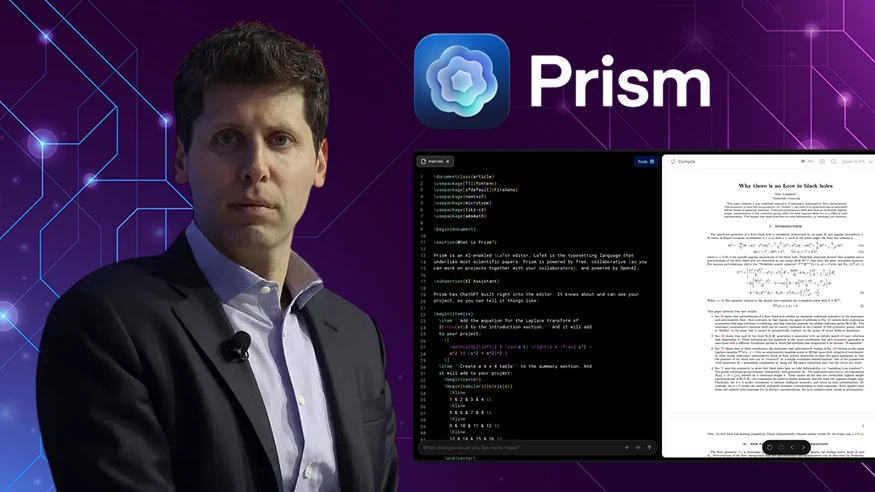
OpenAI has released Prism, a free workspace aimed at helping researchers write and collaborate. It embeds a powerful language model into a LaTeX-friendly editor so authors can draft papers, format equations, manage references, and work together in one place.
Prism arrives as a practical tool, not a miracle fix. You can write a section, ask the system to expand it, tidy up equations, or insert a formatted citation. Multiple people can edit at the same time and see suggestions as they appear. The idea is to stop researchers from hopping between half a dozen apps just to get a single manuscript ready.
The engine behind Prism is built to handle long, technical documents. That matters because academic drafts are not simple blog posts. They contain equations, tables, and chains of logic that stretch across many pages. Prism is set up to keep that context in view so the AI can help in a more targeted way.
That said, the tool has limits. Models can make mistakes, including inventing references or misreading a formula. Users must check claims and verify every citation. Prism speeds up the mechanical parts of writing, but it does not remove the need for careful review and peer scrutiny. Don’t treat its suggestions as final answers.
The launch will prompt questions in publishing circles. Journals and conferences already talk about how to disclose AI assistance. Prism will likely add pressure for clearer rules about attribution and reproducibility. If many authors start using AI to polish drafts, reviewers and editors will have to sharpen guidance on methods and data sharing.
Who will try Prism first? Expect graduate students and small research teams to jump in quickly. They often carry the burden of draft work and stand to gain the most from a single editor that understands LaTeX. Larger labs and institutions may follow, but they will want controls: version logging, access rules, and integrations with existing systems.
OpenAI has signaled that Prism is free for personal accounts now, with broader features for organizations coming later. That suggests a two-stage rollout: let individuals learn the tool, then offer admin controls and integrations for labs and universities. It’s a sensible path. Organizations need governance; researchers need speed.
Prism’s arrival also highlights a quiet change in research workflows. For years, academics have stitched together editors, reference managers, and chat tools. Now the AI is moving inside the document itself. That feels small until you try it. Saving a day or two on formatting can mean moving a project from stalled to submitted.
There will be debate, of course. Some worry that easier writing could lower standards, or that models will introduce subtle errors that slip past reviewers. Those are valid concerns. The balance will come from practice and policy: smart use by researchers, and clear rules from publishers.
For now, Prism is another example of AI tools shifting from demos to workhorse utilities. It treats drafting as an engineering problem. It aims to reduce tedium so researchers spend more time on experiments and less on cleanup. Whether it changes how science is done depends on how carefully people use it, and on how fast journals adapt.
Prism is available. Researchers can sign in with their accounts and begin testing it on drafts and notes. The useful bits will be obvious: faster formatting, easier collaboration, fewer context switches. The risks will be obvious, too. Use the tool. Check the output. Keep control of the final paper.