
Nvidia’s $2B CoreWeave investment signals the next phase of the AI boom
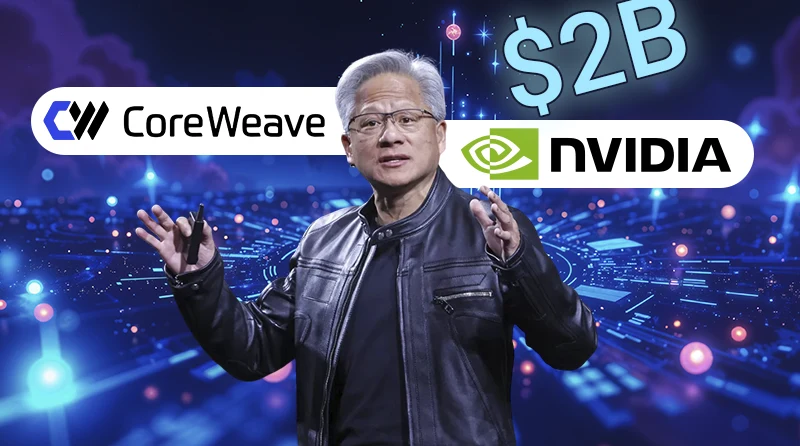
On January 26, 2026, Nvidia made one of its clearest statements yet about where the AI market is headed—not toward flashier chatbots, but toward the hard, unglamorous work of building the compute layer that makes them possible.
The chip leader said it’s investing $2 billion into CoreWeave, deepening a partnership designed to accelerate the buildout of large-scale AI data centers in the United States.
CoreWeave’s rise has been one of the more dramatic infrastructure stories of the AI era: a company that began as a crypto-focused operation and pivoted into a “neocloud” provider built to run massive AI workloads on GPU clusters. Now, Nvidia is effectively helping fund the physical backbone of that business—real estate, power, and the capacity needed to serve customers that can’t wait.
What’s in the deal—and what the money is for
Nvidia’s investment was made in CoreWeave Class A common stock at a purchase price of $87.20 per share, expanding Nvidia’s stake and positioning it as a major shareholder.
The message from both companies is that this is not a “buy more chips” transaction. The funding is meant to support the broader buildout: securing land and power, accelerating data center development, and scaling CoreWeave’s platform, R&D, and workforce. That emphasis matters because it highlights a shift in the AI bottleneck. For many organizations, the limiting factor isn’t ambition—it’s access to dependable compute at the scale required for training and inference.
CoreWeave has discussed ambitions to reach more than 5 gigawatts of AI computing capacity by 2030, a number that underscores how quickly AI infrastructure is starting to resemble energy and industrial planning rather than traditional software expansion.
Why Nvidia is doing this now
Nvidia has spent the last few years supplying the picks and shovels of the AI revolution. But this deal suggests a more strategic posture: helping ensure that the “mines” (AI data centers) can actually be built fast enough to keep demand from outpacing supply.
There are a few reasons the timing tracks:
- Data centers are getting harder to build. Power availability, permitting timelines, grid interconnections, cooling, and suitable real estate are becoming the slowest parts of the chain.
- Capacity commitments create stability. With large customers racing to deploy AI features, cloud providers that can deliver GPUs at scale become critical. Strengthening CoreWeave’s ability to expand helps reduce the risk of capacity shortages.
- Competition is rising across the stack. As more companies develop custom AI chips and alternative accelerators, Nvidia has an incentive to reinforce the surrounding ecosystem—software, infrastructure, and deployment pathways—that keeps its platform central.
In plain terms: if AI is entering an “infrastructure era,” Nvidia wants to be the company powering it—and shaping how quickly it scales.
The big question: smart infrastructure play or circular risk?
Not everyone will read this as a straightforward growth story. Some analysts and observers have raised concerns about the AI market’s financial loops—chipmakers backing the very firms buying and deploying their hardware, potentially inflating valuations and masking risk. Coverage of this deal has pointed to those “circular financing” worries, especially as AI infrastructure companies often carry significant debt to fund expansion.
That doesn’t make the strategy wrong—but it does set up what to watch next:
- How quickly CoreWeave can convert buildouts into contracted, utilized capacity
- Whether power and permitting slowdowns become the dominant constraint
- How the market reacts if AI demand growth cools or shifts
For now, Nvidia’s move is a strong signal: the next chapter of AI won’t be won only in model quality. It will be won in who can build, power, and operate the factories of compute—fast enough, reliably enough, and at a scale the market is demanding.