
Top 10 Applications of Embodied Agents in 2026

AI is no longer a distant future. It is here, shaping our lives, and coming up with new dimensions almost regularly. One advanced frontier of AI that has taken the world by storm in 2026 is the embodied agent!
Embodied AI is transforming the way we interact with technologies by making every conversation more emotionally engaging, intuitive, and human-like. Businesses now demand automation that not just automates but also adapts to the changing environments or conditions fast. Embodied agents fulfill that need by learning from real-world interactions, deploying personalized interaction, automating repetitive tasks, and bringing a significant boost in overall operational efficiency.
The market of embodied AI is booming and expected to reach USD 23.06 billion by the year 2030, growing at a CAGR of around 39.0% from USD 4.44 billion in 2026. The future of embodied agents hints at a wider adoption of this technology across industries like healthcare, logistics, automotive, education, extended reality, and more!
Ahead is a read on everything you must learn about an embodied agent, how it’s transforming human-technology collaboration, top applications of embodied AI in 2026, and more!
What is Embodied AI?
What are embodied agents? An embodied AI or embodied intelligence is an AI with a ‘body.’ Through a physical presence, it learns and understands its surroundings by directly engaging with them. Take AI robots, avatars, simulators, or even those virtual characters in video games, for instance.
Unlike traditional intelligent assistants like ChatGPT, Gemini, or Claude, embodied intelligence works as an independent digital worker that bridges the gap between “thinking” and “doing.”
Embodied ai is evolving rapidly. It’s emerging as a fully multimodal agent from just being a single-sense system. This means it can now understand or act in the real world by blending visions, sounds, languages, touches, or movements. Earlier, it used to rely on vision and touch.
Embodied agents are also shifting from virtual worlds to real bodies like drones, robots, and home assistants. This means that they can easily and quite effectively act in the real world. Titans like Tesla, Meta, and 1X have already introduced humanoid robots that can understand, walk, react, and help people perform daily tasks. And, this is just the tipping point of their evolution!
Expert Quote
According to Ricardo Téllez, a world-famous AI robotics expert, “Embodied agents triumph over the concept that real intelligence always needs a body or a physical presence. Algorithms alone can’t make the cut!”
Much like humans, an embodied agent can learn on the job. The technologies that are enabling it to connect the dots between intelligence, interaction, and action are Large Language Models, advanced robotics, sensors, multimodal AI, cloud and edge computing.
Embodied Agents Market Trends & Growth Forecast (2026–2030)
From robots to digital avatars, an embodied agent holds a promising future! The future of AI will belong to combining human potential with robotic possibilities. Embodied intelligence fits that bill to a great extent. Let’s now quickly find out what the market has to say about this-
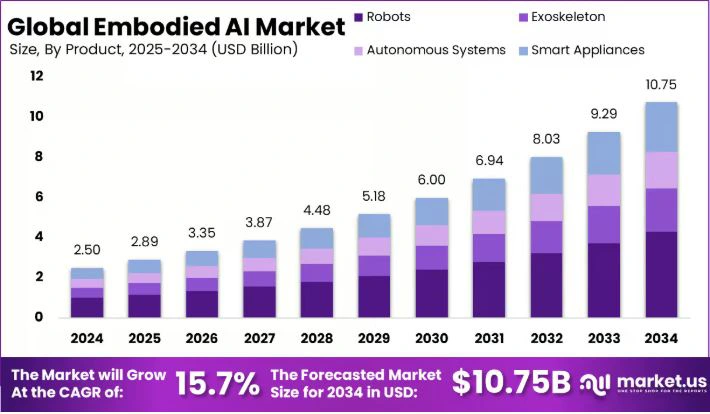
- The global market of embodied AI is poised to grow from $2.5 billion in 2024 to $10.75 billion by 2034, with an annual growth rate of 15.7%.
- Back in the year 2024, North America ruled the market with more than 41% share and approximately $1.03 billion in overall revenue.
- Investors are hugely interested in using AI systems that can work well with smart devices, robots, and self-driving machines.
Let’s now find the increasing adoption rate of embodied agents across industries. They are expected to be adopted more widely by industries such as healthcare, manufacturing, defense, logistics, and more! The robotics market was valued at $73.64 billion globally in 2026. It’s expected to hit $185.37 billion by 2030.
The field of service robots was valued at $46.99 billion in 2023. It’s projected to reach $107.75 billion by 2030. Logistics robots already made up more than 40% of applications in 2024 alone, and advanced healthcare robotics are also witnessing strong growth.
Top 10 Applications of Embodied Agents in 2026
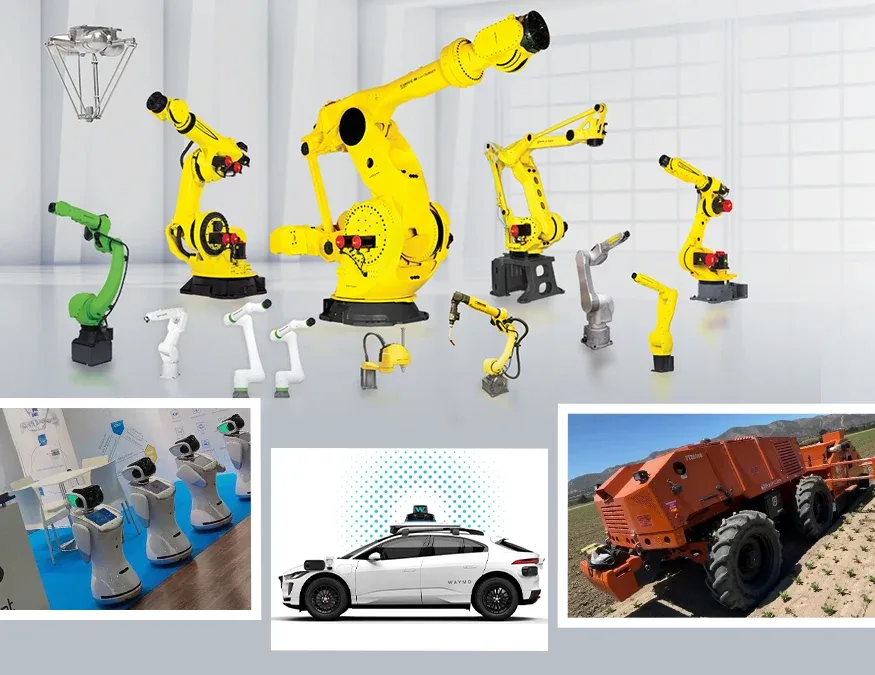
Embodied agent is no longer the future – it’s now! Different industries have already started revolutionizing the way they work through embodied intelligence. Let’s find out some of the top applications of embodied agents in 2026.
1. Healthcare Assistants
Under the supervision of medical professionals, healthcare assistants (robots, smart devices, etc.) provide patients with personal care and support. Some of their responsibilities are assisting with activities like bathing or dressing, tracking vital signs like blood pressure, etc., helping patients with mobility, and more. They mainly work in hospitals, nursing homes, community care centres, etc.
Example: Nurabot is a robotic nurse, built by Kawasaki and Foxconn in collaboration with NVIDIA is a great example of embodied assistance in healthcare.
2. Manufacturing & Industrial Automation
These AI agents take physical forms, such as robots. They perceive their surroundings and carry out different tasks automatically. As the name suggests, these AI agents help factories and warehouses work smoothly by performing complex tasks such as moving items, assembling products, assessing quality, and more! These assistants are great at teamwork as they can collaborate with other workers or even robots to perform a task.
Example: Atlas, Digit, Robots from FANUC, Spot, etc.
3. Smart Environments
An embodied agent in a smart environment is mainly a robot or a smart device that brings more safety, comfort, and efficiency to places like a building, home, office, or factory. These agents can move around, and assist in different tasks like delivering items, cleaning up a space, monitoring environments, controlling temperature, etc. with very little to zero human intervention!
Example: iRobot Roomba, Temi Robot, UBTECH AIMBOT, etc.
4. Service Robots in Retail & Hospitality
Embodied AI agents in the retail and hospitality sectors help streamline tasks such as guiding customers, restocking shelves, cleaning, and providing information about services or products. They make service faster, enhance the customer experience, and reduce the workload for human staff.
Example: Pepper, Relay, Sanbot, etc.
5. Education & Personalized Learning Assistants
An embodied agent that assists in the field of education and personalized learning can provide an interactive teaching experience, resolve queries, and adapt lessons as per the changing needs of students. These agents use speech, gestures, movements, etc., to make the entire process of learning more engaging, effective, and interactive. Some institutions use them to encourage participants, improve classroom tasks, and support the social or linguistic skills of students. All this makes education supportive and dynamic.
Example: NAO, Pepper, etc.
6. Home Automation and Personal Assistants
An embodied agent that works in home automation and personal assistance helps with different tasks such as cleaning, controlling lights, and managing other household chores. These agents can learn from the habits of the homeowners and their surroundings.
Example: Temi, SEAGULL, Pepper, etc.
7. Autonomous Vehicles and Mobility
Self-driving vehicles, robots that can deliver, and drones that can transport packages or people without the need for a driver fall under this category. These agents use artificial intelligence and sensors to navigate safely, keep obstacles at bay, and abide by routes. It brings more speed in travel and makes delivery easier, faster, and a lot more efficient.
Example: Waymo, Baidu Apollo, Avride, etc.
8. Agriculture and Farming Robotics
AI agents designed for the agriculture industry help farmers with planting seeds, monitoring the overall health of plants, picking crops, and more! This is how they minimize the need for manual labour, shorten the time involved in work, and help different farms run smoothly. To make farming easier, many people are investing in these AI agents.
Example: Agrobot E‑Series, FarmWise Titan FT-35, Blue River LettuceBot, etc.
9. Virtual Embodied Agents in AR/VR
Virtual embodied agents refer to the digital avatars or helpers inside virtual worlds and online games. They can guide the users, train them, and respond to their actions. Virtual embodied agents are mainly used to make the overall experience more realistic and interactive. Furthermore, it can adjust to what you do or say in real time.
Example: Avaturn, Genies, DeepBrainAI, etc.
10. Customer Service Robots in Banks & Airports
Embodied agents have also made inroads into banks and airports! In these sectors, an embodied AI agent can help customers or travellers by giving them the right directions, checking people in, resolving their queries, and the like! They can also help in reducing waiting times or long queues, speeding up services, and providing support at any time of day.
Example: Pepper, Relay, Sanbot, etc.
Benefits of Embodied Agents in 2026
Embodied artificial intelligence brings several benefits to the technology table! Some of them are mentioned below –
- Physical and Cognitive Automation
An embodied agent is far more superior to any other AI assistant because it can perform complex tasks faster and more accurately. It combines both artificial intelligence and physical skills to carry out tasks that are not so simple. Such tasks could be managing hospital work, assembling electronics, etc.
- Adaptability
There is a difference between a traditional robot and an embodied agent. The latter can learn or adjust what they do if anything unexpected happens. Thanks to this quality, embodied intelligence works well in unpredictable settings like homes, outdoor environments, warehouses, etc.
- Safety and Precision
When it comes to performing tasks that entail risks or demand attention to details, an embodied agent always makes the cut! It can even give humans stiff competition in this regard. For example, it can help with surgical procedures or even manage harmful materials without putting human lives at any risk.
- Better Human Collaboration
Collaboration between an Embodied agent and humans is great teamwork! While humans apply their creative thinking and ideas to a task, an embodied agent brings speed and reliability to the performance. Such a partnership makes the work better for everyone involved!
- Productivity Around the Clock
An embodied agent can work around the clock. When combined with human intelligence, this incredible capability helps keep hospitals, factories, warehouses, and emergency services running 24/7. This means more output delivered in a shorter window of time!
Challenges and Limitations of Embodied Agents
Does an embodied agent have any limitations or drawbacks? Just like any other robust technology, embodied intelligence, too, comes with certain setbacks. Some of these drawbacks are listed below –
- High Costs
The whole process of building and maintaining embodied agents involves a lot of expenses. The need for premium sensors, expensive hardware, and constant updates adds to the overall cost of the process. Exorbitant cost holds small businesses back from investing in it. This slows down the widespread adoption of embodied AI.
- Limitations of Simulation
Embodied systems indeed get trained on synthetic data from world foundation models and digital twin simulations. These help in simulating real-life scenarios. But such scenarios are unpredictable. Hence, embodied robotics often finds it difficult to perform well outside a controlled environment. This obviously makes it harder for an embodied AI agent to work outside a lab.
- Lack of Flexibility
Embodied agents are great when it comes to performing certain tasks. But they can’t adapt easily to unexpected or any new task. This is 2026, and it’s still a big challenge to create robots that are great at multitasking.
- Safety Related Concerns
An embodied agent uses tools such as microphones, cameras, etc. to get an understanding of its surroundings. In the process, it can non-deliberately collect sensitive or personal data! Unless the makers apply strong privacy rules, there is always a risk of security breaches.
- Legal and Ethical Challenges
Human intelligence is way superior to artificial intelligence, no doubt! But, a powerful entity like an embodied agent could always put its human counterparts under the threat and fear of losing their jobs to it. Safety is another concern, which is yet to be addressed properly. It’s difficult for AI agents to get a green signal from society unless these concerns are addressed.
How Can Businesses Leverage Embodied Agents in 2026?
The next big bet for modern businesses lies in Embodied Intelligence. If you look forward to getting more doors open to take your business to another height through an embodied agent, then learn to implement it the right way.
- Get the Deployment Strategy Right
Make sure that you start with a small project. This could be something like using a robot to get a simple task done. You can rent out a robot or use online platforms to manage it properly. This will always keep you on safer ground by reducing costs or untoward risks.
- Look at the Bigger ROI Picture
The initial cost of investing in an embodied agent might be high, but sketch out the bigger picture! Your company can actually save a lot more time and money as embodied intelligence performs tasks at lightning speed. There will be a huge relief since you won’t need to hire unnecessarily, work long hours, or run the risk of making huge mistakes.
- Best Use Cases for Startups vs. Enterprises
Startups:
If you are in a startup business, then use embodied agents to carry out small but specific tasks. It could be cleaning or delivery, etc. This will save you from spending too much money.
Enterprises:
If you run an already established business and budget isn’t an issue, consider using these AI agents for bigger or more complex jobs. By complex tasks, we mean running warehouses or assisting customers at the airports. These capabilities will give you quite a big productivity push!
Read Also: Machine Learning Courses
Future Trends Shaping Embodied Agents in 2026
Embodied AI has a very promising future ahead in the years to come. Let’s find out some of the upcoming trends to understand how these AI agents will shape the world.
Fully Autonomous General-Purpose Robots
Gone are the days when robots could only perform one task. The advanced AI robots can now handle more than just a single task in offices, factories, homes, and other spaces. For example, you will get a robot that cannot just clean your house but also help you in the kitchen, or with your job-related responsibilities.
Integration with AGI-Level Systems
In the near future, AI robots will master the ability to think, reason, and take action just like us. Their capability to understand various instructions will increase. They will also be able to make smarter decisions – faster – in new situations.
Human–Robot Symbiosis
In the upcoming years, the number of robots working with humans will soar. Embodied robotics will be able to work even more naturally as they undergo further improvements in 2026 or beyond. For instance, they will be able to learn new things simply by observing what’s happening around them. This will help them team up with people more efficiently and achieve common goals easily.
Predictions for Embodied Agents – 2030 and Beyond!
- Adoption Rate
No exaggeration, but by 2030, embodied AI agents will be everywhere. Right now, it might be a bit difficult to picture smart robots roaming about in homes, offices, public sectors, or hospitals, working alongside human employees. But this will be a reality very soon!
- Generalist AI Robots
2030 will welcome smart robots that can do multiple jobs like shopping, cleaning, or providing people with care with efficiency and ease. So, they won’t be limited to just a single task.
- Regulatory & Ethical Frameworks
In 2026, there are still some lapses in the way robots are used. Security breaches or mishandling of sensitive data are still very big concerns. By 2030, these issues will find the right solutions in the form of new safety rules and laws. All these regulations will help users protect their privacy and rights.
- New Jobs Roles
2030 will be a very promising year for those who can design, create, program, or manage robots. AI won’t replace jobs in the future. It’s a wrong notion. But those who fail to excel at it will find it difficult to make the cut.
- Powerful Collaboration – Human + Robots
2030 will witness a powerful collaboration between humans and embodied agents like smart robots, etc. For different projects, they will be working together as a team. Human intelligence will reign supreme in creative tasks. Robots, on the other hand, will speed up or streamline time-consuming or risky jobs.
Conclusion
One thing is clear from the aforementioned discussion – the gap between digital and physical worlds is shrinking fast in 2026. An embodied agent will pioneer this evolution in the years to come. With robotics, sensors and cutting-edge AI technologies, these AI robots are pushing the limitations of possibilities in education, automation, healthcare, and everyday life.
There is no doubt that certain bottlenecks still exist in cost, data, generalization, etc . However, these will be mitigated soon, with increasing tech investments and changing demands in the real world. With time, embodied AI agents will get even smarter, more capable, and productive.
The path forward for an embodied agent is full of promises. From hospitals to schools to homes and warehouses, the embodied intelligence will be ubiquitous everywhere! It won’t just transform the way we work but also the way we live.
FAQs
What are embodied agents in AI?
Embodied agents in AI are intelligent systems that use a body or a physical presence to understand and learn from their surroundings by directly engaging with them. Some of the examples of embodied agents are drones, robots, virtual avatars, etc.
How are embodied agents used in healthcare?
They are used in healthcare mainly as virtual assistants or robots to help perform tasks such as monitoring patients, delivering medicines, supporting elderly care, assisting in surgical procedures, etc.
Are embodied agents safe to use?
If they are designed properly or managed frequently, there’s no risk in using an embodied agent. Just like any other technology, these AI agents need regular checks, safety measures, etc. to keep errors or accidents at bay.
How do embodied agents improve customer service?
Embodied agents can help customers online or in person by answering their queries, solving problems instantly, offering them support 24X7, etc. Embodied agents mainly make customer service safer, faster, and more convenient.
Can embodied agents be used in education?
Absolutely! Embodied agents can act excellently as teaching assistants. They can help students with different learning activities, resolve questions, and make every lesson a lot more engaging and interesting.
Get in Touch with
AI Experts
Kapil Kumar is a leading voice in the field of Artificial Intelligence, blending deep technical expertise with a passion for innovation and real-world impact. As an accomplished author, researcher, and AI practitioner, he brings clarity to complex technologies—making AI not only understandable, but actionable. Whether decoding algorithms or envisioning ethical frameworks for AI, he is committed to guiding professionals, students, and tech enthusiasts through the rapidly evolving world of artificial intelligence.