
IBM Shares Drop 13% After Anthropic AI Modernization Claim

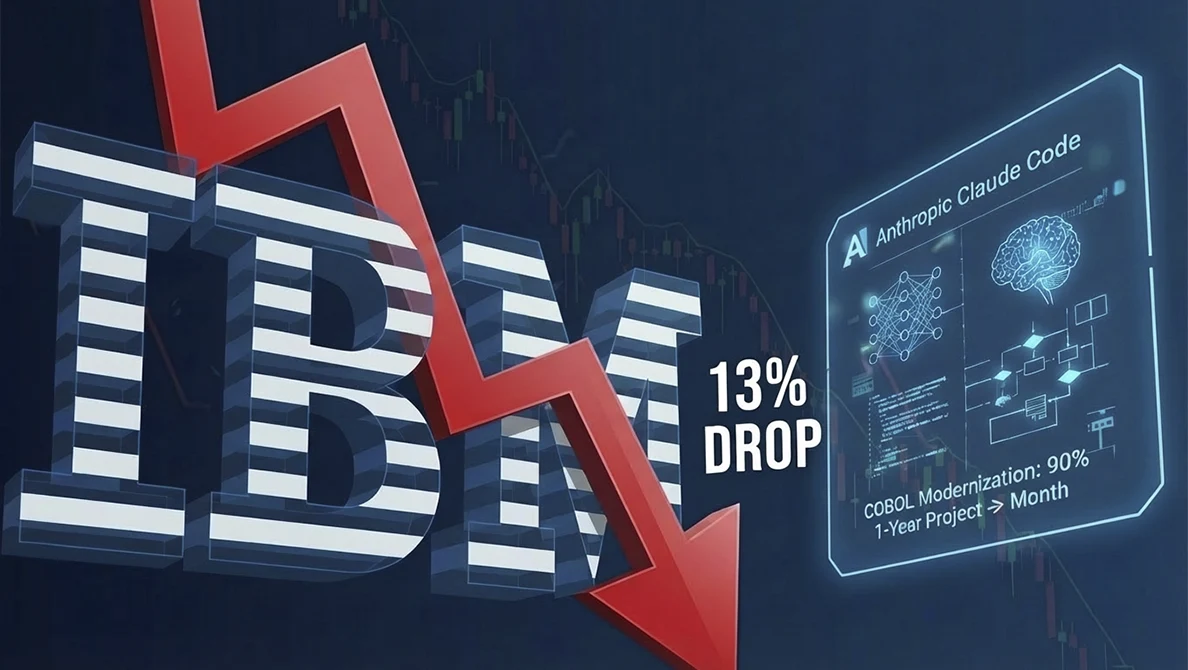
IBM shares took a sharp hit this week after AI startup Anthropic argued that its tools can materially speed up a problem that has haunted enterprise IT for decades: modernizing legacy COBOL systems. On February 23, 2026, IBM stock fell roughly 13%, marking its steepest one-day decline in more than 25 years, as investors tried to price in what faster, AI-assisted modernization could mean for a business that still benefits from long, complex enterprise transitions.
The market reaction was triggered by Anthropic’s positioning of Claude Code as a practical accelerator for COBOL conversion and refactoring—work that runs through IBM’s mainframe ecosystem and remains heavily used across banking, insurance, and government systems. The investor worry isn’t that COBOL will vanish overnight, but that if AI can automate large chunks of analysis, translation, and testing, then modernization projects that once required large consulting teams and multi-year timelines could become shorter, more tool-driven, and potentially less lucrative for traditional service models.
Why IBM’s Legacy Modernization Business Is in the Spotlight
COBOL modernization has historically been a high-friction, high-stakes initiative. These systems often sit at the center of mission-critical workflows—think core transaction processing, claims, benefits, and large-scale record systems. They’re stable, but expensive to maintain, and the pool of experienced COBOL developers has been shrinking for years. That combination has kept modernization demand strong and budgets sticky, even when CIOs would prefer to move faster.
This is where Anthropic’s claim landed like a shockwave: if Claude Code can compress the timeline from “years” into something closer to “quarters,” it could reshape how modernization is scoped and sold. Investors immediately connected the dots to IBM’s exposure—both through its mainframe footprint and the broader revenue streams tied to supporting and evolving these large enterprise environments.
The move also reflects a broader mood in markets: AI announcements are no longer being treated as additive upside for every incumbent. In some corners of software and IT services, AI is increasingly framed as a labor-substituting force—reducing the need for large teams doing repetitive technical tasks and pressuring fee structures that rely on time and complexity.
What This Could Mean for Enterprise IT and AI Services
For enterprise buyers, the promise is straightforward: faster delivery, lower cost, and less operational risk from prolonged migrations. If AI tooling improves code understanding, documentation, and automated testing, organizations may attempt modernization earlier instead of waiting for systems to become brittle or talent to become scarce.
For IBM, the implications are more nuanced than “AI hurts IBM.” The more realistic question is where the value accrues. If AI makes modernization more productized—repeatable workflows, reusable patterns, automated validation—then platform providers and tool ecosystems could capture a bigger slice of spend relative to traditional consulting hours. That doesn’t automatically exclude IBM, but it does raise the bar: IBM would need to convincingly position itself as a leader in AI-enabled modernization, not just the incumbent infrastructure provider.
There’s also a narrative tension here. IBM has benefited from renewed investor enthusiasm tied to its enterprise AI story and software push, including efforts around Watsonx. But markets can hold two truths at once: IBM can be an AI beneficiary in some areas while facing AI-driven disruption in others—especially where work has historically been labor-intensive and margin-rich.
Whether the selloff proves to be an overreaction or an early repricing will depend on what happens next: adoption signals from large enterprises, real-world proof of reliability at scale, and IBM’s response—both in messaging and in product strategy. For now, the takeaway is clear: AI isn’t just creating new markets. It’s changing the economics of old ones, and investors are watching closely.