

How to Choose AI-Powered Accounting Software?

Key Takeaways
- AI is already used by 72% of professionals, so AI-powered accounting software is a must-have for modern businesses.
- Modern accounting software makes use of machine learning to classify, predict, and monitor financial data.
- Small businesses may need a different type of AI accounting software than large companies, but choose one that suits your needs now and as you grow.
- Pricing, integration, and security criteria are other factors influencing software selection.
- When it comes to usability, scalability, and compliance, the best AI accounting software for businesses will deliver a long-term ROI and high return.
Introduction
Accounting has been an integral part of any business’s daily operations. But spreadsheets, receipts, and manual entries can make this laborious and error-prone.
But that’s about to change with AI! It allows you to create accounting software that doesn’t just record numbers, but also thinks, learns, and even predicts.
In fact, AI adoption is on the rise across industries. According to a recent study, 72% of professionals use AI at work, and this number continues to rise.
In accounting, AI has already cut the need for manual data entry by over 50% and is radically accelerating the accounting process. So, if you’re still using traditional accounting tools, you may already be behind the curve.
Since there are many options out there, it is overwhelming to choose the best AI accounting software for business.
That’s exactly why this guide on How to Choose AI-Powered Accounting Software exists to help you make the right decision.
Whether you are a startup founder, a small business owner, or need to scale quickly, this post is designed to help you find the solution that works for you, not what’s trending.
What does AI-powered accounting software do?
Accounting apps with AI aren’t just for a bookkeeper. They are all about automating and improving financial processes using machine learning, OCR (optical character recognition), and predictive analytics. AI accounting software is designed to perform repetitive financial tasks without the intervention of a human workforce while offering real-time insights to help businesses make better decisions.
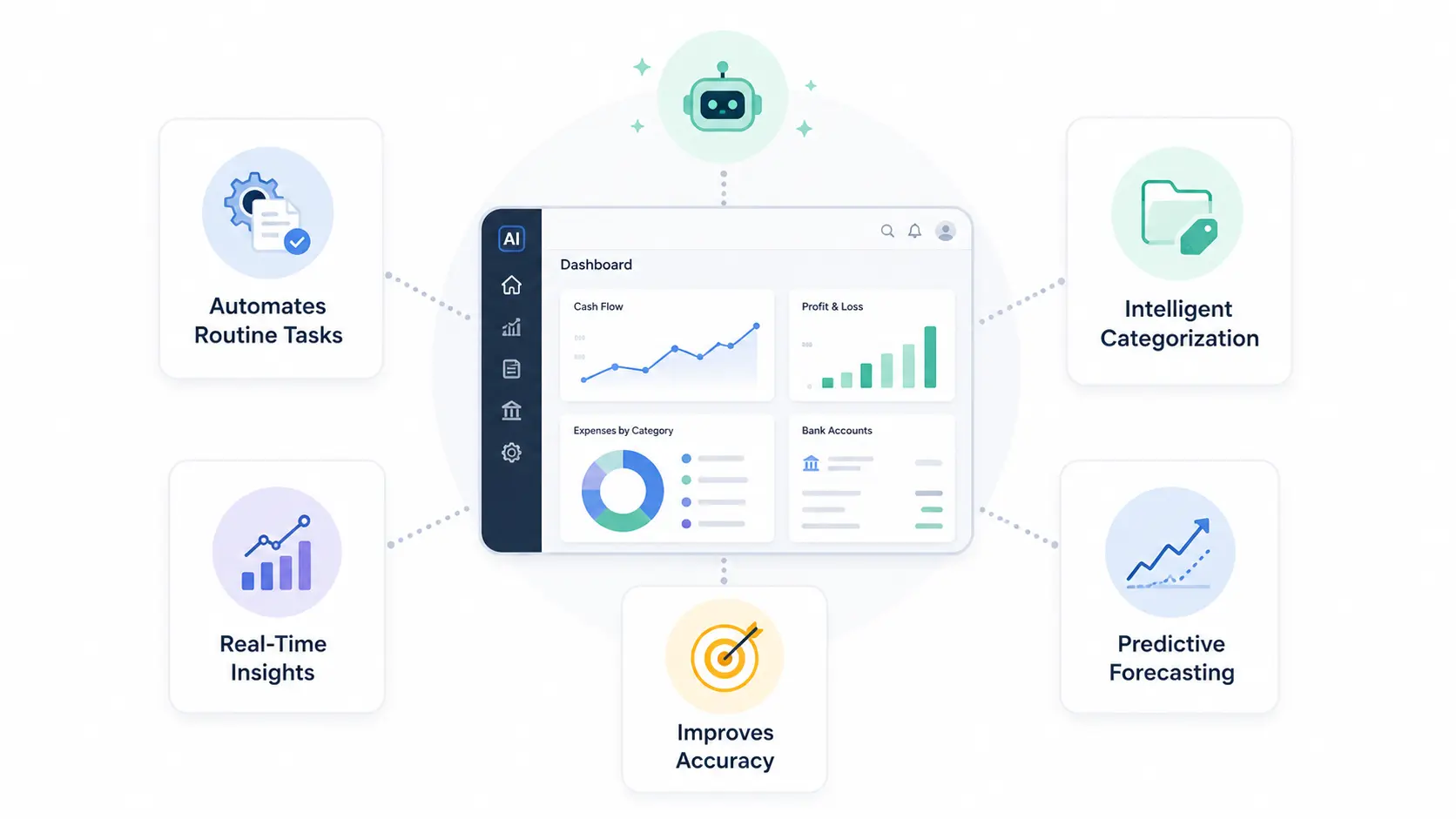
1. Automates routine accounting tasks
One of the biggest benefits of artificial intelligence is automation. It handles entering data, paying bills, or reconciling the bank automatically, and saves time and money. AI, for example, can scan invoices and receipts, extract data, and instantly convert it into accounting entries without anyone touching a keyboard.
2. Enables intelligent transaction categorization
AI systems can learn from past financial data and sort expenses, income, and transactions by type. They become more accurate as they learn patterns and business-specific rules, which will ultimately save time and money.
3. Provides real-time financial insights
Traditionally, a company would receive reports on a quarterly basis. AI tools provide companies with immediate access to their financial data. The AI tools analyze data and produce dashboards that will help a company assess cash flow, KPI’s, and make decisions more quickly.
4. Improves accuracy and reduces errors
Manual accounting can make mistakes. AI can help to minimize such risks by checking and coding the rules on a consistent basis and identifying any duplicates, mismatches, or anomalies prior to them being finalized in the financial statements.
5. Supports predictive analytics and forecasting
Artificial intelligence predicts the future. It analyses the past to predict cash flow, expenses, and revenue that can help companies plan and make decisions better.
Why are Businesses Shifting To AI-Driven Finance Tools?
The increasing adoption of AI-powered accounting solutions is not just a trend but a reaction to the complexity, competition, and need to make immediate decisions. AI-powered accounting solutions are helping them do that.
1. Demand for efficiency and time savings
Accounting processes require manual effort, which is ultimately time-consuming. With AI accounting software, organizations can enter, reconcile, and process invoices. That’s why business owners are looking for the best AI accounting software that will help them cut costs and increase efficiency without hiring new employees.
2. Need for real-time financial visibility
Modern businesses are no longer able to wait around for monthly or quarterly reports. AI-based software provides business information about cash flow, expenses, and revenue that can be used to make better decisions in real-time. For growing or small business startups that are looking for the best AI accounting software for small businesses, this visibility can mean a great deal.
3. Rising focus on accuracy and compliance
The manual accounting process can expose you to human errors, thereby leading to data theft and data breaches. However, the use of AI technology improves accuracy by checking data, validating data, and processing data consistently.
Key Features to Look For
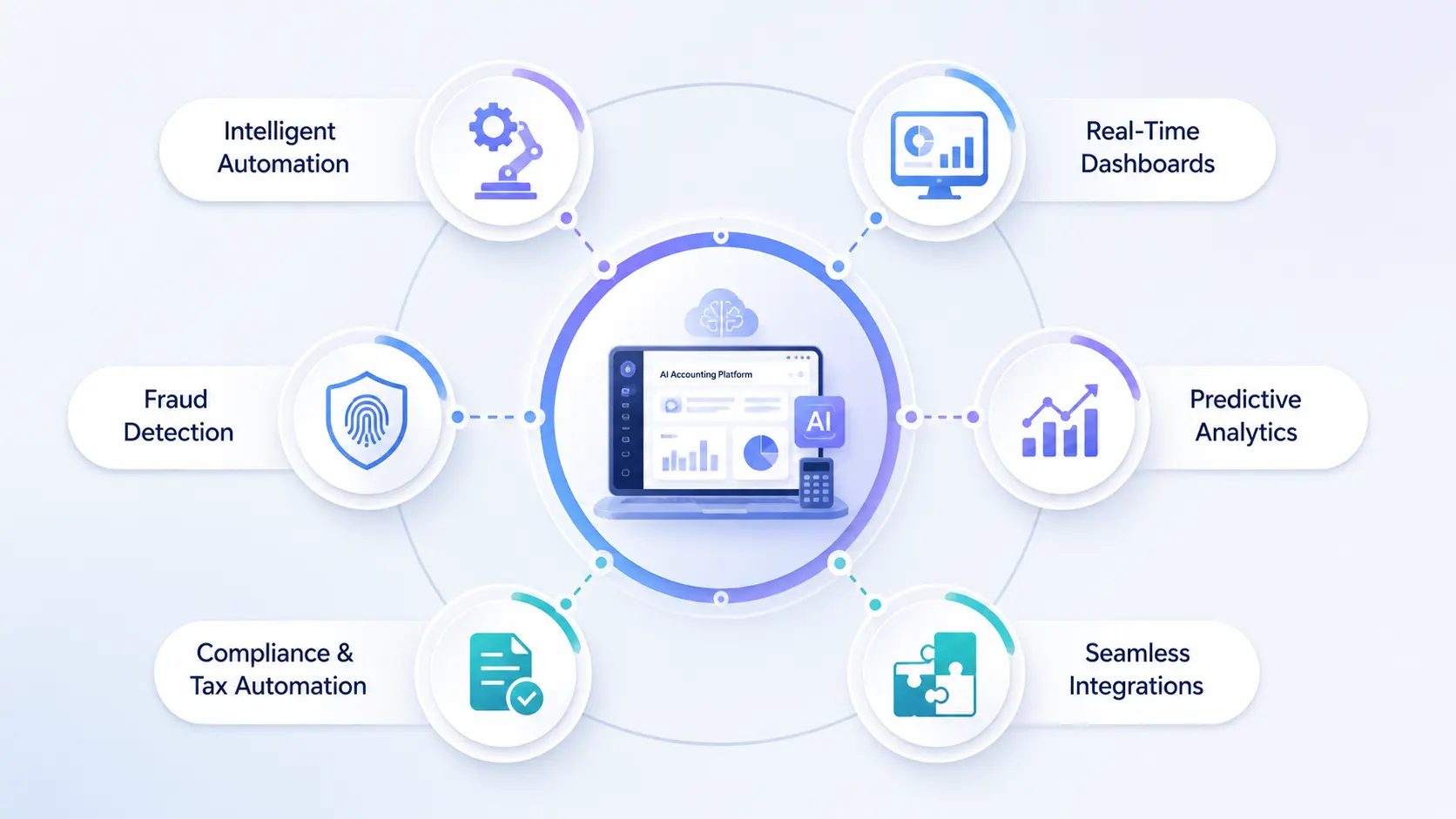
When searching for the best AI-Powered Accounting Software, don’t look only at its features. You want your accounting software to automate a part of your daily routines, but also to give you insight into your business.
- Intelligent automation
Automates repetitive tasks such as data entry, invoicing, and reconciliation while always learning.
- Automated transaction categorization
AI can easily identify transactions by history, which means less labor.
- Real-time dashboards and reporting
Instant visibility into financial performance through live data and dashboards.
- Predictive analytics and forecasting
Analyze the cash flow and expenses of the past to predict future cash flow and expense trends.
- Seamless integrations
Use native APIs to connect directly to bank, payroll, CRM, and other business applications.
- Compliance and tax automation
Conformity to regulations through automated tax calculations and audit-ready records.
- Fraud detection and anomaly alerts.
Identifies suspicious transactions and risks through monitoring.
- User-friendly interface
The user interface of the software should be easy to use by even a non-technical workforce.
- Scalability and customizability
Flexible features and advanced functions allow the system to meet evolving business requirements.
- Natural language queries (AI assistant)
Transactions with data on the financial market are made simple with conversational queries.
Choosing based on business size and complexity
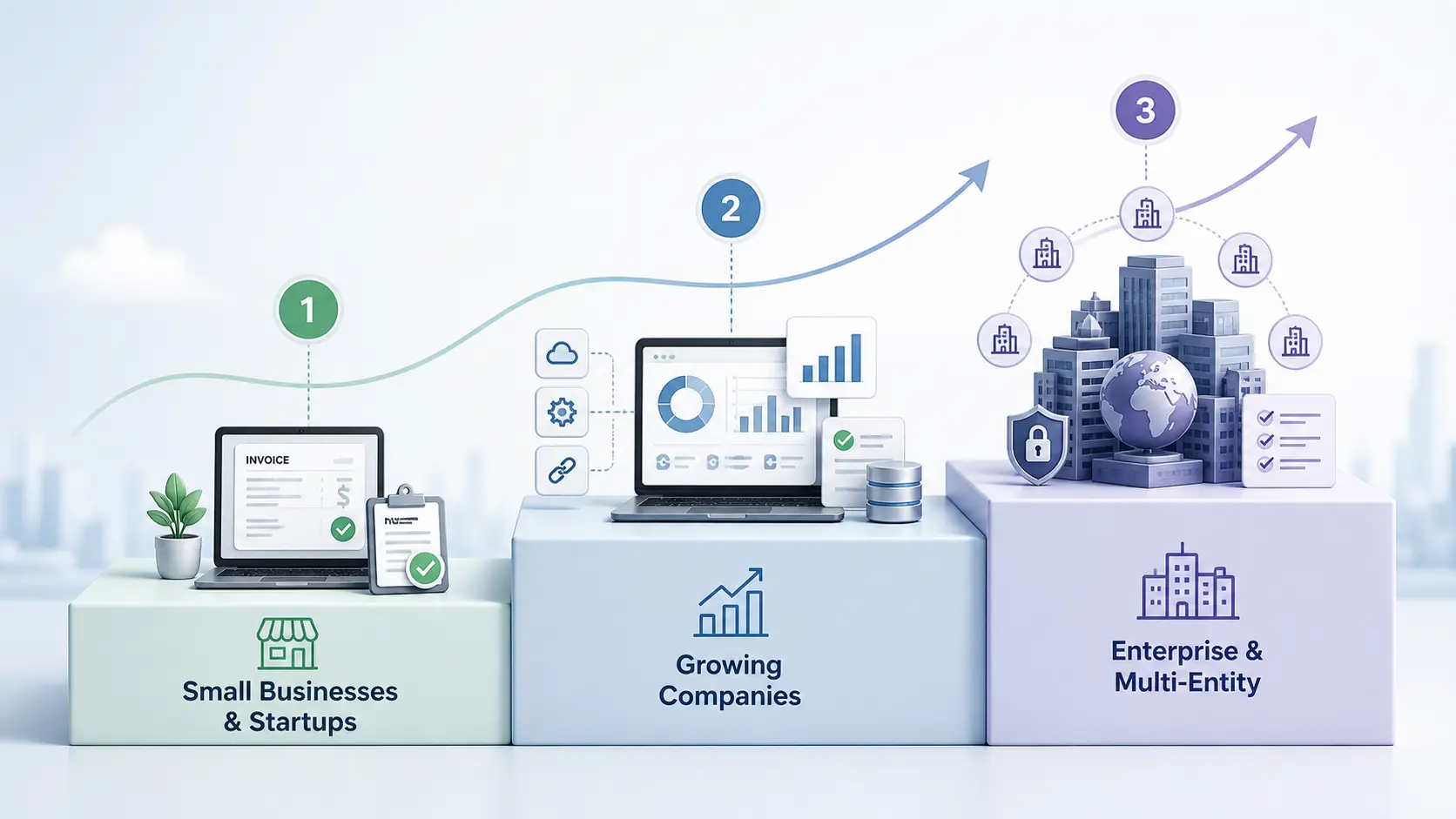
If you are wondering how to choose an AI-powered accounting software, keep in mind your business’s size, complexity, and stage of growth.
Small businesses and startups
Small businesses and startups may require low-cost AI accounting software for small businesses and simple features. For example, look for tools that have easy billing and transaction reporting.
Growing Companies
As your company grows, and you need to support more complex accounting needs, you want a system with advanced reporting and integrations, multiple users access, and capacity to scale.
Enterprise and multi-entity setups
For organizations with a large number of entities, the advanced features, such as consolidation of multiple entities, compliance, workflow, and analytics, are critical to ensure that robust, complex financial operations are implemented.
Comparing popular AI accounting tools
Using the right tools can help you know what works best for your business. Small business software, enterprise software or automation apps that use artificial intelligence might serve different purposes.
QuickBooks vs Xero
QuickBooks Online and Xero are two of the most popular cloud accounting services for small and mid-size businesses.
QuickBooks has many integrated programs, making it a very popular choice for both beginners and businesses with growing businesses. Xero is a modern accounting application that supports strong reconciliations with bank accounts and multiple currencies, making it ideal for businesses in different countries. AI has become more and more sophisticated with both of these platforms, including automatic categorization and intelligent insights, but QuickBooks is chosen for its broader integrations with third parties, and Xero for its simplicity and flexibility.
Sage Intacct vs Oracle NetSuite
Sage Intacct and Oracle NetSuite are designed for more complex, mid-sized, and enterprise organizations.
Sage Intacct’s emphasis is on accounting with strong automation, reporting, and ease of use. With this, it is the ideal option for those who are looking for a robust accounting solution without a full ERP system. Oracle NetSuite is an ERP system featuring CRM, inventory, and analytics suitable for large, multi-entity, or global businesses.
Intacct if you need more depth for your finance or NetSuite if you need all-in-one, AI-driven analytics and automation for large organizations.
Zoho Books and automation tools like Vic.ai and Dext
Zoho Books is an excellent choice for small and medium business owners looking to gain access to a broader platform offering affordable, automated solutions. The solution offers features like automated workflows, transaction categorization, and real-time dashboards that make it a practical option for companies considering adopting AI slowly.
On the other hand, tools like Vic.ai and Dext are more of an AI-first automation platform than a complete accounting system.
- Vic.ai provides AI invoices and accounting tasks for businesses.
- Dext enables data extraction, receipt capture, and pre-accounting automation.
Many businesses are incorporating these tools with accounting software to automate their operations (especially those that place a premium on the best AI accounting software) by categorizing and processing transactions.
Common Mistakes To Avoid
When inquiring about how to choose AI-Powered accounting software, businesses make a few potentially fatal errors that can lead to inefficiencies, additional costs, or the need to change their accounting system later on. Knowing these pitfalls allows you to make a better, more informed decision.
1. Focusing Only On Price
There are some variables that may play a role, but don’t just jump at the lowest price. Some lower-priced products may not include AI features like predictive analytics, classification of transactions, or integrations. These costs can be considerable due to manual labor, monotonous procedures, or even the change of software.
2. Ignoring Business-Specific Needs
A business’s process, industry, and reporting needs are unique. Choosing a similar product and then not getting results from it later might cause more problems. A retailer may need to track inventory, while a service business may need to track billing and time.
3. Overlooking automation capabilities
All “AI-powered” tools do not mean they are truly automated. Some are simply based on simple rules rather than intelligent and learning-driven automation. You need to ensure that the software actually reduces the dependency on manual labor through features like data entry, data reconciliation, and learning.
4. Not checking integration options
Unlike accounting, business software should be integrated with your existing infrastructure (banks, payroll, CRM, ERP). Lack of integration will lead to data silos, duplicate entries, and manual labor that will defeat the purpose of automation.
5. Underestimating scalability
Before you invest in a solution, you may need to look for additional options, such as access for multiple users, advanced reporting, or multi-entity management. A program without scalability can force you to migrate at a later date, which will be a long and costly process.
How to compare vendors effectively?
When businesses decide which solution to implement, they should look beyond the features to assess each provider. Here are the tips to compare vendors based on usability, price, and security aspects to make an ideal choice.
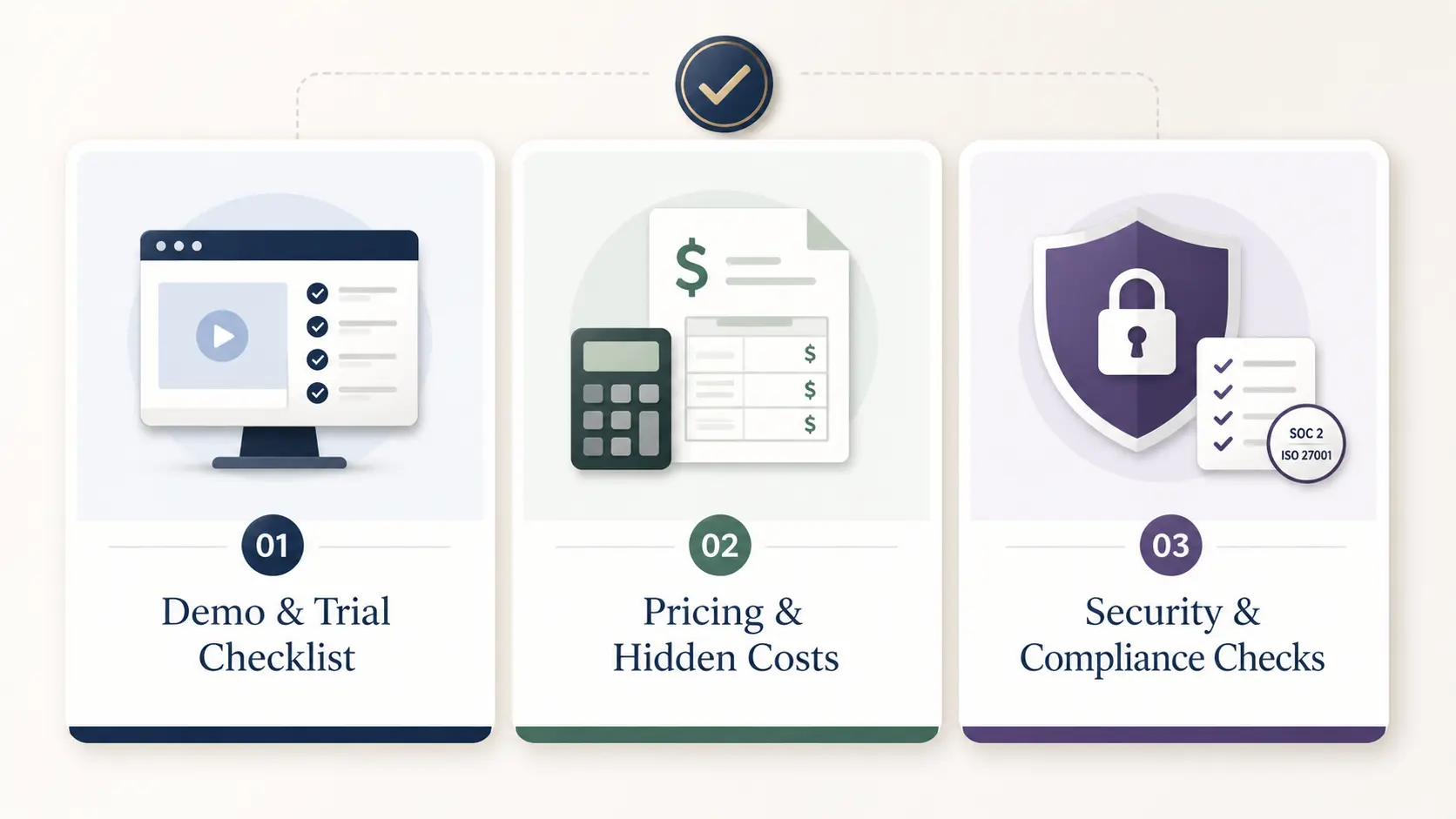
Demo and trial checklist
You can try out the product in a demo or a free trial before you subscribe or buy the software. The demo gives you a good sense of how the product works in real life. The demo will also let you test ease of use, onboarding, and accuracy of AI features like transaction classification and data extraction. You can also test the ease of use of the dashboard, reporting speed, and its integration with your existing tools.
Pricing and hidden costs
When comparing AI accounting software for small businesses, look beyond the advertised price to see how much the product is worth in total. Some providers charge more for premium features, more users, or more transactions. Hidden costs may include adding the software to your existing systems, using an API, integrating the software for you, or servicing clients. Discovering how much it costs to run a business can help you decide whether or not you’ve found the best AI accounting software for small businesses.
Security and compliance checks
Choosing accounting software should be secure and compliant. There is sensitive information on the user’s financial account, and they have to be in a system that protects it. The business should ensure that the software provider offers strong encryption of data, secure cloud storage, and user access controls based on roles to protect this data. The software should also meet your state’s and/or federal tax regulations, such as GST, and come with audit trails and regular backups.
FAQs
1. How do I find out if my accounting software actually uses AI or simple automation?
The AI software does much more than automate transactions with rules. It can learn from your past transactions and keep improving. The adaptive transaction category generation, recommendations and predictions are evidence of the integration of artificial intelligence.
2. What is the best AI accounting software for taxes?
The Best AI accounting software for taxes is an application that uses artificial intelligence to automate the tax process, make sure you are in compliance with new tax rules, and maintain accuracy by identifying errors. The application generally supports your local tax system (GST) and can be easily integrated into your tax filing system for efficient, reliable, and low-effort tax management.
3. How to choose the right SOC 2-compliant AI accounting software?
When choosing software that is SOC 2-compliant, check to see if it is accredited with SOC 2-certification and has security practices in place. Look for data encryption, user-controlled access, and audit logs. Transparent vendors will share reports and ensure your financial information is safe.
4. Is AI accurate in categorizing, forecasting, and anomaly detection tasks?
AI can classify transactions well over time and its accuracy will increase as it learns about your data. AI can also make predictions based on data, but only as good as the data, and sometimes humans have to adjust.
Final thoughts
That’s all about ‘How to Choose AI-Powered Accounting Software’. First and foremost, find the best accounting software for small businesses or for a business by looking at your needs and whether the features that make up the software meet your needs. Accounting software can give companies an advantage over other systems of securing money, such as manual processes, scaling, integration, and real-time data.
The key is to adopt AI, but do so in an effective manner. Avoid common pitfalls, compare vendors, and use features such as transaction categorization and predictive analytics. By doing so, you can select the best AI accounting software for your business that meets your current needs and will grow with your business. The right choice will simplify your financial workflow and allow you to make faster, data-driven decisions in a competitive environment.
Get in Touch with
AI Experts
Kapil Kumar is a leading voice in the field of Artificial Intelligence, blending deep technical expertise with a passion for innovation and real-world impact. As an accomplished author, researcher, and AI practitioner, he brings clarity to complex technologies—making AI not only understandable, but actionable. Whether decoding algorithms or envisioning ethical frameworks for AI, he is committed to guiding professionals, students, and tech enthusiasts through the rapidly evolving world of artificial intelligence.