
AI Fragrance Company Osmo Raises $70 Million in Series B Funding

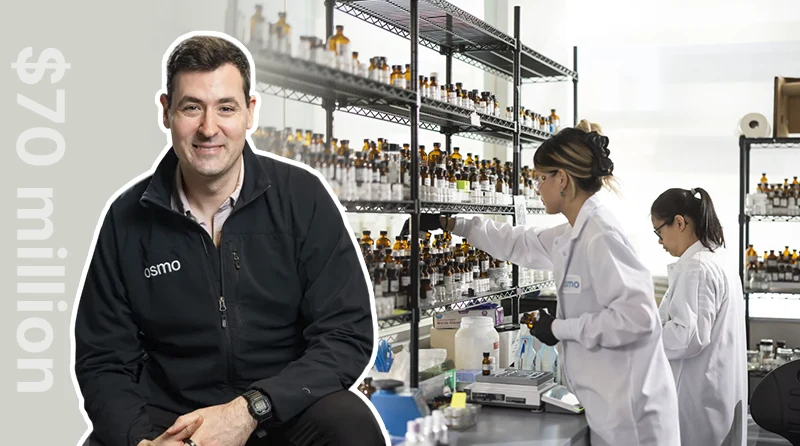
Some investors continue to front the AI and fragrance boom in the year 2026, despite fears that the booms are going to slow down. On Thursday, the AI fragrance company Osmo declared the acquisition of the investment amount of 70 million dollars throughout Series B funding.
“Agility, which is what we lacked in the fragrance industry on a large scale, is what Mr. Wiltschko, the CEO of Osmo, has said. It is relevant to the indie brands that need to make decisions quickly or perish. On the other end are the multinational CPGs, which require agility due to the market share they are losing to these [indie] guys.
Two Sigma Ventures led the Series B funding round, with additional investors being Alumni Ventures and Stripe CEO and co-founder Patrick Collison.
Osmo has increased its C-suite with the new support. Its new employees are ex-Amyris and Unilever executive Mike Rytokoski as chief commercial officer; former Givaudan and IFF executive Mateusz Brzuchacz as chief operating officer; and ex-Mercedes-Benz and Tesla executive Nate Pearson as chief financial officer.
Rytokoski claimed to be drawn to Osmo with its mission of modernising an outdated and unproductive industry. The company refers to its fundamental technology as olfactory intelligence.
Rytokoski said that culture evolves very rapidly and that you have to move with it. There might be opportunities that present themselves very soon, so whoever can take the chance to avail the opportunity is the one that gets the biggest reward.
In 2023, Wiltschko started Osmo, with a $60 million Series A, led by Lux Capital and Google Ventures. The company has endeavoured to make scent digital and come up with things to decode fake sneakers to StockX with the help of odour.
In 2025, Osmo introduced a fragrance house, Generation, which was an AI-based fragrance house meant to compete with companies such as Givaudan and DSM-Firmenich. The Museum of Pop Culture, the functional perfume label Loucil and journalist and television host Alice Panikian are its current clients.
In the event that we succeed, you will hear the name of our product, but you will never see it, said Wiltschko. “We’re B2B. Our mission is to ensure that the brands of other people are excellent in terms of scent, but we will never launch a brand.
The new capital will also help in the growth of the manufacturing facility of Osmo located in Elizabeth, New Jersey. In June, Osmo bought the location and intends to relocate all its operations, based on its office in Manhattan, to New Jersey by the end of 2026.
The adoption of AI is not a unanimous one among the users of perfumes; some customers perceive it as the opposite of the profession of the perfumers. Osmo said that it has two master perfumers at present but refused to provide the number of perfumers and evaluators in its workforce.
The tools, Wiltschko said, help our perfumers be more creative and more productive. It will assist in removing some of the more manual parts, and they can actually concentrate on being as creative as they can.
The ultimate ambitions of Osmo extend further than commercial perfumery, Wiltschko said, although retailers such as Ulta and Sephora keep redoubling their efforts on new fragrance brands. Besides accelerating the scent production pipeline and developing digitised scent-making instruments, Wiltschko claimed that the Osmo prototype named Mount Everest would involve making scent-powered health-care diagnostics equipment, including making a device that could mimic the medical service dog.
What you are witnessing is an increase in the demand of a particular category of scent, which is the less than 15% of the market, fine fragrance, he said. “Scent is everywhere. Scent is going nowhere. It is an important component of our life. You feel it all through the day. It is constructed into rituals, whether you know it or not.
It will also be a difficult technical task to produce scent-based tools, Wiltschko recognised. Furthermore, as a number of investors have been rushing to ride the AI wave, there have been speculations that the sector is about to enter a bubble. It is really a question of survival of the fittest, and Rytokoski said that the companies that will survive such a collapse are the ones that will sell the most.
Rytokoski said that he was in Silicon Valley during the dot-com boom. Many of those companies collapsed. However, a number of them turned out to become terribly successful, such as Amazon and Facebook. And therefore I believe that the same thing will happen here. Others will not succeed, and others will. Our mission is to be among a list of companies that will perform well.