

Prompt Engineering Jobs: Complete Career Guide for 2026


What if I told you the most essential skill for 2026 is not coding? Surprised? Yes, this is one of the shocking truths that most professionals are avoiding, especially beginners. You might be using ChatGPT, but are you getting paid to use it? Only the AI engineers involved in prompt engineering jobs are getting paid for it. The professionals who have mastered the craft of writing prompts earn approximately $120,000 to $250,000 per year.
In 2023, Bill Gates quoted – “AI will change the way people work, learn, travel, get healthcare, and communicate with each other.”
Today, we’re watching that shift happen in real time. Tools like ChatGPT, Gemini, Claude, Perplexity, Grok, and Microsoft Copilot are ruling the roost. ChatGPT has witnessed a 180% year-over-year increase in users as of Nov 2025, and Gemini users have risen 170% this year.
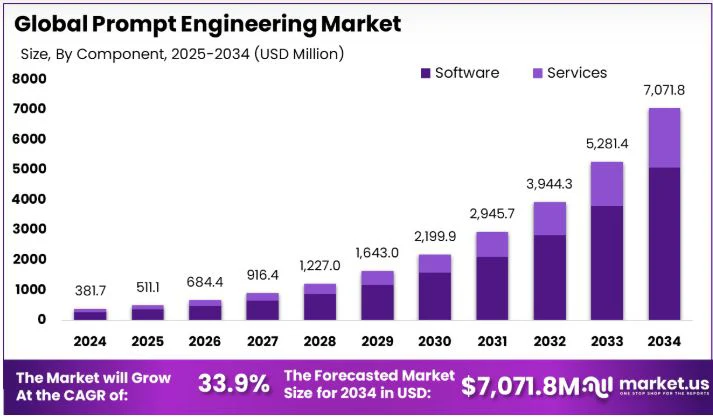
Anyone can use these tools for simple tasks. But using them for business needs skill, clarity, and responsibility. That’s where prompt engineering becomes essential. Another reesearch perdict that Prompt Engineering Market size will reach at a USD 7,071.8 Million By 2034.
Thus, there is a surge in the prompt engineering roles and their salaries. The global prompt engineering market is projected to reach $2.06bn by 2030, at a CAGR of 32.8%. North America is a leading region with a 34.0% share, which clearly indicates there will be a high rise in the roles from 2025-2030, and 2026 will be a promising year.
Behind this surge, there are some major pain points that companies want to solve, such as companies not getting accurate outputs from AI models and businesses not knowing how to integrate AI with safety. For example, a Gen AI chatbot for banking gives incomplete responses without understanding the context, or a brand using an AI model to generate ads but getting responses that violate the brand’s guidelines. There are other challenges that also exist.
Therefore, let’s continue with this article that explores crucial details about prompt engineering jobs and their future. This complete guide will walk you through the information you’re looking for.
What is Prompt Engineering?
The prompt engineering refers to the craft of creating refined instructions for AI models to produce desired output. These instructions are called prompts, and those who have the skill to communicate with the AI models for output creation through prompts are called prompt engineers.
In simple words, you can understand it like this: prompt engineering is the process of communicating with AI in a smart way. It works as if the prompt is clear; the chances of accurate output are high.
That is why there is a significant surge in prompt engineering jobs, and companies need skilled professionals who actually know how to write the prompts for a variety of tasks, such as writing, research, coding, analysis, product design, sales, customer service, and more.
The prompt engineering grew after the inception of Gen AI tools such as ChatGPT, Gemini, Claude, Copilot, and more. However, these tools have some unique differences, such as ChatGPT vs Copilot or Claude Vs Gemini, etc. But the fundamentals of prompt engineering are the same for all, and experts use it accordingly.
Therefore, what’s the ultimate secret about this profession? The secret is that this role requires a mix of creativity, logic, critical thinking, and problem-solving. If you have, you could be the next professional who is just about to open the door for better career opportunities and a high salary.
With the advancements in smart systems, AI prompt engineering jobs are significantly increasing and becoming as crucial as any technical job in the AI industry.
Why Prompt Engineering Jobs are in High Demand
The demand for prompt engineering jobs is rising sharply across diverse industries such as healthcare, manufacturing, logistics, finance, education, and others. According to one of the reports, the prediction for the prompt engineering industry is of $32.78 USD Billion by 2035 at a CAGR of 27.86(2025-2035). This will create a significant hike in prompt engineering job roles.
The key reasons behind the high demand are to bridge the gap between AI models and real-world business needs, which only prompt engineers can do. Tools can only produce the output, but the right person can make these Gen AI tools work accurately, following the intent.
Let’s have a look at some of the top reasons why prompt engineering is crucial for now and in the future!
- Demand Across Industries
Almost all industries are now leveraging AI for automation, such as healthcare, banking, manufacturing, legal services, customer support, and more. Therefore, they need skilled professionals to effectively fine-tune the responses with maximum accuracy.
- ROI on AI Investment
According to Statista, the projected market volume for GenAI is $400.00 billion (37.57%, CAGR 2025-2031), and businesses are heavily investing in LLMs. 92% of Fortune 500 companies are using OpenAI’s technology. The company needs skilled, prompt engineers who can use these models efficiently and deliver positive Return on Investment (ROI) by reducing the need for manual post-processing and editing of generic AI outputs.
- High Salaries & Growth
Correlating to the above two reasons, with the high demand for roles, the salaries of prompt engineers are also increasing, and they can earn $120k-$300k in a year. The package increases with expertise and the industry they work in.
- Achieving Customization
GenAI outputs are not enough for use cases like planning, marketing, customer services, and high-stakes tasks. They need customized instructions and domain-specific expertise that only prompt engineering specialists possess.
- Bridging the Skills Gap
Also, for bridging the gap in AI adoption, these roles are in demand. Prompt engineers work as a vital link between technical teams and non-technical teams and ensure the adoption of AI across the enterprise, business, or organization.
Supporting the above points, here are some market growth and job trends to watch:
- According to ITJobsWatch, there is a 209% year-on-year surge in the number of ads mentioning prompt engineering.
- 71% of organisations are using Generative AI regularly and in at least one business function.
- In the USA, AI adoption is expected to grow 27% (small firms) and 53% (large firms).
- In the future, AI prompt engineering jobs will tend to shift to more complex roles such as “context engineering” or “PromptOps.”
- The top industries hiring prompt engineers on a huge level are – Technology and SaaS, Healthcare and Life Sciences, Finance and Insurance, and Edtech.
Now, you have enough information about Prompt Engineering Jobs. But do you know what skills are required to become a prompt engineer?
As Oguz A. Acar. (Professor, King’s College London) said– “What is a more enduring and adaptable skill that will keep enabling us to harness the potential of generative AI? It is problem formulation — the ability to identify, analyze, and delineate problems.”
Let’s continue with the blog to know more about what skills are required!
Skills Required to Become a Prompt Engineer
Skills play a crucial role in becoming an expert in anything in this world. Thus, skills required to become a prompt engineer are no luxury, and it requires a blend of programming, data analysis, AI, creative thinking, and soft skills. Here are the top skills that you need to acquire for prompt engineering certification and to become an expert.
- Verbal and Written Communication
Who says an AI system can’t communicate? Prompt engineers make this happen through writing a prompt that comprises words and phrases. To become an expert, you need to have command over verbal and written communication, including the grammar rules to write an effective prompt. It will help you write the instructions for Gen AI that really work.
- Programming Skills
Although prompt engineering is not about programming, it requires basic knowledge of Python, Scripting, API Integration, and a working knowledge. For example, using OpenAI’s or DeepSeek’s solution on an enterprise level, you must know how to integrate and use APIs.
- AI Knowledge
Writing the prompts is a front-facing skill, but in the background, NLP, LLMs, Machine Learning, and AI content development skills are required. If you have the knowledge of these, it helps you create the practical and refined prompts.
- Data Analysis
Data fuels every AI system in this world, especially when you are working with LLMs. Your data handling and analysis skills will help you use data to train and refine the models for achieving better outcomes.
- Prompting Techniques
A variety of prompting techniques exist that you need to learn to prepare yourself for prompt engineering jobs. These are zero-shot prompting, few-shot prompting, chain-of-thought prompting, and knowledge-generation prompting. While using these techniques, you’ll be able to work with AI models efficiently. For example, giving AI an example, let the AI think step-by-step to solve the complex problems, providing detailed context and more.
- Domain Expertise
AI Prompt engineering jobs are not limited to any specific domain; it is one-for-all, so based on the industry you want to switch to or want to join as a prompt engineer, you must have domain knowledge. Ex.- knowledge of patient workflows, knowledge of financial instruments like bonds, derivatives, and compliance knowledge.
Therefore, the top skills can be categorized as:
| Core Technical Skills | Key Prompting Skills | Soft Skills | Advanced Skills |
|---|---|---|---|
|
|
|
|
Top Tools and Platforms Prompt Engineers to Use
In addition to the skills, you also need to be an expert in using prompt engineering tools and platforms. The prompt engineers require a mix of tools such as LLMs, prompt testing platforms, frameworks, and others. Here are the most widely used tools by the prompt engineers.
#1. LLMs
The following are the core tools that prompt engineers to work with. Although these are LLMs, they help experts in creating, refining, and testing the prompts, such as:
- ChatGPT: One of the top and widely adopted LLMs used by experts worldwide. OpenAI’s ChatGPT helps prompt engineers for rapid prototyping, brainstorming, reasoning, and creating structured output.
- Copilot: Microsoft’s Copilot is a specialised LLM that helps prompt engineers, especially working in the software development industry. The prompt engineers use it for generating and fixing code using prompts.
- Gemini: Gemini is known and popular among prompt engineers for its multimodal capabilities. The experts use it for complex, real-world tasks that require reasoning and analysis at a higher level.
- DeepSeek: This is one of the cost-effective LLMs that provides excellent performance for coding-related tasks. It helps prompt engineers for developing and optimizing reliable prompts, creating prompt libraries, and specialized assistants.
- Midjourney: It is one of the most reliable tools for prompt engineering best practices, where image and art generation are required. Prompt experts involved in creative, designing, and marketing roles used it for advanced visual prompt engineering.
- Claude: Antropic’s Claude is known for its context awareness capabilities, and it provides highly safe, consistent, and context-aware responses for tasks such as legal documentation, long-form documentation, summarizing books, and more.
#2. Specialized Prompt Engineering Tools
Apart from the LLMs, prompt engineers also use specialized tools for testing, evaluating, optimizing, and versioning the prompts for better output according to their tasks.
- PromptLayer: This is one of the top tools prompt engineers use for visual prompt management, version control, testing, usage monitoring, and team collaboration.
- PromptPerfect: If you are looking for an AI-powered prompt rewriting and optimization tool, PromptPerfect is one of the right choices. This tool automatically rewrites and optimizes prompts and provides high-quality output across diverse AI models.
- LangChain: It is an open-source AI development framework that prompts engineering experts to use for building and deploying LLM-powered applications. LangChain’s key features include pre-built prompt templates, support for agent-based automation, vibrant community support, and others.
- LangSmith: LangSmith is a debugging and testing platform that allows experts to evaluate prompts and model behaviour. You can also use it for evaluating the performance of tools like Lanchain and others. It helps in visualizing the internal thought process of the LLMs to address and fix errors.
- FlowGPT: FlowGPT works more than a tool and acts as a community and repository platform where experts can share, collaborate, and discover effective prompts based on diverse use cases. Due to its community-driven nature, it is the best platform for learning.
How to Get a Prompt Engineer Job (Beginner Roadmap)
Prompt engineering jobs offer better career prospects, and it is a promising job profile that can make you earn good compensation and work on projects that can polish you as an expert. Everything starts from the basics, and you need to make your first move. Here are the steps that will help you get a prompt engineering job as a beginner:
Step-1 Learn Foundational Skills
Start with the basics of LLMs and the foundation of AI. It will give you a brief idea of how a language model works, process instructions, and provide outputs. A basic understanding of the mechanism will help you craft good prompts, handle complex queries, and improve the prompt quality.
Step-2 Learn Prompt Engineering Techniques
It is essential for all prompt engineering jobs that a candidate must have mastery over prompting techniques such as Zero-Shot, Chain-of-Thought (CoT), Role-Playing/Persona,
and Context Engineering. Mastering all these techniques will help you become an industry-ready professional and support your candidature.
Pro Tip: The best way to learn technique is to enroll in one of the best prompt engineering courses where you can directly learn from the experts.
Step-3 Technical and Programming Skills
Although coding is not a mandatory skill for a prompt engineer job, if you have the skills, it will be worthwhile for your profile. Including the basics, you need to know and learn how to call an LLM through an API or APIs. The basic technical skills will also help you understand how AI models interpret inputs.
Step- 4 Practice and Experiment
Once you have achieved the foundational and technical skills, including prompt engineering techniques, practice and experiment with what you’ve learned. The best idea is to start with some basic projects that will help you analyze where you are and improve your skills. Later, you can also add these projects to showcase your real-world experience for beginner prompt engineering jobs.
Step-5 Build a Portfolio
The next crucial step is to build a portfolio to showcase your knowledge and expertise. By systematically documenting your prompt experiments and developing case studies, you can effectively demonstrate how optimised prompts result in enhanced AI-generated responses. Also, make your profile on professional community platforms such as LinkedIn, GitHub, and others. This increases your visibility, and recruiters may find you easily.
Step-6 Apply for Prompt Engineering Jobs
Last but not least, start applying for the jobs available across online job portals such as Fiverr, LinkedIn, Monster, ZipRecruiter, and others. Before applying for the job, evaluate, analyze, and tailor your resume accordingly, and get your dream job.
Pro Tip: Before applying, go through a prompt engineer job description carefully. Thus, you’ll have an idea of what is required, and you are eligible for the profile.
Key Responsibilities of a Prompt Engineer
To become a prompt engineer is not just about writing the prompts; there are also some responsibilities associated with the role. The key responsibility of a prompt engineer is to achieve reliable and accurate results from AI tools. Therefore, here are some other crucial responsibilities associated with prompt engineering jobs:
- Creating High-Quality Prompts
The most significant responsibility is to design, write, evaluate, and optimize high-quality prompts, prioritizing quality output with accuracy. The prompt must be clear and structured, aligned with the use case, industry, and business needs.
- Test, Iterate, and Optimize
Prompt engineers are required to perform the test, iterate, and optimize the prompts, such as experimenting with different variations, tones, structures, and constraints to improve output quality. They also test it on LLMs like ChatGPT, Copilot, Claude, Gemini, and DeepSeek to analyse the performance and fine-tune the responses.
- Prompt Library Development
It is not necessary that, as a prompt engineer, you need to write unique prompts every time. Customizing the previous prompt can also help you work faster and save time. The best way to do it is to create a prompt library to automate the repetitive work.
- Team Collaboration
Team collaboration helps prompt engineers to understand the requirements in a clear way. These experts work closely with product managers, AI developers, data analysts, marketers, and customer support teams, acting as a bridge. This helps experts to deliver reliable results.
- Compliance & Ethics
Prompt engineers also ensure that outputs must not violate compliance, ethics, and the brand’s guidelines. It also helps them to produce safe and unbiased outputs using prompt engineering skills.
- Staying Updated
The experts need to stay updated with the advancements in technology, industry, AI models, and prompting to keep pace and produce relevant results as per demand.
Types of Prompt Engineering Jobs
The prompt engineering jobs are an umbrella term, as there are a multitude of categories available. To become a professional and to choose your career path as an AI prompt engineer, it is a must to know about the following roles:
- Prompt Engineer: This profile is for designing, writing, testing, and refining the prompts using LLMs to produce the desired and accurate output. You can also consider it as a beginner profile.
Salary Range: $80,000–$200,000/ year
- NLP Prompt Specialists: This role required expertise at the linguistic level to create the structured prompts for LLMs and make ML algorithms learns to produce the outcomes. The NLP prompt engineer role is ideal for research-heavy tasks.
Salary Range: $85,000–$150,000/ year
- Senior Prompt Engineer: This role has more responsibilities and tasks. A senior prompt engineer handles the team of prompt engineers and guides them with the work. They also handle prompt libraries, test suites, and strategies.
Salary Range: $ 150,000- $300,000/ year
- Technical Prompt Engineer: This job role combines prompt engineering and coding. Technical prompt engineers write the prompt for coding-related tasks and assist developers to work faster.
Salary Range: $130,000-$200,000/ year
- AI Automation Prompt Engineer: These experts design workflows using tools like Langchain, PromptPerfect, and others, and reduce repetitive work for the teams through automation.
Salary Range: $100,000- $160,000/ year
- Enterprise AI Prompt Engineer: Large companies need specialists who understand compliance, privacy, and internal processes. These are the enterprise prompt engineers who build safe, policy-aligned prompt systems for different departments.
Salary Range: $150,000-$210,000/ year
The other specialized roles involved LLM Tuning Specialist, AI UX prompt designer, GenAI prompt engineer and coach, AI security prompt engineer, AI product manager, and prompt engineer.
Read More About – Highest Paying AI Jobs
Prompt Engineering Salary
Now, some readers might have a question – How much does a prompt engineer earn in a year? Or what is the salary that prompt engineering jobs offer?
The prompt engineering salary depends on a variety of factors such as industry, country, and company. For example, the Salary of a prompt engineer in the USA is $60k-$90k for beginner roles, and it may reach over $200k+ / year for mid-senior roles.
Let’s read more details about it.
#1. By Industry
Based on the industry and domain complexity, the average salary of prompt engineers is:
- Technology/ SaaS: $120,000- $300,000+ / year
- Finance & Banking: $100,000-$250,000+ / year
- Healthcare: $120,000- $250,000+ / year
- Marketing/Content: $80,000-$150,000 / year
- Consulting & Enterprise Services: $150,000 to $250,000+ /year
#2. By Country
Region-wise salaries of prompt engineering jobs are diverse, such as:
- USA: $98,000–$270,000+ average
- UK: £72,500–£87,500 ($92,000–$112,000)
- Canada: CAD 70,000–90,000 ($50,000–$65,000) entry-level.
- Australia: AUD 60,000- AUD 100,000+ / year
- Germany/Europe: $67,000–$92,000 mid-level.
#3. By Company
Big tech companies offer higher packages to prompt engineers, for example:
- Anthropic: Up to $335,000 for prompt librarian roles.
- Meta: ~ $$296,000 per annum
- Google/Microsoft: $150,000-$350,000+ / year
- Open AI: $180,000 to $300,000+ per year
- Equinor/DataAnnotation: ~ $120,000 – $125,000 initially
Career Growth & Future Outlook
The evolution of AI has created a myriad of career opportunities for students, beginners, and professionals, and prompt engineering jobs are one of them. Now, there is a huge demand for prompt engineering roles across industries, companies, businesses, and countries. As of December 2025, the LinkedIn platform has listed 1000+ prompt engineer jobs worldwide.
This is only one platform; the job posting for this role is significantly available and increasing on other platforms too. According to WEF, 40% of businesses are planning to expand their AI workforce and resources, and by 2027, AI, ML, and GenAI roles will be the fastest-growing roles. It all indicated that career growth for GenAI and prompt specialists is outstanding.
Based on the market trends, by 2026, roles like LLMOPs specialist, Generative AI Product Manager, AI Security Prompt Engineer, and AI architect will come into the scene and increase over time.
Still, if you question why prompt engineers are the future of AI jobs? Then it‘s due to:
- Democratization of AI access
- More demand for prompt specialization roles
- Significant AI skills gap
- Demand for ethical AI implementation is more
- Continuous AI evaluation is becoming a priority and more.
Final Thoughts
Prompt engineering is still new, but it’s already shaping careers in a big way. The people who are experts in it are stepping into high-value roles. And the best part? You don’t need a decade of experience to begin. You just need curiosity, consistency, and a willingness to experiment with the prompts using your creative, logical, technical, and analytical thinking.
As a beginner, you can start with the fundamentals, then move to the core technical and prompt engineering skills. Once done, do some small projects, build your portfolio, go through the prompt engineering job description, and start applying for the jobs. The opportunities are growing fast, and there’s room for anyone who’s ready to learn the skills that businesses actively need.
By 2026, more opportunities are expected for the experts, and this will be the best time to start your career with prompt engineering jobs.
FAQs
Is it difficult to become a prompt engineer?
No, it’s easy, only just need to acquire the skills and practical experiences. Once done, you can be a prompt engineer. Only consistency is needed in learning.
What tools should I learn to become a prompt engineer?
To become a prompt engineer, you must learn about the tools such as PromptPerfect, Lanchain, ChatGPT, Gemini, Copilot, Claude, and other platforms.
Are certifications needed for prompt engineering jobs?
It depends on the prompt engineer job description. Although prompt engineer certification will increase your chances of employability.
What skills are required for prompt engineering jobs?
The required skills for prompt engineering jobs are:
- Verbal and Written Communication
- Programming Skills
- AI Knowledge
- Data Analysis
- Prompting Techniques
- Domain Expertise
What tools do prompt engineers use?
The top-5 prompt engineering tools include:
- LangChain
- PromptLayer
- LangSmith
- Agenta
- Mirascope
Get in Touch with
AI Experts
Kapil Kumar is a leading voice in the field of Artificial Intelligence, blending deep technical expertise with a passion for innovation and real-world impact. As an accomplished author, researcher, and AI practitioner, he brings clarity to complex technologies—making AI not only understandable, but actionable. Whether decoding algorithms or envisioning ethical frameworks for AI, he is committed to guiding professionals, students, and tech enthusiasts through the rapidly evolving world of artificial intelligence.