

True Cost of Implementing AI in Healthcare in (2026 Guide)


Key Takeaways (AI Summary)
- The cost of implementing AI in healthcare ranges from $40,000 for a focused pilot to over $2 million for enterprise-wide deployment across hospital networks.
- Data prep and system integration account for the largest share of AI healthcare implementation costs, often exceeding model development expenses.
- The average cost of data labeling projects healthcare institutions undertake varies significantly by use case, with medical imaging projects requiring the highest annotation budgets.
- Regulatory compliance, infrastructure scaling, and workflow redesign directly influence the total cost of ownership beyond initial development spending.
- Healthcare organizations that deploy AI in high-frequency workflows such as diagnostics, automation, and readmission prevention typically achieve measurable ROI within 12–36 months.
Healthcare expenses are among the highest and fastest-growing costs in the United States economy. Administrative inefficiencies alone drain nearly $266 billion every year from the healthcare system, according to the Peterson Foundation. Hospitals also reported more than $200 billion in financial losses between 2020 and 2022 due to staffing shortages, supply disruption, and operational strain (PWC).
Artificial intelligence changes that dynamic.
It can detect risk before complications escalate. They optimize staffing before bottlenecks form. Understanding the Cost of implementing AI in healthcare is not simply a technology discussion. It is a strategic financial decision.
Now the critical question becomes clear.
How much does it actually cost to implement AI in healthcare, and where does that money go?
How Much Does It Cost to Implement AI in Healthcare?
Do not start by asking, “How much does AI cost?” That question is too broad.
Instead, ask: What problem are you solving, how deeply must AI integrate into your systems, and how much data must it learn from?
A simple AI chatbot for appointment scheduling will not cost as much as a diagnostic imaging platform that analyzes thousands of CT scans per month.
Here is how costs typically scale.
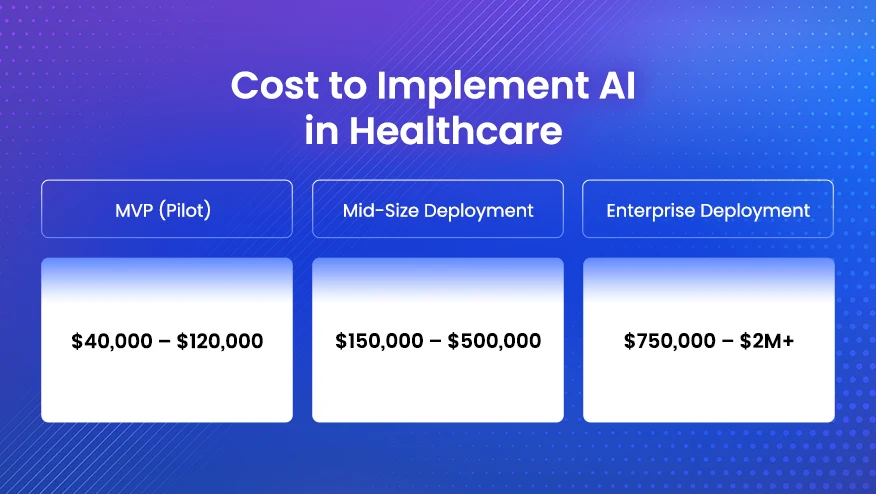
Estimated Cost by Deployment Level
| Deployment Level | Cost Range (USD) | Scope | Timeline |
|---|---|---|---|
| MVP (Pilot) | $40,000 – $120,000 | Single workflow or focused use case | 3–6 months |
| Mid-Size Deployment | $150,000 – $500,000 | Multi-department integration | 6–12 months |
| Enterprise Deployment | $750,000 – $2M+ | Multi-location, full-scale AI ecosystem | 12–24 months |
1. MVP AI Healthcare Implementation Costs
An MVP focuses on proof of concept, and not perfection.
Healthcare organizations use MVPs to validate a targeted case, such as discharge risk scores, claims automation, or triage prioritization. The dataset remains limited. Integration typically connects to one or two systems. Compliance checks remain controlled in scope.
Costs in this range usually include:
- Data prep and limited labeling
- Model development and validation
- Basic integration with EHR or billing system
- Initial security configuration
2. Mid-Size AI Implementation Costs
At this stage, AI interacts and affects the working of multiple departments. Predictive analytics may connect with discharge planning and care coordination. Additionally, automation can connect with billing and revenue cycle systems at the same time.
The cost of AI implementation in healthcare increases because data volume grows, integration becomes wider across systems, security layers become deeper, and user training becomes more structured.
This stage starts improving operations in measurable ways. Many hospitals expect to see a return on investment within the first year after implementation.
3. Healthcare Implementation Cost for Enterprise
In Enterprise, when implementing AI, it becomes a part of their core infrastructure. AI is incorporated into imaging, predictive analytics, automation, and remote monitoring in large hospital networks.
These projects require executive support and long-term planning. The cost of artificial intelligence in healthcare is not one fixed number. It depends on how big the deployment is and how ready the systems are. For this you need to choose a development partner for AI integration projects.
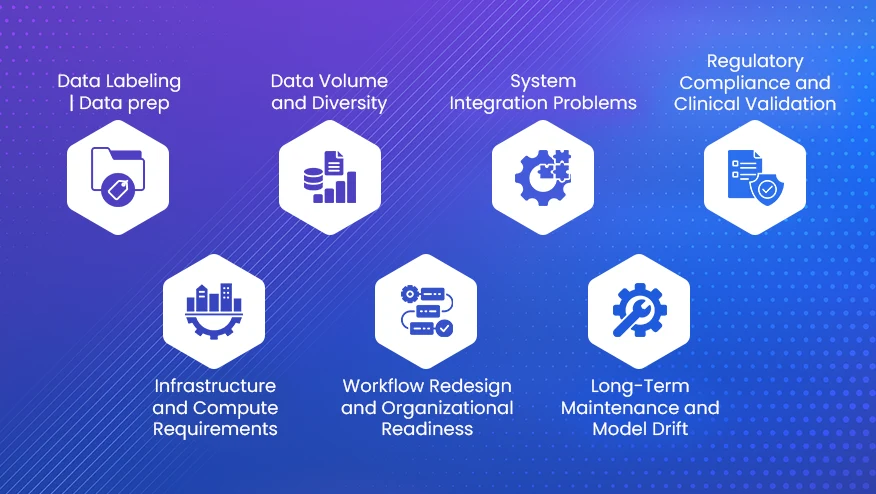
7 Key Factors That Influence AI Implementation Cost in Healthcare
Do not assume AI cost comes from building algorithms.
In healthcare, the real expense lies in prep, validation, and integration. The implementation model only represents a small portion of the total AI healthcare implementation cost.
Let’s examine the factors that materially raise the cost of implementing AI in healthcare.
1. Data Labeling | Data prep
Hospitals generate humongous volumes of data, but almost always, most of it is not machine-learning ready. Clinical notes contain inconsistencies, and images lack standardized annotations.
Before training begins, data must be:
- Thoroughly cleaned and normalized
- Structured consistently across
- Images annotated accurately
- Reviewed through quality control cycles
This stage often consumes 20–40% of the total project budget.
The Average cost of data labeling project healthcare institutions manage varies widely by modality. Structured datasets may require moderate investment. Radiology and pathology annotation significantly increases cost because clinicians must validate thousands of cases.
2. Data Volume and Diversity
Scale changes everything.
Small pilots require limited annotation and computation. Enterprise systems that analyze millions of records require large storage environments, GPU training capacity, and expanded validation cycles.
Data diversity also influences cost.
Performance improves with broader data, but cost rises accordingly. Leaders must balance precision, equity, and financial feasibility.
3. System Integration Problems
AI can only operate on top of the hospital infrastructure in place.
Integration typically involves:
- EHR
- PACS
- Laboratory data alignment
- Billing system synchronization
Each connection requires extensive API development, security validation, and testing; integration frequently represents 20–35% of the total AI healthcare implementation cost.
4. Regulatory Compliance and Clinical Validation
Healthcare AI has to operate under strict regulatory oversight.
Compliance to follow:
- HIPAA-based privacy controls
- Encryption frameworks
- Continuous Access monitoring
- Security audits
Compliance is not optional; it is structural. Organizations that delay compliance planning often face costly remediation later.
5. Infrastructure and Compute Requirements
AI systems require scalable computer environments.
Imaging and natural language models depend on GPU resources. Predictive analytics systems require stable cloud infrastructure and storage capacity.
Initial infrastructure estimates often underestimate inference cost and long-term data growth. As usage expands, cloud expenses scale.
Multi-year infrastructure forecasting protects financial predictability and prevents operational strain.
6. Workflow Redesign and Organizational Readiness
AI implementation changes how teams work.
Predictive alerts reshape discharge planning. Automation shifts billing responsibilities. Imaging prioritization alters radiology queues.
Adoption requires structured training, process mapping, and performance monitoring.
Without workflow alignment, utilization drops. Reduced utilization weakens ROI.
Budgeting must include change management rather than treating adoption as automatic.
7. Long-Term Maintenance and Model Drift
AI systems evolve with clinical environments.
Patient populations shift. Treatment guidelines change. Data patterns drift.
Models require periodic retraining and performance monitoring. Maintenance typically ranges from 10–20% of the initial development cost annually.
Treating the cost of AI implementation in healthcare as a one-time purchase leads to performance decay. Treating it as infrastructure preserves value.
Cost Breakdown of AI Implementation in Healthcare (Phase-Wise Cost)
We should not look at AI implementation as a single expense.
It is not a one-time invoice, but a structured investment that is spread across multiple stages. Each phase has its own risk profile, cost drivers, and operational involvement.
Capital and budgeting are often misallocated if the organizations fail to understand the phase-wise implications. They tend to overspend early, which leaves the maintenance underfunded.
Let’s break down the AI healthcare implementation cost by phases and understand what is involved in each of the stages.
Phase 1: Strategic Planning and Discovery (Approx 5–10% of Total Budget)
Discovery determines whether the AI project will be a success or not, making it very important in the process.
Key objectives of this phase include:
- Defining the business problem and understanding the pain points
- Establishing measurable and quantifiable KPIs
- Assessing the availability of data and its quality
- Identifying the regulatory requirements
Phase 2: Data Collection, Cleaning, and Labeling (20–40% of Total Budget)
This is the phase where cost starts to scale, so take note of this particular phase.
The data received from healthcare organizations is rarely received in a ready state for model training. It requires the silos of data from multiple systems, standard formats, and verification of quality of the data.
This phase includes:
- Data extraction from multiple sources, like EHR, PACS, and lab systems
- De-duplication and normalization of data
- Annotation and its labeling
- Quality control and its validation
- Data storage preparation
The average cost of data labeling project healthcare institutions undertake varies dramatically depending on use case complexity. Structured administrative datasets may require modest investment. Advanced imaging datasets may push labeling costs beyond $150,000 alone.
Phase 3: Model Development and Training (25–35% of Total Budget)
This is where AI starts to become operational.
Data scientists and engineers start to select algorithms, engineer the features required, start to train models, and begin to validate performance metrics. Regressive testing is done to ensure the accuracy threshold of the models.
Key activities include:
- Engineering the features
- Selection of Algorithms.
- Training and fine-tuning of hyperparameter
- Evaluation of performance
- Bias and fairness testing
Phase 4: Integration and Workflow Deployment (15–25% of Total Budget)
Integration determines real-world value.
AI systems must integrate into:
- EHRs
- Imaging workstations
- Billing systems
- Patient engagement platforms
This phase includes:
- API development
- Secure data exchange setup
- Workflow alignment
- User interface development
- Security penetration testing
Phase 5: Validation, Monitoring, & Performance Stabilization (5–10%)
At this phase, AI systems become stable.
At this point, the live data starts revealing edge cases that were missed during training. Monitoring frameworks track performance metrics, latency, and drift across systems.
This stage includes:
- Real-time monitoring setup
- Building Drift Detection Systems
- Organizing Performance Dashboards
- User feedback loops
Phase 6: Ongoing Maintenance & Optimization (10–20% Annually)
Clinical protocols usually evolve in certain windows. Patient demographics shifts. Data patterns change. Model drift becomes inevitable in all senses.
Maintenance includes:
- Periodic retraining from time to time
- Infrastructure scaling system-wide
- Security updates from time to time
- Feature list enhancement
Phase-Wise Cost Illustration
Considering a fairly mid-sized hospital implementing predictive analytics with a $500,000 total budget.
A realistic distribution will look like
- Discovery phase: $40,000
- Data prep and labeling: $160,000
- Model development: $150,000
- Integration and deployment: $110,000
- Stabilization and contingency: $40,000
AI Implementation Cost by Healthcare Solution Type
Not all AI solutions cost the same.
Two hospitals may both “implement AI,” yet one invests $120,000, and the other spends $1.5 million. The difference lies in the problem being solved, the data required, and the infrastructure needed to support it.
Healthcare AI costs vary significantly depending on solution type. Diagnostic systems differ from automation tools. Predictive analytics differ from remote monitoring. Each category carries distinct technical, regulatory, and operational demands.
Now let’s unpack each category.
1. Medical Imaging AI
Medical imaging AI is among the most expensive healthcare AI categories.
Why?
Because imaging data is complex, high-volume, and clinically sensitive.
These systems analyze:
- CT scans
- MRI images
- X-rays
- Ultrasound data
- Digital pathology slides
The primary cost driver is annotation.
Radiologists must label thousands of images. In some cases, pixel-level segmentation is required. That level of precision significantly increases the average cost of data labeling project healthcare institutions undertake.
Imaging AI may begin at $150,000 for limited triage functionality but can exceed $1 million for enterprise-scale, multi-modality systems.
However, these systems also deliver substantial ROI through faster diagnostics and improved throughput.
2. Predictive Analytics
Predictive analytics is mainly about spotting risk early.
Hospitals use it for things like readmission prediction, sepsis detection, chronic disease tracking, and even resource forecasting. Instead of reacting after something happens, these systems try to warn teams before it becomes serious.
Common use cases are:
- Re-admission predictions
- Advanced Sepsis risk detection
- Chronic disease progressions
- Resource utilization forecasting
EHR systems often store information in different formats, so historical data needs normalization. Unlike imaging AI, predictive analytics usually needs less GPU power but more system integration.
Most mid-range predictive systems cost between $150,000 and $400,000, depending on integration depth. ROI usually comes from reduced penalties and fewer avoidable admissions.
3. Hospital Workflow Automation
Workflow automation focuses on fixing administrative inefficiencies.
Common areas include:
- Claims processing
- Coding assistance
- Revenue cycle optimization
- Prior authorization
This category often shows the fastest ROI.
Why?
Because billing errors and manual reviews are easy to measure and reduce. Automation tools combine AI with RPA and connect directly with billing systems.
Costs usually range from $80,000 to $400,000, depending on scale. Many hospitals see savings within the first year by cutting manual review time.
4. Remote Patient Monitoring AI
Remote monitoring combines connected devices with predictive analytics.
It collects data from:
- Wearables
- Glucose monitors
- Cardiac devices
- Blood pressure systems
These systems work continuously, so infrastructure must support real-time data streaming. Security requirements are higher because patient-generated data needs encryption.
The cost of AI implementation in healthcare usually ranges from $120,000 to $700,000, depending on scale. These systems help reduce readmissions and improve chronic care management over time.
The Return on Investment of AI Implementation in Healthcare
Do not ask whether AI is innovative.
Ask whether it improves margins.
Healthcare organizations do not invest in AI because it is advanced technology. They invest because operational inefficiencies drain revenue every day. Administrative waste, preventable readmissions, delayed diagnostics, and manual review cycles quietly erode financial stability.
Let’s examine how ROI actually materializes.
1. Administrative Cost Reduction
One of the highest hidden costs in healthcare administration is overhead, which includes manual documentation, review of billing, authorization handling, and coding audits. This consumes thousands of staff hours annually. Even small inefficiencies spread throughout departments.
However, AI-driven automation can reduce:
- Manual claims review
- Errors in documentation
- Delays in processing
- Redundancy in data entry
Imagine a mid-size hospital that employs 15 billing specialists earning an average of $75,000 annually. The institution can easily save $225,000 in labor capacity each year if automation improves efficiency by just 20 percent.
This kind of administrative automation often delivers the fastest ROI amongst all AI solution categories.
2. Reduction in Readmission Penalties
Readmissions that can be avoided have quantifiable cost implications.
Before release, high-risk patients can be identified by predictive analytics tools. Care coordination teams can then plan follow-ups, intervene earlier, and take a more proactive approach in managing chronic illnesses.
For instance, a hospital that must pay $500,000 in readmission-related fines each year can save $200,000 by reducing that risk by 40%.
3. Gains in Throughput and Diagnostic Efficiency
Medical imaging AI helps in accelerating the prioritization of cases.
If imaging AI helps institutions reduce turnaround time by 25 percent, they will be able to:
- Reduce overtime expenses
- Increase their daily scan capacity.
- Improve patient satisfaction significantly.
- Prevent escalations of untreated conditions.
4. Revenue Cycle Optimization
Inefficiencies in the revenue cycle have a subtle impact on margins.
Denial of claims, coding inaccuracies, and delays in reimbursements can restrict cash flow.
Only as little as a 2–3 percent improvement in claim accuracy across a $200 million revenue base can translate into millions of dollars in improved revenue capture.
These gains easily outweigh the initial AI healthcare implementation cost within a short span of just two years.
5. Conservative Multi-Year ROI Model
Let’s try to model a realistic mid-size hospital deployment.
Let’s assume the Initial investment is $500,000 and the annual maintenance cost is $75,000.
The expected annual benefits are:
- $200,000 in administrative efficiency gain
- $250,000 from readmission penalty reduction
- $100,000 from improved revenue capture
The total annual benefit would approx $550,000
Year 1 benefit (assuming the adoption is 70 percent): $385,000
Year 2 benefit (Increased the adoption to 90%): $495,000
Year 3 benefit (a full adoption): $550,000
The cumulative benefit over three years would be $1.43 million
Total cost over three years would just be $725,000
Net three-year gain: $705,000
This projection uses conservative adoption assumptions. Faster adoption shortens the break-even timeline.
6. Risk-Adjusted ROI Considerations
The ROI projections must account for the following
- Total adoption rate
- Integration delays across systems
- Training costs for specific employees
- Model retraining cycles and durations
The cost of implementing AI in healthcare becomes justified only when the leadership can align financial goals with operational realities, and that’s what it’s all about.
What people need to see is that AI is not merely a technology upgrade; it is a financial performance strategy.
Hidden Costs of AI Implementation in Healthcare
People wrongly assume that AI cost ends at deployment. Let’s examine the most common hidden cost categories.
1. Model Drift Costs
Healthcare environments evolve constantly.
Patient demographics shift. Clinical guidelines update. Treatment protocols change. Data distributions drift over time.
When model inputs change, model performance declines.
2. Cybersecurity and Compliance Audits
AI systems expand the attack surface of healthcare infrastructure.
Security threats increase as more and more data flows through APIs, cloud systems, and monitoring dashboards.
3. Infrastructure Expansion
Initial infrastructure estimates often assume stable usage patterns, which isn’t always the case.
Organizations should always forecast multi-year infrastructure growth rather than relying solely on first-year projections.
Why Hidden Costs Matter
Hidden costs do not necessarily make AI expensive.
They make it predictable.
Organizations that incorporate hidden cost forecasting into initial planning maintain financial discipline. Those who ignore long-term operational expenses often view AI as more expensive than it actually is.
The cost of implementing AI in healthcare becomes manageable when leadership anticipates a full lifecycle investment.
AI is infrastructure, not a one-time tool.
Real-World Examples of AI Implementation Cost in Healthcare
Hospitals hesitate to invest in AI because projected costs appear abstract. Seeing structured financial examples helps leadership evaluate feasibility with confidence and inspire innovation like no other.
Below are two very realistic, financially grounded cases that reflect how AI healthcare implementation cost translates into measurable returns.
Example 1: Mayo Clinic – AI in Medical Imaging
The Mayo Clinic has implemented AI in radiology and cardiology imaging to improve diagnostic speed and accuracy. Their AI Center supports multiple imaging use cases, including stroke detection and cardiac MRI analysis.
Mayo has publicly discussed how AI helps:
- Prioritize urgent scans
- Improve detection accuracy
- Reduce diagnostic variability
- Support radiologists in decision-making
While exact implementation costs are not publicly disclosed (which is normal for hospitals), Mayo has confirmed that AI is embedded into imaging workflows at scale.
Example 2: Mount Sinai Health System – Predictive Analytics for Readmissions
Mount Sinai Health System (New York) implemented machine learning models to predict patient deterioration and readmission risks.
Their data science team developed predictive algorithms using EHR data to:
- Identify high-risk patients before discharge
- Enable earlier intervention
- Improve care coordination
Mount Sinai reported measurable improvements in identifying patients likely to deteriorate or return.
Conclusion
Healthcare systems lose money quietly through inefficiencies, delays, and preventable complications. Artificial intelligence addresses those losses proactively rather than reporting them after the fact.
The cost of implementing AI in healthcare depends on scope, integration depth, and data maturity. Projects range from focused pilots to enterprise-scale transformation. Data prep, compliance, and infrastructure drive most of the expense.
Organizations that align AI investment with high-impact workflows achieve measurable ROI within 18–36 months. Artificial intelligence in healthcare is not a luxury upgrade. It is a financial strategy for operational stability and long-term competitiveness.
FAQs
What is the difference in cost between off-the-shelf and custom AI solutions?
Off-the-shelf AI is ready-made software. You pay a yearly fee, usually between $20,000 and $100,000. It is cheaper at first, but not very flexible.
Custom AI costs more upfront because it is built for your hospital. However, it fits better and works more smoothly in the long run.
How does AI reduce costs in healthcare?
AI can save money in multiple ways, mostly by automating repetitive tasks and reducing mistakes.
It helps prevent readmissions, reduces billing errors, and improves workflow efficiency. Small improvements across departments lead to big savings over time.
How does AI benefit the healthcare industry?
AI helps doctors make faster and better decisions.
It improves diagnosis speed, tracks patient data automatically, and helps hospitals act before problems get worse. That means better care and stronger efficiency.
Get in Touch with
AI Experts
Kapil Kumar is a leading voice in the field of Artificial Intelligence, blending deep technical expertise with a passion for innovation and real-world impact. As an accomplished author, researcher, and AI practitioner, he brings clarity to complex technologies—making AI not only understandable, but actionable. Whether decoding algorithms or envisioning ethical frameworks for AI, he is committed to guiding professionals, students, and tech enthusiasts through the rapidly evolving world of artificial intelligence.