
How to Choose a Development Partner for AI Integration Projects? [2026 Updated]


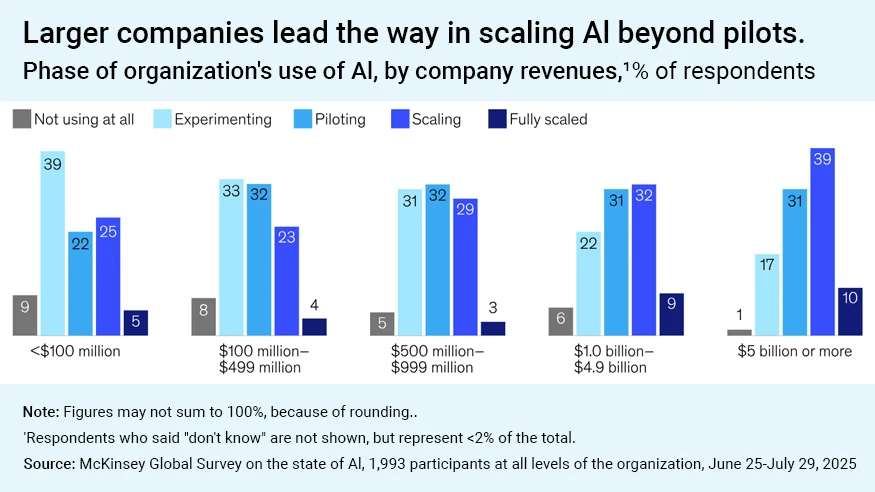
Businesses are investing in AI to enhance efficiency, decision-making, and productivity. Recent enterprise studies show that nearly 87% of big companies have deployed artificial intelligence in at least one function. At the beginning of 2026, 78% of businesses are already utilizing AI in at least one area of their operations.
However, most of those efforts never turn into real, measurable results. Research consistently finds that around 95% of AI initiatives fail to deliver meaningful business value. It’s not because the models are weak. Teams struggle because AI never gets properly embedded into real workflows.
Most organizations already have the tools and budget, but they don’t get the intended results because they lack the right development partner for AI integration projects. The firms need a partner that can help them connect AI with their existing systems like CRMs, ERPs, data warehouses, or other processes.
When a business is stuck with an inexperienced integration partner, its project pilot fails, costs rise, and security risks increase. That is why your choice of development partner matters more than the specific AI model you pick. A capable partner helps you connect AI to real business outcomes, lock down security and governance early, and make sure teams actually adopt the solution.
This blog explains how to choose a development partner for AI integration projects that can help you successfully implement the AI to get the intended results.
Why Choosing the Right AI Integration Partner Matters More Than the Technology
AI models are continuously evolving, which can alter your existing workflows, halting operations. The best integration partner has years of experience in integrating AI for business. Ultimately, they decide whether your AI project pilot will fail or succeed, irrespective of the model.
1. AI Success Depends on Business Outcomes, Not Demos
Strong AI integration partners don’t talk about vague abilities. They turn AI into specific KPIs like shorter handle times, faster underwriting, higher conversion rates, or less risk of fraud. They don’t celebrate a successful pilot that looks impressive but never produces desired outcomes. An AI integration partner sets a goal for success and reports on it. A pilot without a measurable KPI is only a demo.
2. See Integration as the Main Issue
Most AI projects fail where systems, teams, and data come together. The problem is not with the AI model but its integration. That’s why the right partner focuses on APIs, data flow, and legacy system limits. They focus on how AI works with your CRM, ERP, or data warehouse, along with choosing the right model. Without strong integration, even the best AI will end up isolated and unused.
3. Reduce Operational and Regulatory Risk
AI introduces real operational and regulatory risk because of poor access control, unclear audit trails, or black-box decisions. When regulations fail, legal, security, and compliance teams stop projects long before users do.
Strong partners build security, privacy, and governance into the system from the start. They plan for auditability, access control, and the option for human intervention before an AI project goes live. This approach reduces late-stage delays, rework, and compliance-related roadblocks.
4. Drive Real Adoption, Inside Teams
AI only delivers value when teams trust the system and understand how it fits into their daily work. The best partner ensures that AI integration doesn’t change your existing workflow, instead of forcing the team to change the way they operate. As a result, teams adopt AI as a key part of their workflow. Best-in-class partners anticipate issues and proactively prepare solutions to those issues.
5. Help You Evolve After Launch
AI systems lose value when they are not regularly monitored and updated. Good partners prepare for training, monitor success, and update their future roadmaps every 12 to 24 months. They have systems that adapt as data, behavior, and regulations change. This mindset keeps your system relevant after the initial launch.
How to Find a Development Partner for AI Integration Projects? [2026 Checklist]
Picking the right partner starts long before vendor demos or pricing calls. Teams that rush this stage usually pay for it later through stalled pilots, rework, or quiet abandonment. This checklist reflects what works in real programs, not idealized sales cycles.
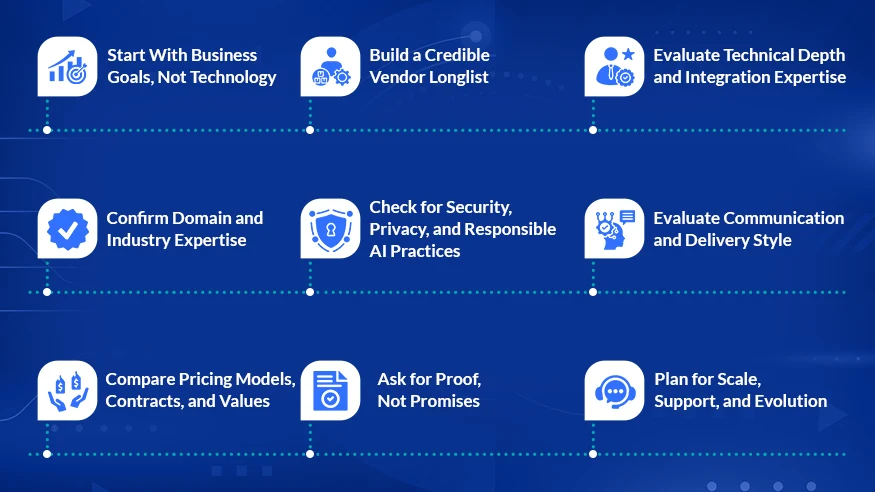
1. Start With Business Goals, Not Technology
Before evaluating vendors, it is critical to establish a clear intent for using AI. Many businesses adopt AI technology when a more straightforward process could solve the same issue, resulting in wasted time and stalled pilots. The first step is to determine your primary objective of using AI, such as reducing costs, increasing revenue, improving efficiency, or managing risk.
Once you have identified your intent, the next task is to understand three to five primary use cases and how AI will be integrated with existing infrastructure. Understand what the data will be used for and how it will flow. At this point, write down your boundaries on compliance related to data residency, gaps in internal capabilities, budget limitations, and time frame.
2. Build a Credible Vendor Longlist
To identify AI development and integration service providers, take help from the neutral sites, such as Clutch, G2, LinkedIn, and other industry analyst reports. Compare and evaluate the vendors that you have found based solely on their development and integration capabilities, such as API, middleware, MLOps, DevOps, and data pipelines.
While choosing a partner, begin with consultation of networks, partnerships within the ecosystem, and prior successes. Doing so greatly simplifies the task of finding a partner for your business. In 2026, companies like The NineHertz, Azilen Technologies, and OpenXcell have a significant amount of experience in the area of AI integration across different industries.
3. Evaluate Technical Depth and Integration Expertise
This is where real AI integration partners stand out from simple AI development companies in USA. Many vendors can take an existing model or provide a proof-of-concept chatbot, but only a few can provide production-grade systems to handle complex problems.
You should evaluate a vendor’s capabilities in the following areas:
- Core AI: The vendor must possess a thorough understanding of machine learning, deep learning, LLMs (large language models), frameworks, etc. They should be able to do more than just wrap third-party APIs.
- Integration engineering: A partner should excel at working with APIs, microservices, event-driven applications, integration of legacy systems, and the ability to change data in more complex ways.
- MLOps/lifecycle management: A vendor should follow industry best practices for versioning, CI/CD, monitoring, retraining, rollback, and infrastructure as code.
4. Confirm Domain and Industry Expertise
Find a partner who is knowledgeable in your industry and domain to help minimize non-compliance errors and mitigate risk during implementation. For example, if you were to partner with a vendor in the healthcare industry, they would be familiar with HIPAA regulations, the HL7 standard, and clinical vocabulary. Likewise, if you were working with a vendor that provides services related to finance, they would understand the applicable laws governing anti-money laundering, Basel III, and the process for reconciling trades.
Look for partners who are familiar with the success metrics or standards of your industry and the associated compliance regulations. If the vendor demonstrates their experience by asking questions regarding your organization’s challenges, they likely possess substantial expertise. This way, they develop a custom solution based on your organization’s specific requirements rather than offering a one-size-fits-all approach.
5. Check for Security, Privacy, and Responsible AI Practices
Some of the greatest obstacles faced by organizations are the limited availability of high-quality data and varying degrees of technical maturity. However, security and compliance difficulties are some of the biggest problems.
Investigate how often your potential partners perform penetration testing, store and transmit encrypted data, use role-based access control, and audit logs. Determine if their data security practices comply with applicable laws, such as GDPR, HIPAA, SOC 2, ISO 27001, PCI-DSS, etc.
Also, examine their views on responsible AI, such as model bias, explainability, human governance, and oversight with respect to significant decisions.
6. Evaluate Communication and Delivery Style
Poor communication and unclear roles are always at the top of the list of reasons why AI projects fail. If the vendor can’t work with your stakeholders, respond to feedback, or escalate problems in the right way, their technical skills don’t matter.
Investigate the way your partners work: do they follow an agile process with regular demo presentations or a waterfall approach with longer feedback cycles? What processes do they use to align business and technical stakeholders?
In addition, consider their practical operational issues, including
- How do they communicate? (E-mail, Slack, Microsoft Teams)
- What project management tools do they use? (Jira, Asana, Trello)
- How often do they communicate with you?
- How much overlap do they have with your time zone?
- Do you have a dedicated product owner on the project?
7. Compare Pricing Models, Contracts, and Values
AI integration project pricing varies depending on the type of project and level of scope defined. Many partners work on variable and fixed prices.
Each approach has advantages and disadvantages. A fixed price provides clarity on how much it will cost up front but could raise the price if your requirements change later in the process. On the other hand, time-and-materials agreements allow for greater flexibility but also require more hands-on involvement in overseeing the project.
Take into account the total cost of ownership for the full project lifecycle, including initial development, hosting (cloud services), ongoing maintenance and support, retraining models, and future enhancements.
8. Ask for Proof, Not Promises
When reading vendor case studies, look for measurable results like higher sales, shorter handling times, better accuracy, and lower costs. A rough estimate like “30%-40% reduction” would give a meaningful indication of success from the project to date.
A structured proof-of-concept (PoC) helps you understand what is technically feasible, the risk of integration failure, and the scope of collaboration. This should take place in a period of 6 to 8 weeks. Define specific success goals ahead of time, such as
- How accurate will we need to be?
- What are the key milestones for complete integration?
- What are the key performance benchmarks?
9. Plan for Scale, Support, and Evolution
As AI models and associated data continue to evolve, they must also be monitored, retrained, and optimized on an ongoing basis. A “build it and leave it” mentality will be detrimental to your operations within a short time frame.
When evaluating potential providers, ensure that they are able to provide ongoing support (after the first deployment) as soon as your AI solution becomes operational (e.g. observability dashboards, alerts for model drift or data quality issues, retraining schedules, and increased capacity to handle increased volume).
Talk about how they handle knowledge transfer, such as code repositories, runbooks, and documentation standards, so you don’t have to stay with one vendor forever. Agree on how the roadmap will develop over time, such as by having quarterly planning sessions to decide which new features to add, how to add more use cases, and how to respond to changes in regulations or company goals.
Mistakes to Avoid While Looking for a Perfect AI Partner
Most AI partnerships don’t end in a big way. They steadily disappear because teams make the same mistakes when choosing partners.
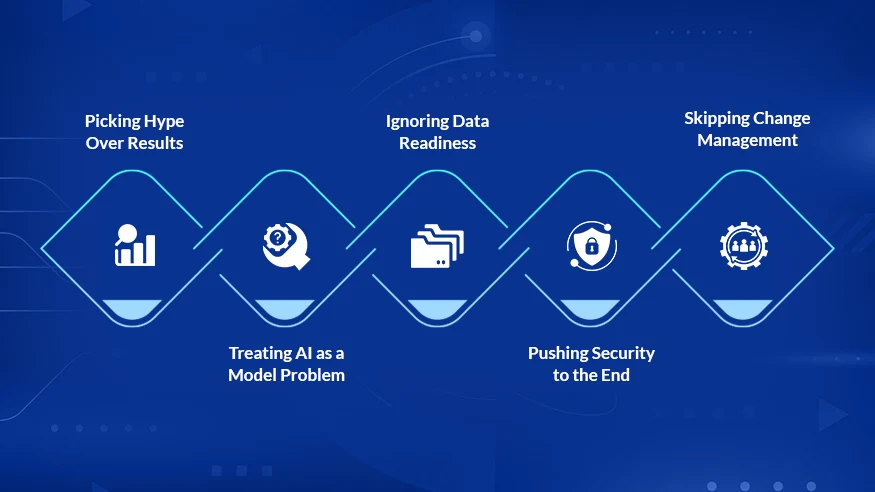
Mistake 1: Picking Hype Over Results
Demos, buzzwords, and big-name models impress teams, but then they realize that no one has articulated what success in business really means. The end result is AI that looks good but doesn’t change any of the metrics that leaders care about.
Instead of talking about technology right away, encourage each partner to link their solution to one or two specific business KPIs.
Mistake 2: Treating AI as a Model Problem
The approach works on its own, but it doesn’t integrate well with CRM, ERP, or operational workflows. AI stays stuck in pilots because people didn’t pay attention to systems and processes.
Instead, look at partners mostly based on how well they can integrate, how well they know the system, and how much experience they have with data plumbing.
Mistake 3: Ignoring Data Readiness
Bad data quietly ruins AI projects by being inconsistent, having flaws, and not being explicit about who owns it. People criticize the model, but the actual problem is upstream in pipes and governance.
Instead, make sure the data is ready and any gaps are found before any major AI creation starts.
Mistake 4: Pushing Security to the End
If security reviews enter after concerns arise, you will have excessive rework, delays, and shutdowns of the project. Legal teams will develop a loss of trust in you.
Begin by treating security, access control, auditability, and AI ethics as architectural requirements from day one.
Mistake 5: Skipping Change Management
AI features are released, but workers don’t use them because the workflows weren’t changed or explained. Even if the technology works, usage stays modest.
Instead, ask for plans for UX, training, and redesigning workflows together with the delivery of models and systems.
Final Thoughts
AI will keep getting faster, cheaper, and easier to access. Teams that win with AI focus less on chasing models and more on building systems that work inside real businesses.
The biggest difference between success and quiet failure usually comes down to execution. Strong teams choose a development partner for AI integration projects who understands workflows, constraints, data, and people. They plan for governance, design for adoption, and think beyond the pilot.
Once you stop treating AI as a one-off experiment, the conversation changes. AI becomes a repeatable capability instead of a risky bet. The right partner helps you connect technology to outcomes and keeps that connection intact as your business evolves.
Use this guide as a working framework. Ask tougher questions. Push for proof. Revisit it before signing contracts or committing budgets. A thoughtful choice now will shape how AI supports your systems, teams, and decisions for years to come.
Frequently Asked Questions (FAQs)
What makes an AI development service provider reliable?
A reliable AI development service provider delivers systems that teams actually use, not just pilots that look good in demos. They link every AI initiative to a clear business metric from the start, such as cost reduction, revenue lift, or risk control. Governance, security, and privacy show up as design requirements, not last-minute add-ons. Most importantly, past clients are willing to share honest feedback about what worked and what didn’t.
How do you choose the right AI development company for your business?
First, identify how AI will impact your business and how you track the success of the AI. Make a list of potential partners that are knowledgeable in integrating AI into business environments, secure with the information in your company’s software, and have an in-depth knowledge of your business. Prior to making a long-term commitment, ensure that the partner is compatible with your business by going through both a discovery and a pilot phase.
Get in Touch with
AI Experts
Kapil Kumar is a leading voice in the field of Artificial Intelligence, blending deep technical expertise with a passion for innovation and real-world impact. As an accomplished author, researcher, and AI practitioner, he brings clarity to complex technologies—making AI not only understandable, but actionable. Whether decoding algorithms or envisioning ethical frameworks for AI, he is committed to guiding professionals, students, and tech enthusiasts through the rapidly evolving world of artificial intelligence.