
Nvidia to Acquire AI Chip Startup Groq’s Assets in Record $20 Billion Deal

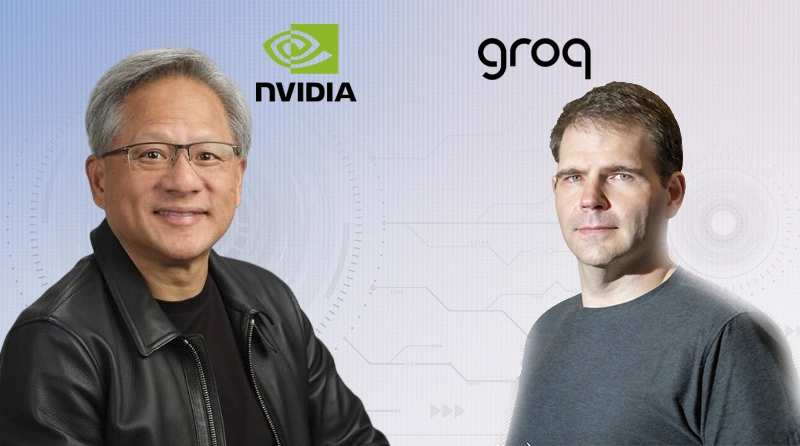
Nvidia is acquiring the assets of Groq, a designer of high-performance AI Chip Startup, for $20 billion in cash, as reported by Alex Davis, CEO of Disruptive, the lead investor in the startup’s last round in September.
Davis, whose company has spent over half a billion dollars on Groq since its inception in 2016, said the deal was made in haste. Three months ago, Groq raised $750 million at a valuation worth approximately $6.9 billion. Other round investors were BlackRock and Neuberger Berman, Samsung, Cisco, Altimeter, and 1789 Capital, where Donald Trump Jr. is a partner.
In a blog post on Wednesday, Groq announced that it has entered into a non-exclusive licensing deal with Nvidia on the inference technology of Groq, but it did not specify a price. In the transaction, the founder and CEO of Groq, Jonathan Ross, and Sunny Madra, the president of the company, and other key executives will be part of Nvidia in order to further develop and expand the licensed technology, the post asserted.
Groq further stated that it would remain an independent company with Simon Edwards, who is the finance chief, as CEO.
Colette Kress, the Nvidia CFO, refused to comment on the deal.
According to Davis, Nvidia is acquiring all the assets of Groq but none of the nascent Groq cloud business. Groq wrote, “GroqCloud will not cease its operation.
The acquisition is, by far, the biggest Nvidia has ever made. The company made the largest acquisition in its history in 2019, acquiring Israeli chip designer Mellanox for nearly seven billion dollars. Towards the close of October, Nvidia possesses cash and short-term investments of 60.6 billion, as compared to 13.3 billion early in 2023.
In an email to the workers that CNBC obtained, Nvidia CEO Jensen Huang stated that the deal will increase the capabilities of Nvidia.
Huang wrote that the company would incorporate Groq processors with low latency in the NVIDIA AI factory architecture and expand it to support an even greater variety of AI inference and real-time workloads.
Huang said, As we continue to add talent to our ranks and license the IP of Groq, we are not buying Groq as a company.
The Nvidia deal had an analogous but smaller one in September, when the company paid more than 900 million to acquire Enfabrica CEO Rochan Sankar and other staff and to obtain the technology of the AI hardware company, CNBC reported then.
Other tech giants, which include Meta, Google, and Microsoft, have spent a lot of money in the past two years to acquire some of the top AI talent in a number of forms of licensing agreements.
As its cash hoard has grown, Nvidia has followed through with its increase in investments in chip startups and the ecosystem in general. The firm has invested in AI and energy infrastructure corporation Crusoe, AI model developer Cohere, and increased its investment in CoreWeave. As the AI-based cloud provider was preparing to initial public offering this year.
In September, Nvidia announced that it would make up to $100 billion investments in OpenAI, with the startup pledging to operate at least 10 gigawatts of Nvidia product usage. The firms are yet to declare a formal transaction. Later the same month, Nvidia indicated that it would invest in Intel to the tune of $5 billion.
as part of a partnership.
Groq has been pursuing revenue of $500 million this year, with the booming demand of AI accelerator chips being used in accelerating the process of large language models to accomplish inference-related tasks. When Nvidia approached the company about acquiring it, Davis said that it was not seeking a sale.
In 2016, Ross and a team of other former engineers established Groq. He helped to design Google’s own processor, known as the tensor processing unit, or TPU, the search giant’s own chip, which is finding applications by certain companies in place of Nvidia graphics processing units.
During its first SEC filing, when it announced a $10.3 million fundraising in late 2016, Groq named as principals Ross and Douglas Wightman, an entrepreneur and former Google X employee in the Google X moonshot factory. Wightman was also an employee of Groq until 2019, according to his LinkedIn profile.
Groq is not the only chip company to have become popular over the AI boom.
Cerebras Systems, a developer of AI chips, was set to have an IPO this year before cancelling the filing in October, informing it that it had raised more than $1 billion in a funding round.
Cerebras has not indicated that it plans to undertake a proposed offering as of now in a filing with the SEC, though it did not justify it. At the time, a spokesperson of the company told CNBC that the company still hopes to go public as soon as possible.
In late 2024, Cerebras announced an IPO, as it was preparing to compete with Nvidia in an attempt to develop processors to execute generative AI models.