

15+ Best AI Security Certifications in 2026


Did you know- 97% share of organizations have reported AI-related security incidents? The key reason is ignorance of the security protocols. Undoubtedly, implementation requires expertise, and that comes from AI security certifications.
Now, the question is, why does this happen? There is a rapid adoption of artificial intelligence across industries such as healthcare, finance, government, SaaS, and e-commerce. AI completely supports innovation, and enables businesses to better resource optimization, automating repetitive tasks, and reducing overheads. However, it also introduces some critical risks that conventional cybersecurity systems fail to handle.
As companies rely more on AI, security risks start showing up in practical ways. Training data can be altered without notice, which leads models to behave in unexpected ways. Some attacks do not break systems directly but quietly push AI to make wrong calls.
Sometimes an AI model works like a “Black Box,” as there is no explanation why a decision was made. This creates trust and audit problems, especially in regulated sectors. The compliance rules are tightening; on the other hand, there is a shortage of qualified and experienced AI security professionals.
According to McKinsey’s 2025 survey, 88% of organizations use AI in at least one function, up from 78% in 2024. Healthcare AI spending hit $1.4 billion in 2025 Menlo Ventures. 84% of business leaders accepted that cybersecurity risks are their top concern while adopting AI for business.
Supporting this, there is a famous quote from Adam Fletcher(CSO, Blackstone)- “AI is accelerating both cyber threats and regulatory responses. Policymakers are scrambling to put guardrails in place, but the pace of innovation is making it harder than ever to keep up.”
Therefore, businesses need future-ready workers to mitigate cyber risks. AI security certification programs help experts build secure, trustworthy, and compliant AI systems.
This blog discusses 15+ best Artificial Intelligence security certifications programs of 2026. Here are some of the best choices you can make to advance your career or prepare your workforce to implement cybersecurity systems while adopting AI.
Why AI Security Certifications Matters in 2026
AI is no longer an experiment for most businesses. It runs customer support, pricing, risk scoring, fraud checks, and even hiring tools. When something goes wrong, the impact is immediate and visible. That is why AI security certifications matter more in 2026 than they did even a year ago.
Traditional cybersecurity skills are not enough for AI systems. As there are some potential threats that exist in 2026, such as:
- AI-enhanced Phishing (personalized AI generates fake emails)
- Data Poisoning & Model Tampering (poisoning or manipulating training data to cause incorrect decisions or biases)
- Voice Cloning(cloning of voice for money-related cyberattacks)
- Deepfake Fraud(creating images or videos with malicious intent that look original but are not).
- Shadow AI & Data Leakage(use of unauthorized AI tools that leak sensitive data).
- Polymorphic Malware (malware that manipulates the code to evade detection).
Because of these threats, professionals need to understand how models are trained, how data can be misused, and how attackers target AI logic instead of servers. AI security certification programs help fill this gap with practical knowledge.
For business leaders, certified professionals reduce risk. They help teams design AI systems that are safer from the start, easier to audit, and easier to defend during compliance reviews.
For professionals, the best AI security certification signals real capability. It shows you understand both AI behavior and security controls, not just theory. In a market with limited AI security talent, certification helps you stand out for the right reasons.
Key Skills Covered in Artificial Intelligence Security Certification
The best part about AI security certifications is that once the course is completed, the professionals achieve the skills to protect the AI systems from emerging threats. Instead of theory, the AI/ML certification programs focus on practical skills.
Therefore, the key skills covered in the Artificial Intelligence security certification are:
- How AI Models Fail in Real Environments
Understanding how data poisoning, model manipulation, and adversarial inputs affect outputs, and how to spot early warning signs.
- Data Security
Learning where AI data leaks happen, how data gets misused, and how to apply basic controls that reduce exposure and misuse.
- Risk Assessment for AI Systems
Knowing how to evaluate AI features from a security and business risk point of view, not just a technical one.
- Explaining AI decisions
Gaining the ability to document how models work, why decisions were made, and how to answer questions during audits or disputes.
- AI Governance and Compliance Basics
The core is understanding what regulators expect, how to align AI systems with internal policies, and how to avoid compliance gaps.
- Working Across Teams
Learning how to address AI risks clearly to product, legal, and leadership teams without technical overload.
- Machine Learning for Security
How to use machine learning for threat, anomalies, and vulnerability detection to build AI-powered secure systems.
- Generative AI Security
It covers how to secure LLMs, prompt injection prevention, jailbreaking, and prevention from data biasing for model training.
Also Read: AI Product Management Courses
Top Artificial Intelligence Security Certification in 2026
Till now, you must have gotten the important details on why AI security certification programs are crucial and what skills you gain. Now, let’s explore 15+ best Artificial Intelligence security certifications programs in 2026. While accessing the list, you’ll read details like course description, key takeaways, and best for.
Let’s start with the list.
#1. Certified AI Security Professional- Practical DevSecOps
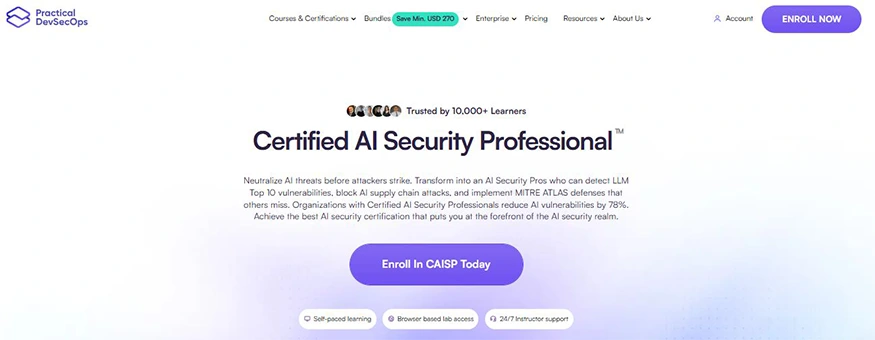
Image Credit: practical-devsecops
CAISP is one of the best AI security certifications available for professionals who are looking for career prospects in the field of cybersecurity for AI systems. The course starts with the basic intro, then step-wise leads to the advanced topics with a deeper understanding. Course modules cover 7 chapters and a practical DevSecOps certification process.
Key Takeaways:
- Deep understanding of AI security basics
- Understanding and attacking LLMs such as GPT & BERT, MITRE ATT&CK, ATLAS framework.
- Identification of OWASP Top 10 LLM vulnerabilities.
- AI attack analysis and defence using DevOps
- Supply Chain Attacks in AI
- Threat Modeling AI Systems and more.
Ideal Learners: Cybersecurity Professionals, DevOps/DevSecOps Practitioners, Security Engineers, and others.
#2. IBM Generative AI for Cybersecurity Professionals Specialization
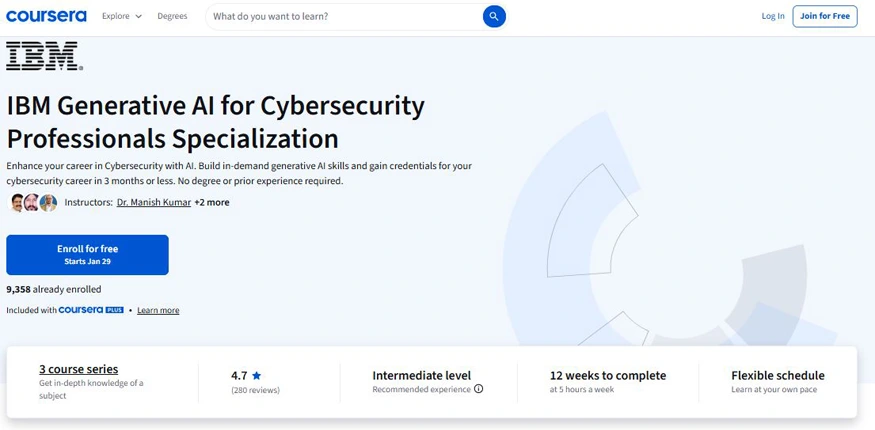
Image Credit: Coursera
If you are looking for an intermediate-level AI cybersecurity course, this IBM course can be a great choice. It explains how generative AI shows up in real security work today, along with how security teams use AI tools to review alerts, analyze logs, and speed up investigations.
It also explains where these tools fail and where they add risk. The focus stays on usage, not model building. You learn what generative AI can help with, what it cannot, and why blind trust is risky. The course keeps the scope practical and avoids heavy theory.
Key Takeaways:
- How generative AI is used in daily security operations
- Identification of appropriate Gen AI models and tools for cybersecurity
- Generative AI prompt engineering concepts for cybersecurity
- Applications of GenAI techniques to real-world cybersecurity scenarios
- Threat modeling, context management, incident management, and others
- Safe and responsible use of AI in security teams
Ideal For: Security analysts, engineers, and individuals interested in a cybersecurity career using prompt engineering.
#3. AI Security- INFOSEC
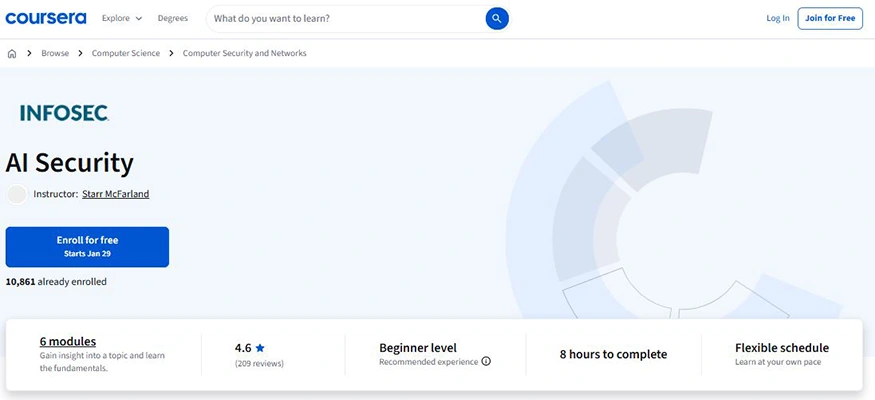
Image Credit: Coursera
This course is for individuals who want to learn more about AI rules and laws, or are in legal roles, and want to learn technical aspects of AI for security. By the end of this course, you will have a deep knowledge of AI, its use cases, and the situations where you can apply it effectively.
The AI Security course talks about different kinds of AI, machine learning, the AI development lifecycle, AI governance and risk management, and the current and changing laws that affect AI. It has 6 modules that cover crucial topics in detail, such as AI fundamentals, Responsible AI, emerging laws, AI security, and more.
Key Takeaways:
- How common AI systems are structured and where risks appear
- What governance and risk management mean for AI in business
- How privacy and compliance affect the use of AI systems
- Basics of legal frameworks and emerging laws on AI use
- Ways to talk about risks and controls with non-tech teams
- Understanding responsible and ethical practices for AI deployment
Ideal For: Individuals in technical roles, legal professionals, security managers, business managers, and others.
#4. ISACA Advanced in AI Security Management
AAISM is one of the top AI security certification programs available online for global professionals. It is one of its own AI-centric security management certifications made to help seasoned IT professionals to strengthen the security of the company and defend against threats that are unique to AI. After course completion, as an expert, you’ll be able to handle evolving security risks with AI, AI security policy implementation, use of responsible AI across the system, and organization.
Key Takeaways:
- Identification, assessment, monitoring, and risk mitigation
- How AI changes audit and risk assessment processes
- Identifying control gaps in AI-driven systems
- Managing AI risk at an organisational level
- Understanding governance responsibilities for AI use
- Aligning AI practices with existing security frameworks
Ideal For: Auditors, risk managers, security managers, and compliance professionals
#5. Certified AI Security Fundamentals
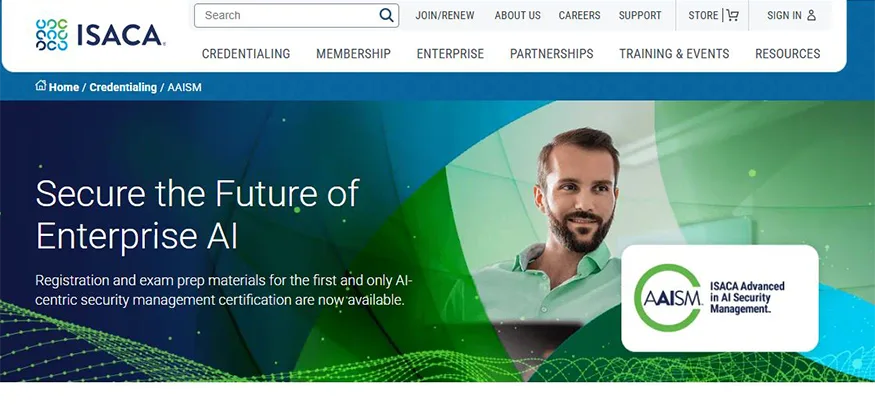
Image credit: isaca.org
The CAISF is the best AI security certification program that focuses on comprehensive training in the critical domain of AI security. Through the course, the participants will learn how to safeguard data and AI systems against potential threats. Tonex’s Certified AI Security Fundamentals certification course is for the proficiency level of intermediate and is an online, instructor-led program.
Key Takeaways:
- Basic understanding of how AI systems operate
- Common security risks linked to AI and machine learning
- How poor data handling affects AI outcomes
- Where traditional security controls fall short with AI
- Core ideas behind AI risk and protection
- Foundation knowledge for further AI security learning
Ideal For: IT professionals, cybersecurity specialists, AI developers, and teams integrating AI, with no prerequisites required.
#6. AI Security Fundamentals – Microsoft
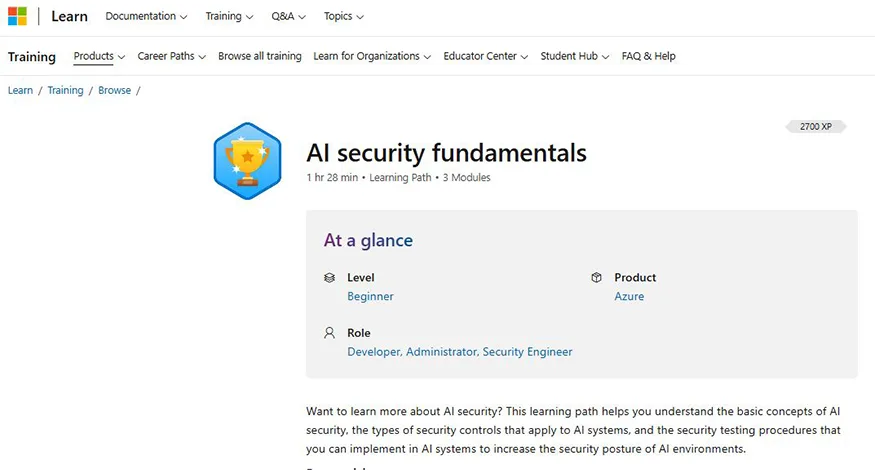
Image Credit: Microsoft
There is a multitude of AI security certification programs available online. Still, if you’re looking for one that can help you learn AI security basics in detail, this program is for you. The course is designed and developed by experienced cybersecurity experts from Microsoft. While accessing the program, you’ll learn about the types of security controls that apply to AI systems, security testing procedures, AI jailbreaking, AI prompt injection, model manipulation, and more.
Key Takeaways:
- Basic security risks linked to AI workloads
- Protecting data used by AI systems
- Managing access and identity around AI services
- Understanding shared responsibility in cloud-based AI
- Applying security controls without slowing teams
- Building security awareness around AI use
Ideal For: AI developers, system administrators, and security engineers
#7. Building AI Strategy Certificate- ICS2
ICS2 is one of the leading nonprofit member organizations for cybersecurity professionals. The organization offers a program called Building AI strategy, which is a self-paced program that helps cybersecurity professionals adopt AI in their organization. This course is an entry point into AI security. It explains how AI systems work at a basic level and where security issues usually appear.
The focus stays on fundamentals, not advanced attacks or deep technical work. You learn how data, models, and AI workflows can introduce risk if they are not handled carefully.
Key Takeaways:
- AI foundation and cybersecurity applications of AI
- Avoidance of overconfidence in AI security
- Global AI regulations understanding
- Secure by design AI planning
- Leadership considerations and strategies for adapting AI
- Core ideas behind AI risk and protection
Ideal For: Cybersecurity professionals, CISSP holders, Teams exploring AI tools, and others.
#8. AI Security Essentials for Business Leaders- SANS Org
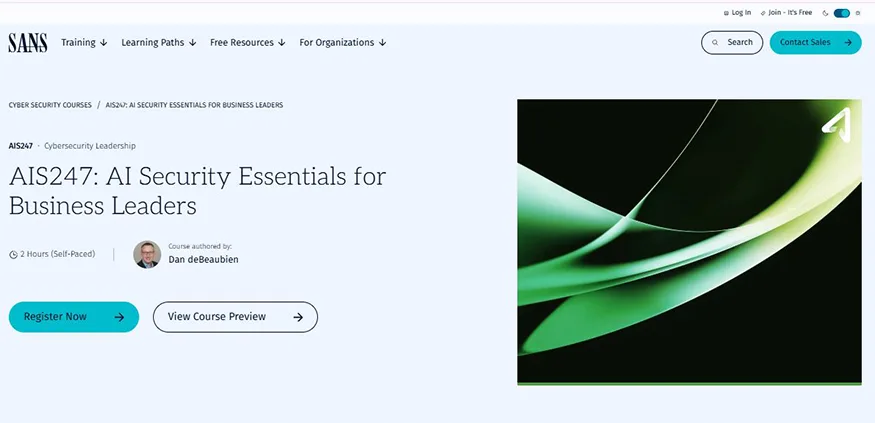
Image Credit: sans.org
This is a short online course for business leaders. It provides a basic view of AI in the context of risk, security, and governance. While accessing this AI security essential course by SANS org, the leaders and executives will gain essential knowledge to understand, oversee, and govern AI adoption. As a learner, you will gain insight into generative AI, AI literacy, technology trends, risk management frameworks, policy governance, and real-world security threats.
Key Takeaways:
- Common AI tools and terminology in today’s business
- Working of Generative AI models, risks and limitations
- Recognition and elimination of threats like deepfakes
- How to build basic policies that align with emerging rules
- How risk frameworks like NIST AI RMF support governance
- Steps to assess organisational AI maturity and priorities
Ideal For: Business leaders, security managers, risk and compliance professionals
#9. AI Security and Risk Management- DataCamp
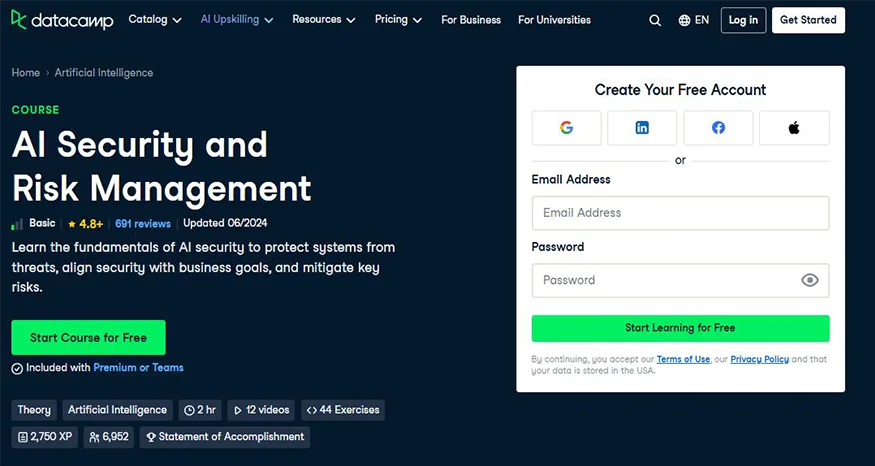
Image Credit: Datacamp
This is the basic level course. But, its offerings are valuable for professionals who seek to learn the fundamentals of AI security, threat elimination, risk mitigation, and apply cybersecurity aligned to the business needs.
This course is ideal for people who want to learn more about AI security, and they can make better decisions about how to protect their organisation. Here you’ll also learn how to make sure that your company’s AI security efforts are aligned with its goals. Also, real-life examples of how AI security can help with business strategies, and more.
Key Takeaways:
- Awareness of security risks with AI systems
- Enhancing security operations with AI
- Secure AI development
- Effective risk assessment steps
- Strategic integration of AI security
- The EU AI Act and compliance knowledge
Ideal For: Beginners, IT and security staff, risk and compliance teams, and business leaders.
#10. Certification In Generative AI In Cybersecurity- GSDC
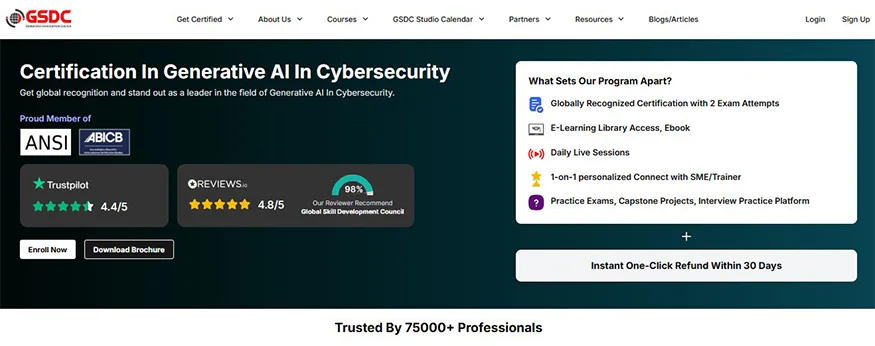
Image Credit: gsdcouncil.org
Generative AI has applications across diverse fields. It also has applications in cybersecurity and helps professionals to enhance system security using AI models. This program teaches how generative AI is used in cybersecurity. It focuses on practical tasks like detecting threats, analysing malware, and automating security checks with generative models.
Learners also explore ethical issues and how to use these tools safely. The course offers live sessions, practice exams, and a capstone project. The professionals can earn a certificate after attempting a certification exam at the end.
Key Takeaways:
- Threat detection and response by GenAI models
- Applications of AI to security tasks like anomaly spotting
- Ways to use AI tools without introducing new risks
- Ethical factors in AI security
- Hands-on practice with labs and projects
- Certification exam with practice tests
Ideal For: Chief technical officers, change practitioners, service architects, cybersecurity analysts, and others.
#11. AI Security & Governance – Securiti Education
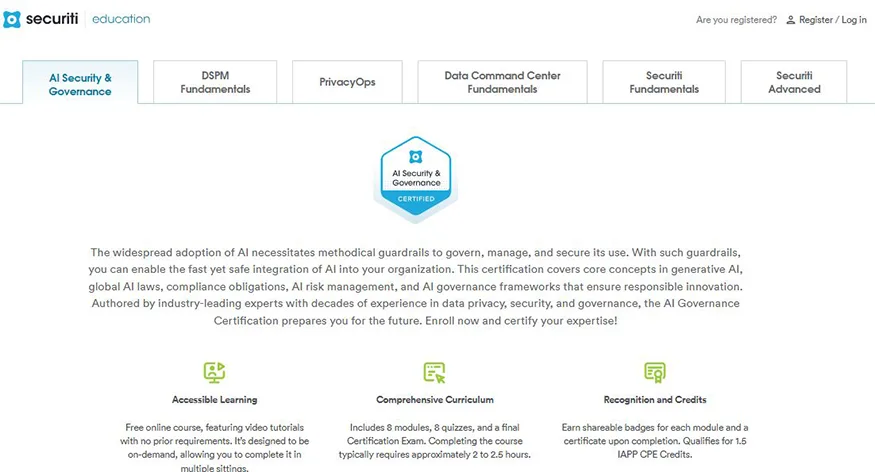
Image Credit: Securiti Education
With the increasing adoption of AI, cyberthreats are also increasing. Thus, security and governance are a must. This AI security and governance course by Securiti Inc comprehensively covers all aspects. The syllabus includes crucial concepts in generative AI, global AI laws, compliance obligations, AI risk management, and AI governance frameworks.
The course is designed by the industry-leading experts with experience in data privacy, security, and governance. There are 8 modules, 8 quizzes, and a final certification exam that prepare professionals for the future.
Key Takeaways:
- Fundamentals of AI and GenAI
- Basics of AI Governance
- Identification and documentation of AI models inside an organisation.
- Risks assesment associated with AI usage and data flows.
- Global rules and compliance obligations must follow
- How to build governance practices that support business and legal goals..
Ideal For: Security & compliance teams, risk and compliance professionals, business leaders, and managers.
#12. Artificial Intelligence Governance Professional
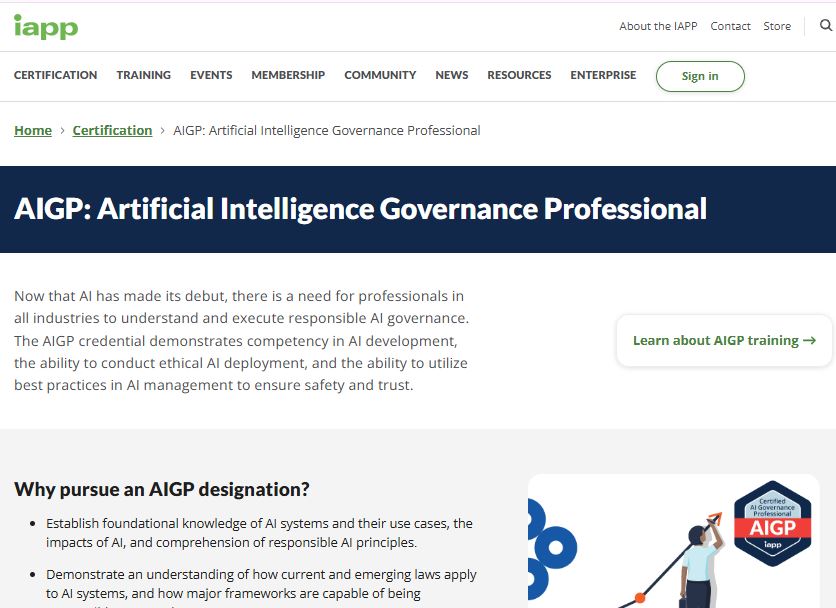
Image Credit: iapp.org
The Artificial Intelligence Governance Professional (AIGP) certification shows you understand how to manage and govern AI within a business. It focuses on real responsibilities such as risk, ethics, laws, and controls for AI systems. You learn the life cycle of AI, how to spot governance gaps, and how to apply global standards and regulations. The credential is issued after an exam that tests these core competencies.
Key Takeaways:
- Baseline knowledge of AI governance and responsible principles
- How current and emerging laws apply to AI systems
- How to manage AI risk within organisations
- Ways to align AI practices with frameworks and standards
- What governance and oversight look like in practice
- How to document and report on AI governance work
Ideal For: Security leaders, risk and compliance professionals, legal teams, and privacy officers.
#13. Advanced in AI Audit(AAIA) Certification- ISACA
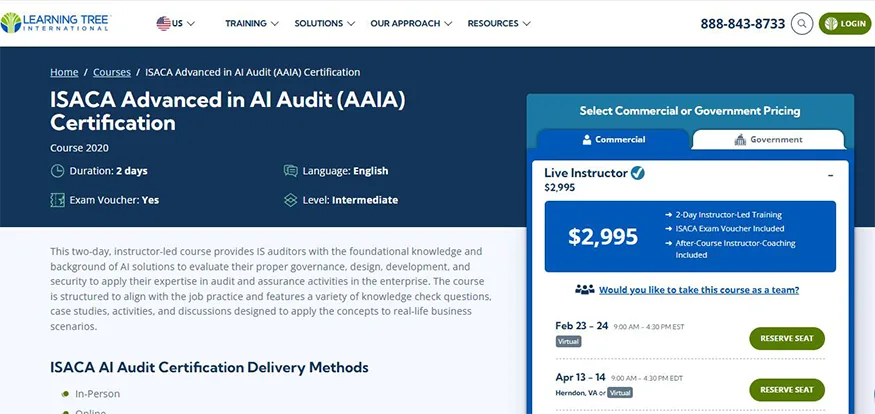
Image Credit: learningtree.com
This instructor-led, two-day course provides IS auditors with the basic knowledge and background they need to evaluate AI solutions’ governance, design, development, and security. Thus, the professionals or experts can use their skills in auditing and ensuring the business. The course is set up to be like working on the job, and it includes numerous knowledge-testing questions, case studies, exercises, and discussions that show how the ideas can be used in real business situations.
Key Takeaways:
- Auditing AI systems using structured audit methods
- Reviewing data sources and model behaviour during audits
- Identifying control gaps in AI-driven processes
- Understanding governance and accountability for AI decisions
- Managing AI risk within existing audit frameworks
- Preparing audit findings for leadership and regulators
Ideal For: IT auditors, Risk and assurance professionals, compliance and governance managers, and security leaders
#14. Offensive AI Attack Tools and Techniques- SANS
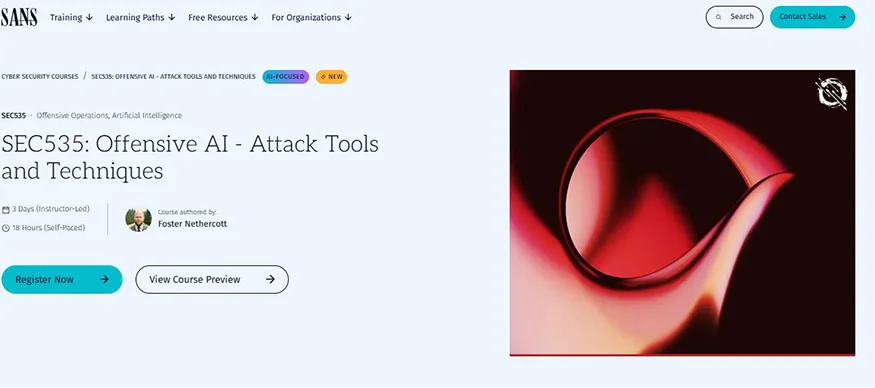
Image Credit: sans.org
Compared to the other AI security certifications, this course is a little bit exciting. This course looks at how attackers use AI in real-world attacks. It focuses on offensive use, not defense theory. Learners study how AI helps with phishing, malware development, reconnaissance, and automation.
The course shows how tools powered by AI lower the skill barrier for attackers and speed up attacks. It also explains why security teams need to understand offensive AI to defend against cyberattacks. The training is hands-on and built around realistic attack scenarios.
Key Takeaways:
- OSINT analysis with AI automaton
- How attackers use AI to automate and scale attacks
- AI-driven phishing, social engineering, and malware techniques
- Using AI for reconnaissance and target analysis
- Limits and weaknesses of AI-powered attack tools
- Practical understanding of modern AI threat methods
Ideal For: Security analysts, penetration testing professionals, red team operators, and security architects.
#15. Applied Data Science and AI/Machine Learning for Cybersecurity Professionals
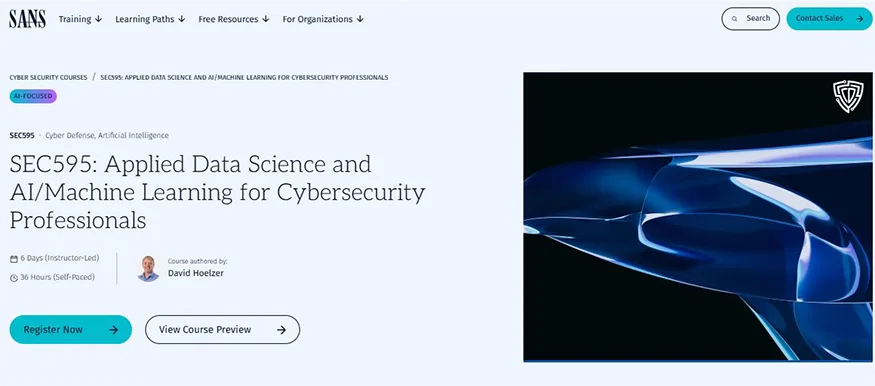
Image Credit: sans.org
Consider it as one of the best AI security certifications for professionals who want to learn how to utilize AI, ML, and Data Science to secure AI systems. The key speciality of this course is simplifying complex concepts. After completion of the course, learners will be able to apply AI techniques to real-world challenges and scenarios.
Participants solve real security challenges using statistical models, probabilistic tools, and neural networks rather than engaging in theoretical discussions. You will build skills to extract, analyze, and visualize security data, construct predictive models for threat detection, and apply anomaly detection systems.
Key Takeaways:
- How to design custom ML solutions for security data
- AI-based anomaly and threat detection
- Neural network development for security classification tasks
- Impactful data visualizations for security insights
- Security data analysis through Python automation
- Threat detection with predictive AI capabilities
Ideal For: Blue team, SOC members, Infosec professionals, and others.
#16. AI Security- Stanford School of Engineering
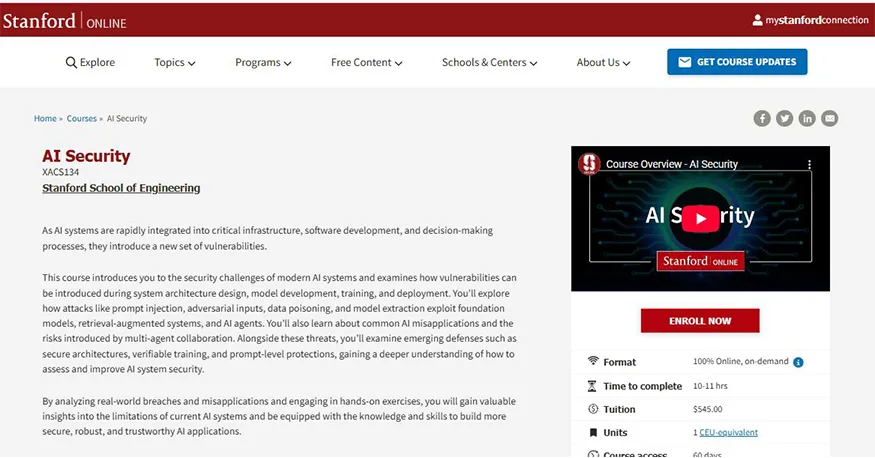
Image Credit: online.stanford.edu
As one of the best AI security certification programs, this course is about the security challenges of modern AI systems. It focuses on how vulnerabilities can be introduced during system architecture design, model development, training, and deployment. When accessing the course, the learners explore a variety of attacks and prevention using AI, such as prompt injection, data poisoning, adversarial inputs, and model extraction. This course also talks about common AI misapplications and the risks introduced by multi-agent collaboration.
Key Takeaways:
- How machine learning models are attacked in practice
- Risks tied to training data and model exposure
- Adversarial inputs and why models misbehave
- Privacy issues in AI systems
- Security limits of current AI techniques
- How design choices affect AI safety
Ideal For: Security engineers, software engineers, researchers, and technical leads.
Salary Trends for AI Security Professionals in 2026
In 2026, as AI implementation is crucial, it is more crucial to secure it from threats. This is the key reason behind the spike in AI security-related jobs. Employers are paying a good amount for hybrid roles, such as security + ML/GenAI + cloud, to implement a secure system for their organization. These roles are increasing compared to conventional cybersecurity roles.
From the context in artificial intelligence jobs for security roles, the key trends are:
- AI Security Specialists: $100k-$170k
- Cloud Security Engineer: $120k–$160k
- Security Architect: $130k–$190k
- Security Engineer: $100k–$140k
- Detection Engineer: $156,666–$198,800
- DevSecOps Engineer: $160,900–$198,700
There are certain factors that are driving salary growth, such as:
- Skills Shortage: The demand for AI security roles is high, but there is a talent gap. Technology companies are offering high salaries to attract experts in AI, ML, and Automation.
- Increased Risk: Data poisoning, prompt injections, adversarial input, and other threats are some potential threats. The cyber criminals are using these as tools to break into the system, and attacks are increasing.
- Compliance Strictness: With the increasing risks, the compliance rules are tightening. This raises demand for roles focused on governance, audit, and AI risk.
- Failure Cost: AI failures are costly. A single issue can affect thousands of users at once. Instead of paying for the failure, it would be best to hire someone who can prevent it.
How to Choose the Right AI Security Certification
Now, the most important question for every learner is how to choose the right course from the AI security certifications.
Although there are myriad courses available online, every course has its merits and focuses on a niche. Therefore, here are some steps that will lead you to the best AI security certification.
- Define Your Role
Not all AI security certification programs serve the same purpose. Some focus on hands-on security work, while others focus on governance or audit. Choose what suits your job, not what sounds impressive.
- Focus on Practical Skills
The practical skills always work, thus while choosing the course, always prefer that it must make you learn practical skills that you can capitalize on in real life while performing your role.
- Check Industry and Compliance Fit
While selecting AI security certifications, it also matters that they must suit your industry and related compliances, such as HIPAA, GDPR, or others.
- Check the Skill Depth
The best AI security certification explains how risks happen and how to handle them. Look for programs that cover data, models, and real use cases instead of high-level theory.
- Will It Help You Grow?
Last but not least, while selecting your choice among AI security certification programs, always look for the future aspect. The program you are going to attend must suit your future growth.
Once you get a satisfactory answer, start wth the course, gain practical knowledge, apply it through pilot projects, update your CV, and start applying for jobs.
Conclusion
AI systems are no longer theoretical; they are progressing in every field. With the increasing use, the cyberthreats are expanding. Even a single attack can put an organization into chaos. Thus, protection is needed from a variety of vulnerabilities, and only experts can ensure it.
There is a massive demand for AI security professionals, with a talent shortage. AI security certifications bridge this gap. From the employment perspective, if you have such a certification, it can lead you to a lucrative job. Or if you are a business or technical leader, you can guide your team in implementing a perfect security strategy for your organization. The only thing you need to do is just start with a course that suits your role, helps you gain practical knowledge, stay relevant, and offers long-term growth.
FAQ
What is an artificial intelligence security certification?
An AI security certification stands for a program where you’ll learn cybersecurity techniques to avoid, eliminate, and mitigate risks like data poisoning, prompt injection, model tampering, and others.
Are AI security certifications worth it in 2026?
Yes, AI security certifications are worth it in 2026 as there is a massive demand for professionals who can make AI systems secure, considering the potential cyberthreats, and make the system future-proof.
Do I need prior AI or cybersecurity experience to enroll?
It depends on the course. For example, beginner-level courses do not require any experience, but if you go advanced, then it may require some skills such as Python programming, familiarity with cybersecurity, data handling, and others.
What skills do AI security certifications cover?
AI security certifications cover key skills such as:
- Threat Identification and Risk Management
- Secure AI Development and Controls
- Regulatory Compliance and Governance
- Security Testing Procedures
- AI Fundamentals in Security
- Strategy and Workforce Adaptation
Which industries value AI security certifications the most?
Almost all industries are now valuing the AI security certifications, where some of the top industries are healthcare, finance and banking, government and public sector, SaaS and technology companies, e-commerce, and telecommunications.
Get in Touch with
AI Experts
Kapil Kumar is a leading voice in the field of Artificial Intelligence, blending deep technical expertise with a passion for innovation and real-world impact. As an accomplished author, researcher, and AI practitioner, he brings clarity to complex technologies—making AI not only understandable, but actionable. Whether decoding algorithms or envisioning ethical frameworks for AI, he is committed to guiding professionals, students, and tech enthusiasts through the rapidly evolving world of artificial intelligence.