

AI Agent Development Cost in 2026: A Complete Guide


Key Takeaways
- The adoption of AI agents is rapidly increasing, and the world market will expand from USD 11.78 billion to USD 251.38 billion between 2026 and 2034, which is 46.61% of CAGR.
- A major portion of enterprise adoption is represented by build-your-own AI agents, which take up 43% of the AI Agents Market, as organisations have come to value customisation, strategic control, and the ability to combine proprietary data, domain-specific logic, and custom workflows, which directly drive up the AI agent development cost in 2026.
- There is a complexity and cost in development that is primarily driven by machine learning (28% market share), natural language processing (24%), and deep learning (22%), which directly impacts the cost of training, infrastructure, and maintenance.
- The development of AI agents in 2026 can range in price between $5,000 for simple low-code agents and $300,000 and above for enterprise-grade multi-agent systems.
- The primary drivers of cost are enterprise and healthcare adoption, as by 2026, more than 40% of enterprise applications will use AI agents.
- Healthcare is rapidly growing in the use of AI agents with patient engagement, automation, and real-world applications.
In 2026, AI agent development cost has become a boardroom-level conversation for businesses worldwide.
But wait, and let’s understand the hype behind “AI agents”.
It’s hard to imagine any organization not integrating AI into its business to speed up performance and tasks, can you? And why shouldn’t they be?
These AI agents have significant business benefits, including increased productivity, time savings, and lower operating costs.
Let’s have a quick look at the facts related to AI agents!
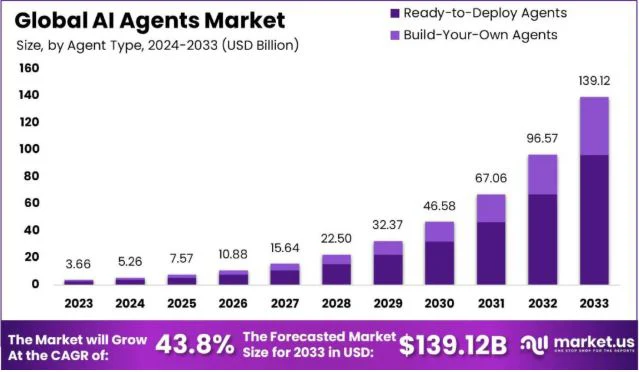
Image Credit: markets.us
- More than 88% of enterprises are currently planning to use agentic AI in their existing operations.
- The AI Agents Market size is projected to grow to USD 139.12 Billion by 2033 at a CAGR of 43.88%.
- After adopting AI agents, two-thirds (66%) say that they’re delivering measurable value through increased productivity.
Though the market and value look promising, the question that comes up in every boardroom conversation is simple:
How much does it cost to build an AI agent?
The cost to build an AI agent generally ranges from $10,000 to $ 200,000, depending on integration requirements, complexity, team expertise, and more.
Now, the question arises: How can you budget, control, and reduce the costs of an AI agent development in 2026?
Let’s dive in!
What Is an AI Agent?
In layman’s language, an AI agent is software that can sense its environment, decide what to do, and act on that decision to achieve its respective business goals. While conventional automation systems operate according to predefined rules, one key feature of AI agents is that they learn from data and can evolve and improve in new situations. They are deployed in applications that range from responding to customer inquiries to scheduling appointments, interpreting and storing information, executing transactions, and helping make informed decisions. An AI agent is effectively a digital employee that can act, think, and respond on its own without multiple humans directing its every move.
According to the following Gartner study, by 2026, more than 40% of enterprise applications will be AI-powered agents that operate in the background to support daily activities. This change is indicative of how quickly companies are willing to put this technology in the hands of AI agents to do real work at scale.
Main Cost of AI Agents Development
The AI agent development cost varies widely based on how intelligent, autonomous, and scalable the agent needs to be, which is why understanding the different cost levels helps businesses choose the right solution without overspending.
1. AI Agent Type: Basic
Description: AI agents, also known as artificial intelligence agents, are simple, predictable tools that perform tasks and even answer questions you ask them, using simple algorithms or automata. It is not designed with deep learning; instead, it relies on pre-trained models or rules.
Features & Capabilities:
- Responses are rule-based.
- Simple customer support or task automation.
- Integration with other tools is minimal.
Estimated Cost: $5,000 – $15,000. It is easy to learn and perfect for small businesses or pilots, with short development times.
2. AI Agent Type: Moderate
Description: Moderate agents use NLP-based natural language processing, know some subtle contextual information, and have a little more dynamic interaction.
Features & Capabilities:
- NLP-based conversation skills are essential in conversation.
- Simple tasks can be automated effortlessly.
- Moderate integration with business systems.
Estimated Cost: $20,000 – $50,000. It’s ideal for bots that serve customer service, task workflows, or internal support tools that require more understanding and flexibility.
3. AI Agent Type: Advanced
Description: Advanced AI agents are more adaptive, can think in steps, are more contextually aware, and can adapt to change. They usually have machine learning support and can connect to multiple data sources.
Features & Capabilities:
- Understanding of context and learning over time
- Integration with APIs, databases, workflows
- Stronger conversational and decision logic.
Estimated Cost: $50,000 – $150,000. It is ideal for AI co-pilots, recommendation systems, and intelligent task automation at scale.
4. AI Agent Type: Enterprise
Description: Enterprise agents are specifically designed for large-scale corporations and tight-deadline environments. They deal with multi-level complex processes, strict compliance needs, and a high volume of interactions.
Features & Capabilities:
- Multi-agent coordination is essential
- Decision engines that take real-time decisions are real-time systems
- Integrations with legacy systems in depth
- Security and governance to a business-grade level.
Estimated Cost: $100,000 – $300,000+. It is suited to the financial services, healthcare, and large-scale organizations that require high reliability and customization.
Bonus Read: Best Agentic AI Development Companies in The USA
Types of AI Agents & Their Cost Ranges
AI agents come in many forms, and each type has its own business purpose, with direct effects on the development complexity and overall cost. The following table lists the most common types of AI agents, their functions, and typical development costs to help you see where your investment may lie in custom AI agent development.
| AI Agent Type | Description | Development Cost (USD) | Example |
|---|---|---|---|
| Conversational AI Agents | They also have natural language or voice-based capabilities that allow communication with the user through text or voice, with natural responses. For businesses, the most frequent use is to respond to customers’ questions, offering help or solutions in real time. | $10,000 – $60,000 |
|
| Autonomous AI Agents | Autonomous agents act alone and without any human intervention. They take in, process, and act to sort things out, determine, and carry forward. | $40,000 – $120,000 |
|
| Generative AI Agents | These agents add new text, images, code, or reports based on prompts and data. They are primarily dependent on big language models and generative AI approaches. | $30,000 – $100,000 |
|
| Multi-Agent Systems | Multi-agent systems are systems in which multiple AI agents interact to exchange information and solve problems. They are not uncommon in large-scale or dynamic environments. | $80,000 – $250,000+ |
|
| Task-Oriented AI Agents | They are aimed at particular, pre-defined goals. They follow a structured workflow and use business automation tools to manage routine tasks. | $10,000 – $40,000 |
|
| Hybrid AI Agents | Rule-based logic and machine learning or generative AI are blended to create hybrid agents. This approach is empowering and enables you to have some control, as well as flexibility and learning. | $50,000 – $150,000 |
|
| Decision-Making AI Agents | Such agents work with large datasets, handle reasonable numbers of choices, and can provide suggestions or decisions based on goals and constraints. | $60,000 – $200,000+ |
|
11 Key Factors Affecting AI Agent Development Cost?
So, if you wish to have an idea of your budget for an AI agent, you can ask yourself this question: What makes it expensive to build an AI agent? Whether it is the choices made on the tech side or the costs of repairs and maintenance, repair costs will fluctuate from year to year, but at least you’ll be able to get some sense of the AI agent development cost.
1. Complexity of the AI Agent
The more complex an AI agent is, the more expensive its development is. A simple agent with predefined questions requires less effort than one with context, reasoning across steps, and adaptation to user behavior. Edge cases require more testing, better training data, and advanced logic for complex agents.
Developers also spend more time on workflows, decision trees, and fallback mechanisms. This complexity, along with development time, infrastructure needs, and long-term maintenance costs, has an impact on the total project.
2. Type of AI Technology Used
Cost is also directly related to the choice of AI technology. Rule-based systems are less expensive to build than machine learning, natural language processing, and generative AI models. For instance, large-scale language models require more computing power and specialist knowledge.
Custom-built models are more expensive than pre-trained APIs but offer greater control and accuracy. Enterprises have to balance performance needs and budget constraints; advanced AI technologies generally produce better results, but require additional upfront and ongoing investment.
3. Data Processing & Storage Requirements
Data is an important asset for AI agent development, and processing it requires significant capital. Large amounts of structured and unstructured data require sophisticated processing pipelines, storage solutions, and backup systems.
Also, it takes time and skill to clean, label, and prepare the data. The growth in data volumes pushes firms to invest more in cloud storage, databases, and data management tools, which, in turn, lead to higher development and operating costs.
4. Development Approach
Pre-built frameworks and APIs speed up the development and cost. On the other hand, building everything from scratch takes more time and skill. Adopting an agile strategy allows teams to iterate quickly and can reduce waiting costs associated with ever-changing requirements. However, this fixed-scope approach can penalize flexibility. The right development strategy is essential to cutting costs and achieving business goals.
5. AI Model Training & Fine-Tuning
Training and grading for AI modeling can be expensive. The fact that pre-trained models are not in themselves expensive, but rather that the expense is related to fine-tuning, the cost of data, and the computational requirements for specific applications, is an important one.
The custom models will require more data and additional experimental and optimization work. Repetitive training and reinforcement could be added to improve accuracy and avoid errors. Each iteration takes cloud resources, developer time, and testing effort. The higher the cost of training and fine-tuning, the more specific and domain-specific the agent needs to be.
6. Deployment Costs
It’s not just programming code to deploy an AI agent. Teams are forced to choose between cloud, on-premises, and hybrid environments with different cost structures. Cloud-based deployment is available and flexible, but requires monthly usage charges.
On-premises systems require much higher ongoing system maintenance and hardware investment. It also introduces costs in terms of the infrastructure needed to grow the agent to meet the increasing demand from users. Load balancing, monitoring tools, and failover systems add to deployment cost but are necessary for reliable performance.
7. Integrations & Third-Party APIs
Most AI agents also communicate with old systems such as CRMs, ERPs, payment systems, and analytics tools. Each of these integrations is being developed, tested, and maintained. Third-party APIs are often billed through a subscription or usage model and increase with usage.
Integration complexity introduces performance and security vulnerabilities as well. As the number of systems an agent is plugged into increases, more development time will be spent addressing data flow and reliability issues, which have an indirect impact on the overall cost.
8. Ongoing Maintenance & Upgrades
There are currently no “build once and forget” AI agents. Since they are dynamic, they must constantly adapt to be accurate, secure, and useful. Data or user behaviour can be changed, and models can be retrained. All these costs are at regular intervals: software updates, bug fixes, and performance improvements.
Businesses also hire system monitoring tools to ensure accuracy and system health. The bulk of the cost is spent over time on maintenance and upgrades, particularly in large-scale long-run deployments.
9. UI/UX, Infrastructure & Hosting
A good design increases adoption, but also costs. The challenge for designers and developers is to deliver on more intuitive dashboards, conversation flows, and user interactions. In the infrastructure front, the AI agent needs reliable servers, databases, and network resources.
The infrastructure required for broader availability and faster response times comes at a higher cost. These costs may seem logical for companies, but UI/UX and infrastructure impacts can also affect internal perceptions of performance and satisfaction.
10. Security & Compliance
This, in turn, can drive up costs, particularly if AI agents need to comply with security and regulatory requirements, which is common in highly regulated industries. Data will be secure and inaccessible to developers. Compliance with GDPR, HIPAA, or SOC 2 adds additional layers of validation and documentation. Also, annual security check-ups can take a toll on your budget. It is costly, but it provides data security along with legal and reputational savings.
11. Testing and QA
Applications of practical performance are closely monitored. QA groups will test features, perform performance and security testing, test edge cases, and prevent failures post-launch. AI systems should undergo additional validation to assess both the model’s performance and potential bias or unexpected behaviour.
Automated and manual testing can also be time-consuming and resource-intensive. But if you skip this step, you may be forced to pay for it later through costly repairs; testing is an inevitable but important upfront cost in the development process.
Read Also: Application of Embodied Agents
AI Agent Development Cost by Industry (2026)
The AI agent development cost is highly variable across industries, as each has different requirements for what the AI agent should do, for compliance, and the types of data it would work with. Below is a table of industry-wide typical use of AI agents in 2026, along with what businesses can expect to spend based on real-world use cases.
| Industry | AI Agent Function | Development Cost Range (USD) | ||
|---|---|---|---|---|
| Healthcare |
|
$60,000 – $180,000 | ||
| Finance |
|
$70,000 – $200,000 | ||
| eCommerce |
|
$40,000 – $120,000 | ||
| Education |
|
$30,000 – $90,000 | ||
| Insurance |
|
$60,000 – $160,000 | ||
| Real Estate |
|
$35,000 – $100,000 | ||
| Human Resources |
|
$25,000 – $80,000 | ||
| Legal |
|
$80,000 – $200,000+ |
How to Optimize AI Agent Development Costs?
The process begins with making intelligent decisions early and avoiding unnecessary complexity to optimize the AI agent development cost. The goal is not to have the best AI agent possible, but the right one for your business needs. Companies can reduce spending and still make real profit from their AI investment by planning carefully, choosing the right tools, and thinking long term.
Keep a Clear Use Case in Mind
Identify the exact problem the AI agent needs to solve before development begins. Costs quickly spiral out of control when teams try to force an agent “do everything.” The purpose-oriented use case is to speed up development, limit features, and make ROI easier to quantify.
Use Pre-Trained Models And Existing Frameworks
Adopting these existing AI agent development models or platforms is much less costly than developing them from scratch. Pre-trained models are faster to train and require less data, but are powerful when fine-tuned correctly.
Choose The Right Development Approach
Agile development helps test early, get feedback, and avoid expensive changes. This staged process reduces cost for businesses because they can invest in small increments rather than requiring a large capital budget.
Optimize Data Usage
While clearer, more organized data is always better for avoiding training mistakes and speeding up development. The investment of starting now to manage the data properly will ultimately save on costs related to model accuracy and the need for continual retraining.
Plan For Scalability And Maintenance From Day One
The custom AI agent development software can be designed with the desired growth in mind, without requiring costly redesigns. Long-run operational costs are managed with clear monitoring, schedule changes, and performance tracking.
Limit Unnecessary Integrations
Connect the AI agent to systems that directly relate to the intended use. Each new integration costs API development, testing, and continues to be completed.
Monitor Performance And Usage Continuously
Monitoring is an ongoing process to address issues, such as missing features or increases in cloud costs. Small optimizations over time can save big.
AI Agent Development Costs Worldwide (2026)
The AI agent development cost can vary greatly depending on local talent, labor costs, infrastructure, and compliance requirements. The following table of costs by region in 2026 lists the approximate number of “characters” on the page and column with a general idea of the actual cost.
RegionTypical Development Cost (USD)Key Factors & Notes
| North America | $80,000 – $200,000+ | High labor costs, demand for enterprise-grade AI, regulatory and compliance requirements, and advanced customizations. |
| Western Europe | $70,000 – $180,000 | Competition-driven markets, EU data regulation, slightly lower laborcosts than North America, and a strong focus on security. |
| Asia Pacific | $40,000 – $120,000 | Budget-friendly development teams, cloud-based solutions, flexible outsourcing options, and expanding AI talent centres. |
| Latin America | $40,000 – $120,000 | Mid-level AI agents can create AI with emerging AI talent, competitive costs, cloud, and open-source frameworks. |
| Eastern Europe | $50,000 – $130,000 | Competitive rates for technical expertise, extensive software engineering skills, ideal for custom and multi-agent systems. |
| Middle East | $50,000 – $140,000 | Increasing AI ecosystem, multiple local and international developers, government, and enterprise digital transformation. |
What are the Future Trends in AI Agent Development Cost?
As AI technology advances, businesses’ spending on custom AI agent development is also rapidly increasing. Being able to anticipate means companies can be smarter in their budgeting, investment in the right solutions, and stay on top of competitors while keeping costs down.
Increased Use of Pre-Trained Models
Businesses will increasingly depend on pre-trained AI models and large language models to reduce development costs. Companies can tailor these agents to their needs, avoiding much time and money compared to creating them from scratch. This movement opens up AI capabilities to small and medium businesses without massive budgets and enables larger businesses to spend more to support customization and integration.
Shift Toward Cloud-Based Development
AI agent development will continue to be dominated by cloud platforms. Cloud computing, on the other hand, enables users to save money on on-premises hardware and to operate at scale with low maintenance costs. In an environment where cloud providers offer AI-specific services at attractive prices, businesses can cut costs and deploy AI agents more quickly without sacrificing performance or reliability.
Greater Focus on Automation in Development
Automation will lower the AI agent development cost. Tools that automatically generate training data, test AI models, or improve workflows will speed up and reduce development costs. It will also help companies reduce human resources costs and develop more accurate and efficient AI agents.
Rising Demand for Multi-Functional AI Agents
Rather than developing different agents for each functionality, companies will select AI agents capable of managing multiple tasks. This complicates the development process in the short term but also has long-term savings in later maintenance, updates, and infrastructure consolidation. Multi-layered AI technologies that deliver more value per dollar will be increasingly important to businesses.
Emphasis on Sustainable and Efficient AI
Energy-efficient AI models and green computing practices will affect the costs of AI agent development in 2026 and beyond. Optimizing algorithms to reduce power consumption reduces cloud compute costs, and a sustainable practice attracts investors as well as customers. Businesses will keep costs under control and follow global sustainability trends by balancing performance and efficiency.
Conclusion
In 2026, the AI agent development cost differs widely based on complexity, industry, region, and the type of technology used. A simple AI agent costs anywhere between $10,000- $40,000 while a complex one might require a significant investment of $200,000+. Moving from simple conversational bots to enterprise multi-agent systems can be expensive for businesses, and they will need to understand their needs, data requirements, and integration expectations to ensure both performance and cost.
Frequently Asked Questions
What is the average cost of AI agent development in 2026?
On average, the AI agent development cost ranges from $10,000 to $200,000, depending on the agent’s complexity, features, and use case. Basic agents will be cheaper, while advanced or enterprise-grade agents will be more expensive.
What factors affect AI agent development costs the most?
The biggest cost drivers are the agent’s complexity, the type of AI technology used, data requirements, integrations, and ongoing maintenance.
How do AI agent costs differ by industry?
The cost of AI agents is variable by industry because of data sensitivity, compliance requirements, and functional complexity. Healthcare and finance agents, for example, are more expensive because they need strict security and accuracy, while eCommerce or HR agents are typically more affordable.
How long does it take to build an AI agent in 2026?
Building an AI agent in 2026 usually takes 6 to 16 weeks. Simple agents can be launched earlier, while complex or enterprise-level agents take longer due to customization, testing, and integrations.
Get in Touch with
AI Experts
Kapil Kumar is a leading voice in the field of Artificial Intelligence, blending deep technical expertise with a passion for innovation and real-world impact. As an accomplished author, researcher, and AI practitioner, he brings clarity to complex technologies—making AI not only understandable, but actionable. Whether decoding algorithms or envisioning ethical frameworks for AI, he is committed to guiding professionals, students, and tech enthusiasts through the rapidly evolving world of artificial intelligence.