

How Much Does AI App Development Cost in Dubai?


- AI app development costs in Dubai can range from AED 80,000 to AED 800,000 or more, depending on the complexity of AI, integration with other systems, infrastructure, and compliance requirements.
- In 2025, the AI industry in the UAE was worth $7.39 billion USD, and it’s expected to grow to $221.38 billion by 2034 with an average compound annual growth rate (CAGR) of 45.90%.
- Delaying investment into AI will create a significant lag for businesses in comparison to their competitors who are currently scaling through the use of AI.
- Investment in generative AI, computer vision, and enterprise automation applications requires higher levels of investment in terms of training, modeling, and GPU infrastructure.
- Wrong cost estimates early in the planning phase are one of the most common factors contributing to stalled or over-budget AI projects.
- There are hidden costs associated with AI APIs, cloud hosting, preparing data, and retraining models that can add significant expense to a budget throughout the life cycle of an AI project.
- Requirements for compliance, organization-wide security standards, and scalability expectations specific to Dubai create a significant financial impact on any AI project.
- By engaging an experienced AI app development company in Dubai from day one, businesses will minimize rework costs and develop scaled AI applications.
Dubai is not experimenting with AI. It’s building its economy on it.
The UAE AI market was valued at USD 7.39 billion in 2025 and is projected to hit USD 221.38 billion by 2034, expanding at a 45.90% CAGR (The Report Cubes). That’s not a trend. That’s a structural shift in how business gets done in this region. From logistics to healthcare to financial services, sectors are making strides in adopting AI, while the UAE government’s National AI Strategy 2031 supports their efforts with policy, infrastructure, and capital.
The UAE has seen 42% of businesses use AI, and 65% of UAE IT professionals say the use of AI has increased in the last 24 months, according to the IBM Global AI Adoption Index. The appetite is real. The urgency is real, too. Only looking at DIFC financial firms, the estimated utilization of AI increased by 19% between 2024 (33%) and 2025 (52%), while generative AI has increased by 166% year on year, as reported in the DFSA AI Survey 2025 (DFSA).
For companies competing in this space, not investing in artificial intelligence could result in losing both competitively and financially, a scenario that gets worse over time.
Understanding AI app development costs provides you with the real picture about the cost and reduces the uncertainty. AI app development cost in Dubai depends on your business requirements. For instance, a basic AI FAQ chatbot and an enterprise AI copilot are both “AI apps.” They sit at completely different ends of the cost spectrum.
In this blog, we will break down the cost app type, development stage, and hidden cost category, so you don’t arrive with a budget estimate and underestimate what’s actually involved.
Average AI App Development Cost in Dubai
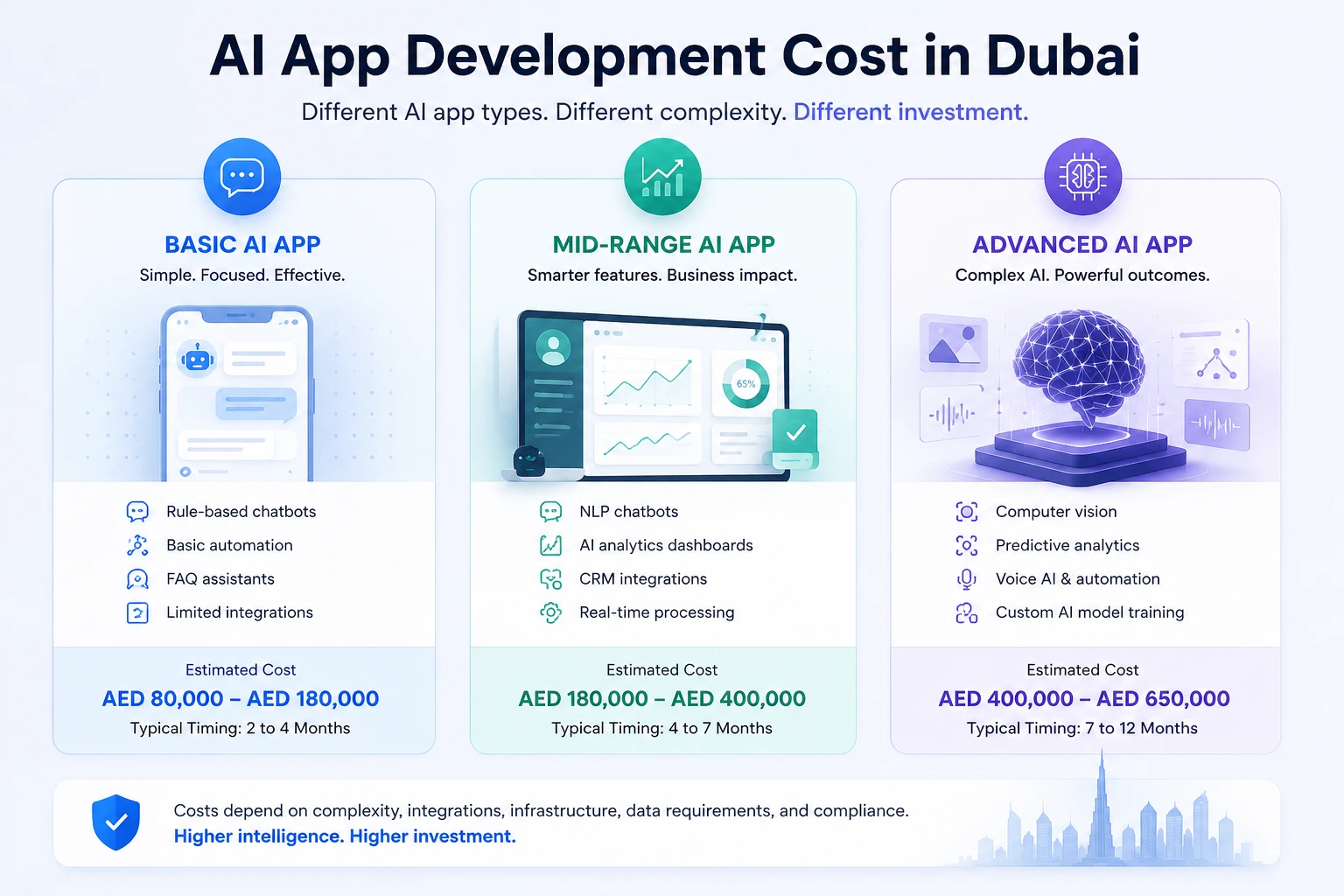
Costs vary based on functionality, the sophistication of the underlying AI model, the number of integrations, infrastructure requirements, and enterprise readiness. There’s no single price tag. What follows is a realistic breakdown of what businesses typically spend at each tier.
| App Type | Estimated Cost (AED) | Typical Timing |
|---|---|---|
| Basic AI App | AED 80,000 to AED 180,000 | 2 to 4 Months |
| Mid-range AI App | AED 180,000 to AED 400,000 | 4 to 7 Months |
| Advanced AI App | AED 400,000 to AED 650,000 | 7 to 12 Months |
| Enterprise-Level AI Platform | AED 650,000 to AED 800,000+ | 10 to 18+ Months |
Basic AI App Cost
This type of application includes rule-based chatbots, AI FAQ assistants, basic recommendation engines, and basic automation tools. The features offered are basic: very little AI logic, basic dashboarding, occasional integration, and a limited user base.
You can expect to spend in the range of AED 80,000 to AED 180,000 for the development of a basic application.
Basic AI applications work well for startups testing and using AI technology or companies developing rigorously an MVP (Minimal Viable Product) to test whether or not to develop a more significant product. You should not expect real-time intelligence or custom model training with this type of app. The AI is mostly pattern-matching and predefined logic.
Mid-Level AI App Cost
This is where most growing businesses land. NLP chatbots, AI analytics dashboards, CRM-integrated AI tools, and recommendation systems all fall here.
Costs typically run between AED 180,000 and AED 400,000.
What drives prices up at this tier is rarely the interface. It’s the backend work. Some of the various features that increase the overall complexity of developing an AI application include integrating third-party processes, designing custom workflows, managing multiple data sets, and processing data in real time. Cloud infrastructure and API consumption start mattering here, too. A CRM-integrated AI assistant that handles live customer queries is a very different engineering challenge than a static FAQ bot.
Advanced AI App Cost
Computer vision apps, predictive analytics platforms, voice AI, and AI-powered automation tools sit in this range. A typical budget for serious projects is between AED 400,000 and AED 650,000.
Increased development costs are mainly attributed to the number of phases involved in a project, high-quality data sets necessary for training customized models, multiple annotation processes, using graphics processing units (GPUs) for training the model, and multiple stages of testing to ensure model accuracy.
An AI-powered logistics tracking app with predictive delivery estimates, for instance, needs historical route data, real-time inputs, and ongoing optimization even after launch.
AI output at this level is probabilistic, not deterministic. Testing is fundamentally harder.
Enterprise AI App Cost
Enterprise automation platforms, AI copilots, fintech AI systems, and healthcare AI platforms belong here. Budgets usually begin with a minimum of AED 650,000 and often exceed AED 800,000 due to the size of the project.
Other factors that influence development costs include scalability, security, compliance with various regulations, ERP system integrations, multi-user architecture, and ongoing AI optimization.
Generative AI apps built on LLMs like GPT-4 or custom enterprise language models add another layer: token-based API pricing, prompt engineering, and GPU inference costs that compound with usage volume.
Anyone who has scoped an enterprise AI platform knows that the initial build is often just the beginning of the spend.
Key Factors That Affect AI App Development Cost in Dubai
When evaluating an AI application cost, it is important to note that the pricing is affected by the intelligence level, data complexity, type of infrastructure, level of integration with systems, and scalability. Here’s what actually moves the number.
App Complexity
A simple automation that routes support tickets is not the same as a real-time AI system making personalized product recommendations at scale. Real-time processing and personalization significantly increase development complexity, both in architecture and testing. The more your app needs to think fast, the more expensive it gets to build and run.
AI Model Type
The type of AI driving the app has a major impact on cost:
- Rule-based AI: Lowest cost, limited intelligence
- Machine learning models: Moderate cost, trained on your data
- NLP systems: Higher cost, language-specific nuances
- Computer vision: Significant GPU and training investment
- Generative AI: Highest cost tier, ongoing API and infrastructure expenses
Custom-trained models cost considerably more than API-based implementations. But they also tend to perform better on specialized tasks. The choice between training your own model and calling an external AI API is one of the biggest cost decisions in any AI project.
Data Training Requirements
Good AI needs good data. Data collection, cleaning, annotation, model training, and validation all take time and money. Poor-quality datasets don’t just deliver bad results. In addition, delays caused by changes and delays in the preparation of data all impact project budgets.
Data preparation can account for anywhere from 20% to 30% of the budget for an AI project; however, many businesses underestimate the time and money required to prepare data.
UI/UX and Backend Development
AI applications require a more robust backend architecture compared to standard applications due to raw processing load, real-time output, and required scalability
On the front end, the user experience (UX) and AI interactions must create clarity and build trust in the user. They need to know what the AI is doing and how it is doing it, especially in regulated sectors like finance and healthcare.
Third-Party Integrations
Integrations with third parties (CRM, ERP, payment gateways, cloud-based AI services, analyzers, etc.) add time for developing applications. Enterprises usually need middleware for integrating applications and adding additional layers for security. With the introduction of a new integration point, there is a possible point of failure that requires testing and maintenance.
Security and Compliance
In Dubai, the PDPL framework regulates the protection of personal information in the healthcare and banking sectors. Businesses must adhere to country regulations as well as comply with individual regulations for clinical data protection and encryption. Any organization or application that fails to complete the compliance phase will only defer its exposure to either fines or damaged reputation until the application is successfully implemented.
Cost Breakdown for AI Development
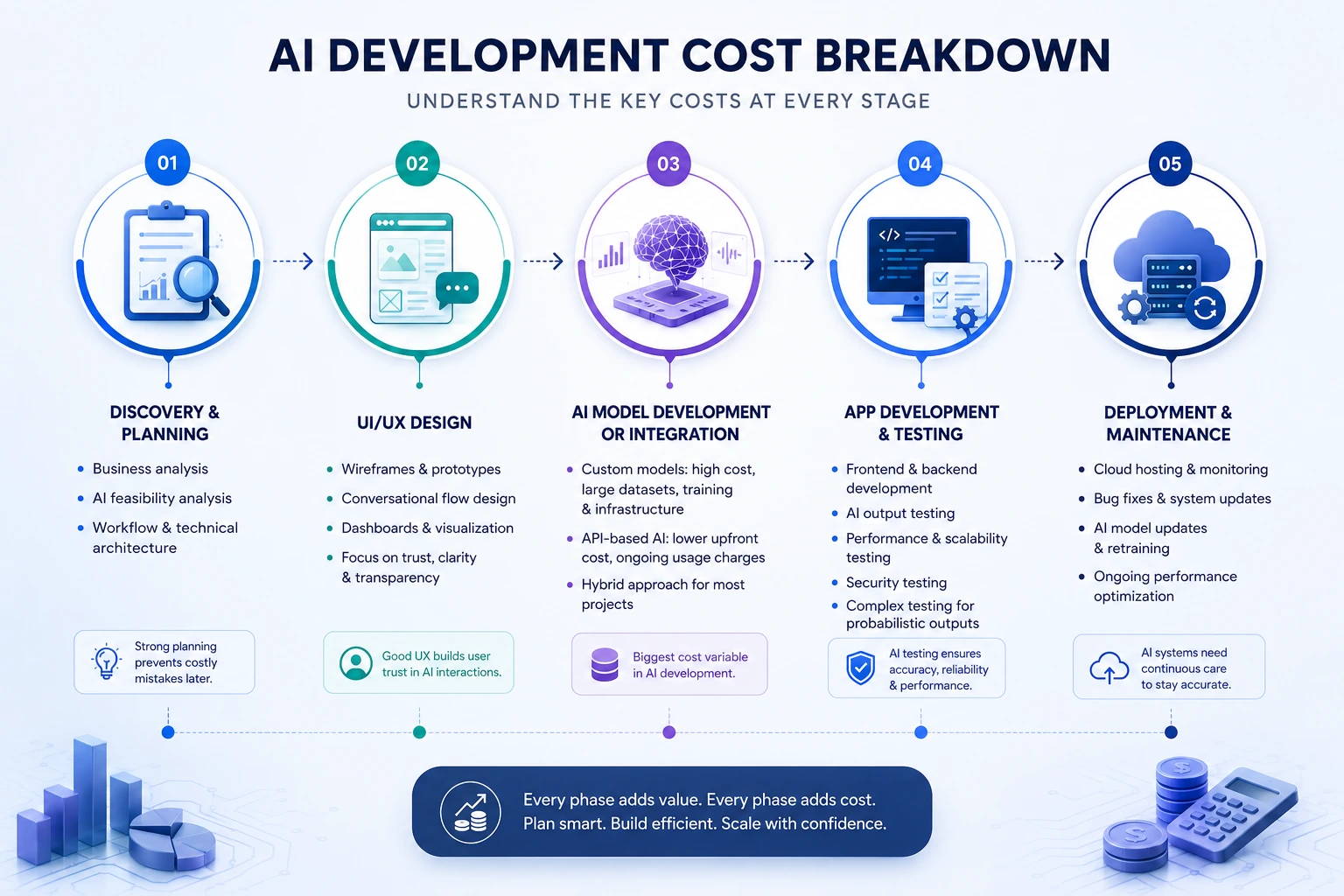
AI applications can incur a multitude of costs during their complete development life cycles, not just during development. Appropriate planning for each of the phases can prevent budget surprises.
Discovery and Planning Phase
This phase includes business analysis, feasibility analysis of utilizing AI, and workflow/technical architecture development. If poor decisions are made during this phase, there may be an impact on the costs incurred in future phases.
UI/UX Design
Wireframes, conversational flow design, and dashboards define user interaction with AI. A seamless user experience requires additional thought with respect to response transparency, error handling, and user trust. This isn’t standard app design.
AI Model Development or Integration
This is where the biggest cost variable lives.
Custom AI models are expensive to build. They require large, labeled datasets, training pipelines, compute infrastructure, and iterative refinement. Accuracy takes time.
API-based AI is faster to deploy and cheaper upfront. But ongoing API costs, especially for generative AI, scale with usage. What looks affordable at low volume can become a significant operational expense at scale.
Most mid-to-large projects use a hybrid approach: API-based AI for general capabilities and custom models for domain-specific tasks.
App Development and Testing
Frontend and backend development, AI output testing, performance optimization, scalability testing, and security testing. AI testing is inherently more complex than standard software testing. The outputs are probabilistic. You’re not just checking whether a button works. You’re evaluating whether the model behaves correctly across thousands of possible inputs.
Deployment and Maintenance
Cloud hosting, monitoring, bug fixing, AI model updates, and ongoing performance optimization. AI systems don’t stay accurate by themselves. Retraining cycles, new data ingestion, and model adjustments are part of running a real AI product.
Hidden Costs in AI App Development
This is where many businesses get caught off guard. The visible development cost rarely tells the full story.
AI API and Cloud Costs
OpenAI APIs, GPU hosting, cloud inference, token usage, and storage are all usage-based expenses. At low volume, they feel insignificant. As user numbers grow, these costs scale fast. A generative AI app handling tens of thousands of daily queries can accumulate significant API bills that weren’t fully anticipated in the initial project budget.
Data Labeling and Preparation
For custom AI systems, data annotation and data cleaning aren’t optional. They’re foundational. Structured, validated, high-quality training data is what separates an AI that works from one that doesn’t. Companies that do not spend time or resources developing predefined labels incur higher costs to fix later.
Security Audits
Regulatory testing of all services concerning encryption, compliance testing, and identifying vulnerabilities creates additional expense for the developer of those financial, healthcare, or enterprise-related professional service providers.
Model Retraining and Updates
AI apps are not “build once and forget” systems. Models drift over time as real-world data changes. Accuracy degrades. Data sets change. You must constantly review the accuracy of the training cycle and optimize your AI model; there’s a recurring cost associated with every step of this process that you need to budget for from day one.
Some vendors quote a number for AI development without factoring in those recurring costs in their initial quote.
Why Choose The NineHertz for AI App Development in Dubai?
If something goes wrong during AI development, the cost can be extremely high. Thus, selecting a partner that is a good fit instead of selecting the cheapest partner should be a priority.
Proven Previous Success
The NineHertz has a substantial history of delivering successful enterprise AI products, AI apps, and automation systems across industries such as logistics, retail, healthcare, and financial services. Real projects, real operational environments.
Full-Stack AI Expertise
The team works across NLP, computer vision, generative AI, and machine learning. The right technology is selected as per project requirements, not the team’s default preference.
Dubai and UAE Market Knowledge
UAE PDPL compliance, fintech security standards, and healthcare data regulations all shape how AI systems must be built here. We have worked within these constraints and know what drives cost and risk in this market specifically.
End-to-End Delivery
From discovery and UI/UX through development, deployment, and ongoing maintenance, The NineHertz covers the full lifecycle. The team that scopes your product builds and supports it.
A Track Record Worth Checking
Years of delivered AI projects and consistent client outcomes across industries give NineHertz a track record that goes beyond capability claims. Past delivery is the most reliable signal of future performance.
FAQs
How long does AI app development take in Dubai?
A basic app requires a development cycle of between 2 and 4 months; however, enterprise clients developing an enterprise AI platform that requires strict regulatory compliance (or need to develop custom models) require a minimum of 12 to 18 months for development to be completed.
What factors affect AI app development cost?
Here are the cost drivers for AI application development costs: Types of AI models, complexity of data, infrastructure requirements, third-party integration, compliance (or regulatory requirements), and scalability of the overall solution.
How much do AI application maintenance costs in Dubai?
To calculate the cost, consider these into account: cloud hosting, monitoring of the AI Model updates, retraining the model updates, security protocol updates, and API calls.
Expect annual maintenance to run 15 to 25 percent of the initial development cost for mid-to-advanced AI apps. Generative AI apps with heavy API usage may exceed this range.
Is generative AI app development more expensive?
Yes, meaningfully so. Generative AI app creation has more expensive pricing because of the combination of LLM blends, Token/API charges, GPU infrastructure, varied processes, and time spent on development. Operational costs for generative applications increase over time and will continue to grow as volume increases. Businesses looking to develop generative AIs would be wise to factor in both initial development expenses and ongoing inference costs into their total budget.
Conclusion
AI app development cost in Dubai depends on the AI intelligence, the infrastructure that is required, integration capabilities, and any compliance in which the business operates. A number without context means very little.
What’s worth understanding is that the initial build is rarely the only financial commitment. Cloud costs, retraining cycles, security audits, and API expenses are part of operating an AI product long-term. Businesses that plan for these from the start tend to get more from their investment.
The best way to proceed, rather than looking for the lowest price for developing an AI application, would be to determine your company’s objectives and budget that works for your business. Defining your objectives, like an MVP or enterprise-level application, is critical prior to contracting with any developer.
If you’re looking for a company that specializes in developing AI-based solutions, The NineHertz is the right choice for you. We have all the right technical expertise to develop the best application for you, and we also understand the local market to effectively develop the right solution for you.
Get in Touch with
AI Experts
Kapil Kumar is a leading voice in the field of Artificial Intelligence, blending deep technical expertise with a passion for innovation and real-world impact. As an accomplished author, researcher, and AI practitioner, he brings clarity to complex technologies—making AI not only understandable, but actionable. Whether decoding algorithms or envisioning ethical frameworks for AI, he is committed to guiding professionals, students, and tech enthusiasts through the rapidly evolving world of artificial intelligence.