

How to Choose AI Assistants for Business? (2026 Guide)


Key Takeaways
- Businesses can choose the right AI assistant by analyzing their real-time challenges, business goals, and customer expectations.
- Choosing the right AI assistant for business is highly important to achieve the desired results and generate a good ROI.
- According to statistics, 44% of the USA customers would prefer to have an AI assistant to resolve their queries at the time they are raised.
- ChatGPT, Claude, and Gemini are currently the top AI assistants, used globally by people to generate media and automate tasks.
- AI assistants help to eliminate human errors, offer 24*7 assistance, and improve performance with time.
It’s history now when people used to have a human assistant to remind them about tasks, perform unproductive work, or simply assist in something. Artificial intelligence is now doing all this, without getting paid, expecting a raise, and with zero human error. That’s why the global AI assistant market size was valued at $16.29 billion in 2024, growing with a CAGR of 18.8% to achieve the significant valuation of $73.8 billion by the end of 2033. However, there are a plethora of AI assistants, and thus, the big question that arises is “How to Choose AI Assistants for Business”?
Therefore, in this blog, we will be discussing all about AI assistants, how they work, which are some of the best AI assistants, and how you can choose the right AI assistant for yourself. Let’s begin-
8 Key Steps for Choosing an AI Assistant?
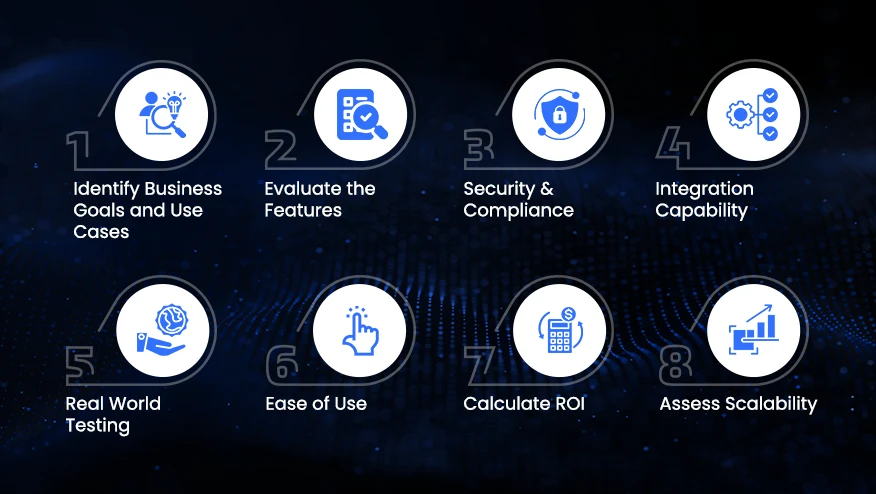
It is highly important to choose the right AI assistant for your business to mitigate the identified challenges, streamline time-consuming operations, improve productivity, and witness financial gains. Here are some of the key practices that you can follow to choose the right AI assistant for your business-
1. Identify Business Goals and Use Cases
The very first thing that you need to do is identify the business goals that you wish to attain through the adoption of an AI assistant. While many AI assistants are tailored for general purposes, others are designed to perform a specific type of task. Thus, it becomes important to ensure that the AI assistant you plan to implement has the core capabilities and features aligning with business use cases.
For instance, if you are looking for an AI assistant that can scan the resumes, shortlist the profiles based on criteria, and align the interview, you will need an AI assistant designed for this purpose. A general assistant might not be able to fill this particular gap.
2. Evaluate the Features
You should have a look at the core features of the AI assistant that you wish to implement. Features define the core capabilities of the software and how it will work. Therefore, make sure that your AI assistant has the features which aligns to your tasks, industry, and overall requirements.
3. Security & Compliance
AI assistants are designed to interact using personal as well as professional information about the user. Most of the business information is highly confidential and thus at risk of being hacked. You can choose the right AI assistant by ensuring that it comes with enterprise-grade security protocols and aligns with all the defined regulations and compliance.
4. Integration Capability
There might be a need for the integration of AI assistants with the existing technology ecosystem to perform certain tasks. For example, an AI assistant can only schedule the meeting through integration with the calendar. Therefore, you should assess the integration capability of the software that you plan to buy or build as your AI assistant.
5. Real World Testing
It can be a great idea to test the AI assistant for a short period of time to assess if it goes well with your requirements. For the same, you can opt for the trial period of an off-the-shelf solution or the MVP version of the custom-developed assistant.
6. Ease of Use
AI assistants are meant to be used the majority of the time. Thus, it must offer a seamless user experience while providing the navigation, buttons, and information at the right place. Make sure that the software you plan to implement as an AI assistant has a simple yet intuitive interface with easy navigation to the features.
7. Calculate ROI
While it is not advisable to compromise the quality of AI assistants for a few dollars, it is always important to analyze the financial returns. For the same, you can evaluate the subscription or development costs of the AI assistant, compare it with your productivity gains, and calculate the ROI. The right AI assistant will always bring a good ROI.
8. Assess Scalability
Your business needs to evolve with time. Whether it is workflow getting more complex or the number of users increasing, an AI assistant must be designed to withstand the increasing load. Thus, ensure that you choose the right AI assistant that can evolve with your business needs and stakeholders’ expectations.
Top Considerations for Choose AI Assistants for Different Business Needs
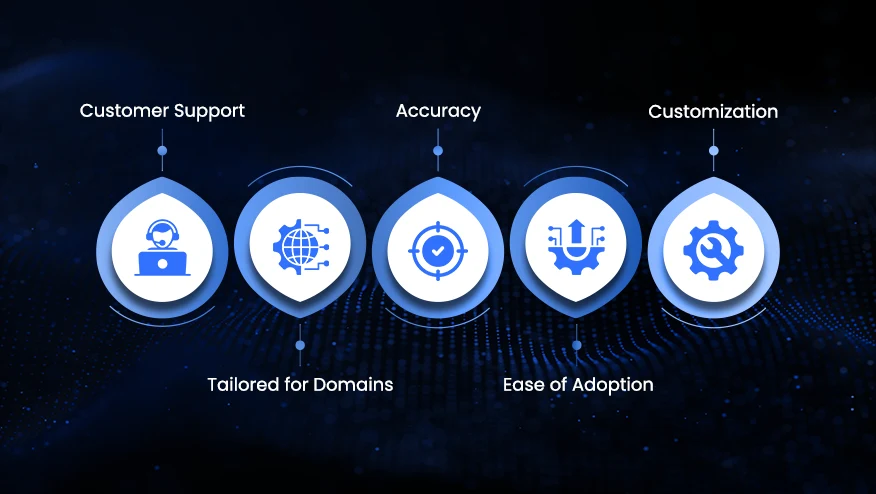
Now we know the key practices to choose the right AI assistant. However, there are certain considerations that should be taken care of when choosing the right AI assistant for your business.
1. Customer Support
There can be multiple AI assistant vendors that provide software aligning with your business needs and workflow challenges. However, software is prone to errors and malfunctions. Thus, you can choose the AI assistant that comes with around-the-clock customer support and technical assistance.
2. Tailored for Domains
Apart from the core features, many AI assistants are designed for a particular business domain. You can find the AI assistant for marketing, human resources, sales, coding, designing, customer support, and much more. Choose the one that resonates with your domain and requirements.
3. Accuracy
Eliminating human errors is one of the biggest reasons behind businesses opting for digital assistants. Therefore, evaluate the accuracy of your AI assistant, natural language processing capabilities, speed, and ability to handle multiple tasks simultaneously to choose the best one.
4. Ease of Adoption
It is generally not a good idea to make massive changes in the existing workflow of the organization just to adopt a novel software. Therefore, you should choose the AI assistant that requires the least interruption to your legacy system and workflow.
5. Customization
Many vendors provide ready-to-deploy AI assistants, which sometimes don’t carry the features relevant to business needs. Thus, there should be the option for customized features. You can also go for the custom AI assistant development for long-term benefits and better control over the software.
7 Key features to look for in an AI assistant
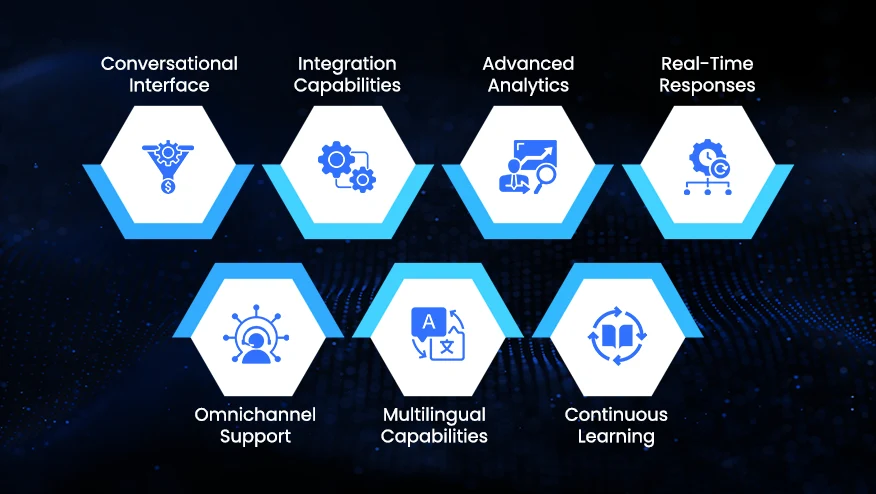
As interpreted in the earlier section, the features are the core determining factor for the efficiency and relevance to your business needs. Therefore, make sure that your AI assistant carries the features according to your particular business requirements-
1. Conversational Interface
The conversational interface has always been one of the best user interfaces that can be used, even by stakeholders with no technical expertise. Therefore, you should ensure that natural language processing capability in your AI assistant that can understand the intent, handle complex queries, and adapt to new learning from the interactions.
2. Integration Capabilities
The AI assistant functions best in integration with the existing business software. This feature allows your AI assistant to connect with other important business software, share data, process information, and automate the workflow.
3. Advanced Analytics
This feature makes the AI assistant capable of analyzing large volumes of data and converting the raw information into actionable insights. It ensures that you always make decisions on the basis of historical information, customer expectations, and market trends.
4. Real-Time Responses
No matter how big a team of human assistants you hire, there is always a gap between query submission and response generation. Therefore, the real-time response feature allows the AI assistant to generate instant outputs by accurately analyzing the commands and triggers given in the input.
5. Omnichannel Support
Omnichannel support feature enables the AI Assistant to function seamlessly across platforms like website, mobile app, email, social media, spreadsheets, and much more. It makes the software easier to use and establishes a better data flow.
6. Multilingual Capabilities
This is one of the most useful and basic features that comes with all the AI assistants. The multilingual support ensures that the AI assistant can be used by businesses and users worldwide. At the same time, it even increases the use case of the software by exhibiting real-time translation and localization.
7. Continuous Learning
This is the best feature, mostly incorporated into customized and high-end AI assistants. As the name suggests, the feature enables the software to learn from the interaction over time. Therefore, the performance and quality of outputs continuously enhance over time.
5 Best AI assistants in 2026 (Our recommendation)
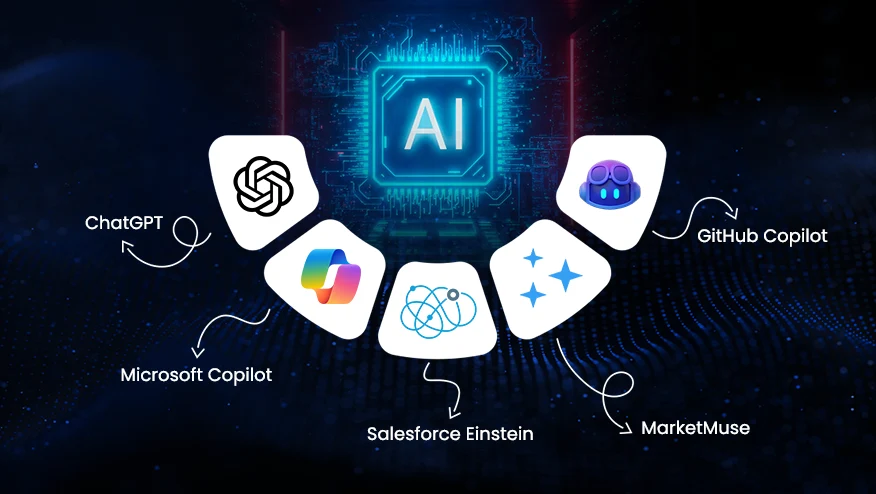
It is an AI era, and we have plenty of AI assistants around us to appreciate as the ideal examples. Also, having a glimpse of the best AI assistant also helps to answer our question “How to Choose AI Assistants for Business”. Therefore, we have created a list of the best AI assistants in 2026 along with their specialization in the respective domain or key workflow-
1. ChatGPT- Content Curation & Idea Generation
Whenever we talk about artificial intelligence, ChatGPT always tops the list. Not only was it the first platform that introduced AI to mass, but it has undergone periodic upgrades to align with changing requirements. ChatGPT comes with natural language understanding that helps with various tasks like content creation, coding support, strategic brainstorming, and research assistance.
ChatGPT has more than 900 million weekly active users with over 2.5 billion daily prompt processing. Most of the businesses rely solely on this tool for their content creation, idea generation, and strategy curation.
2. Microsoft Copilot- Workflow Automation & Enterprise Productivity
Microsoft Copilot is designed to be integrated into Microsoft 365, which is currently used by over 3.7 million organizations globally. It connects to platforms like Word, Outlook, Excel, and Teams to automate different tasks like report generation, data summarization, meeting insights, and email drafting.
Due to the integration between Microsoft Suite and Copilot, the software is used in different domains like sales, marketing, HR, administration, etc.
3. Salesforce Einstein- Predictive Sales Intelligence
While Salesforce in itself is a great customer relationship management software that helps businesses to better understand their customer needs and provide a personalized experience, Salesforce Einstein takes the game to an entirely new level. The AI counterpart brings features like opportunity forecasting, revenue prediction, automated email insights, and lead scoring.
All these core competencies play a significant role in empowering the sales teams while offering the real time recommendations to shorten sales cycles while enhancing overall win rates.
4. MarketMuse- Content Intelligence and SEO Strategy
Search engine optimization has been the go-to concept for businesses globally to rank well on the search engines, get leads, expand businesses, and connect with potential customers. While manual SEO is getting ineffective, the use of MarketMuse for advanced and automated SEO brings competitive advantages.
MarketMuse helps businesses to create AI-powered content planning, SEO optimization insights, and competitive analysis. A wholesome amount of high-quality data can be collected with these practices that encourage the overall organic growth of the organization.
5. GitHub Copilot- Developer Productivity & AI Code Completion
GitHub Copilot is a highly appreciated tool among the global developer community as it is designed to analyze the codebase context, provide smart recommendations, and reduce human errors from development tasks. Whether it is single-line autocompletion or full function implementations, GitHub Copilot covers it all.
The core capabilities, like context-aware code generation, copilot chat for problem sharing, and automated documentation, make the development process much easier for programmers.
Custom vs. Ready-made solution
When planning to bring an AI assistant to the businesses, there are two major options that most decision makers consider. The first one is a customized AI assistant that is built from scratch with all the features imparted according to particular business and workflow requirements. The second one is ready-made solutions offered by certain vendors, which are easy to deploy but come with limited customization.
Let’s have a look at both types of AI assistants and find out which one to choose-
| Factor | Custom AI Assistant | Ready-made Solutions |
|---|---|---|
| Business Alignment | Customized solutions are designed according to real-time business needs, KPIs, workflow, and departmental objectives. | Ready-made solutions are designed for the generic workflow and business tasks. |
| Scalability | Custom AI assistants are highly scalable and capable of handling an increasing user base and new features. | The scalability depends on the vendor roadmap, with no guarantee for the new features. |
| Data Ownership & Control | Offers complete control over the hosting environment, data pipelines, and governance policies. | Data handling is entirely dependent on the third-party infrastructure. |
| Integration Capabilities | Can be seamlessly integrated into legacy systems like CRM, ERPs, and internal tools. | Can be integrated only with predefined connectors. |
| Customization Scope | Custom AI models, personalized LLMs, role-based agents, and enterprise RAG can be integrated. | Features are set according to the vendor’s plan. |
| User Experience | Personalized user interface with design according to brand themes and easy navigation. | The user interface is decided by the vendor with very minimal scope for changes. |
| Cost Structure | Requires a higher initial investment as all the features and technologies are imparted from scratch. | Requires less upfront cost but needs to be renewed according to the subscription plan. |
| Development Time | Needs more time to develop. | Can be deployed in a comparatively shorter timeframe. |
Thus, no doubt customized solutions have superior performance and more scope for business alignment. While the off-the-shelf solutions can be considered for the short-term advantages, they can not be expected to scale according to business needs.
It is highly suggested to build a customized AI assistant under the technical guidance of an experienced development company like The NineHertz or Azilen Technologies.
Conclusion
AI assistants have been outperforming human assistants in terms of accuracy, timeliness, and cost efficiency. Not only do they provide around-the-clock assistance, but their efficiency also increases over time. However, choosing the right AI assistant is highly crucial, but can be complicated at the same time. Therefore, it becomes important that you consider factors like usability, features, cost, technologies, and compliance alignment when choosing an AI assistant for yourself.
If you are also looking to hire an AI assistant but are still confused about what to trust, you can reach out to our team for a free consultation.
FAQs on How to Choose AI Assistants for Business?
How to choose a multilingual AI voice assistant for business?
Answer- You can consider the following practices to choose the right AI assistant for your business-
- Identify Business Goals and Use Cases
- Evaluate the Features
- Security & Compliance
- Integration Capability
- Real World Testing
- Ease of Use
- Calculate ROI
- Assess Scalability
What is the difference between a custom AI assistant and a ready-made one?
Answer- A custom AI assistant is designed from scratch with all the features and technologies imparted according to business needs. Thus, it also requires more upfront investment and time. Ready-made solutions are offered by vendors that can be deployed in businesses with certain customization. It requires comparatively less time and resources.
How much does it cost to develop a custom AI assistant?
Answer- It costs anywhere between $40,000 to $300,000 to build a custom AI assistant. However, certain factors help to determine the exact AI assistant development costs. The key factors are development approach, location of development team, AI model & integration, features, maintenance, development timeline, hiring model, etc.
How long does it take to build a customized AI assistant?
Answer- A custom AI assistant can be designed within 4-6 months. However, similar to the cost, different factors like third-party integration, team size, hiring model, data availability, and project complexity can influence the overall development timeline.
Get in Touch with
AI Experts
Kapil Kumar is a leading voice in the field of Artificial Intelligence, blending deep technical expertise with a passion for innovation and real-world impact. As an accomplished author, researcher, and AI practitioner, he brings clarity to complex technologies—making AI not only understandable, but actionable. Whether decoding algorithms or envisioning ethical frameworks for AI, he is committed to guiding professionals, students, and tech enthusiasts through the rapidly evolving world of artificial intelligence.