

How Do AI Dash Cams Work in Construction Vehicles?

Key Takeaways:
- The U.S market for AI dash cams is expected to reach $3.77 billion by 2035 with an annual growth rate of 16.39%.
- The construction industry accounts for 1032 fatal occupational injuries every year, making it one of the riskiest industries to work in.
- AI dash cams for fleet management are becoming popular as they enhance accountability and minimize liability in a high-risk industry.
- Traditional dash cams can only show you what went wrong. But AI dash cams can show you what is about to go wrong and what actions you can take to prevent it.
- AI dash cams monitor risky behaviours and flag dangerous patterns such as hard braking or swerving while driving.
The construction industry accounts for 1032 fatal occupational injuries every year, making it one of the riskiest industries to work in.
Even if a single incident occurs, it leads to vehicle damage and triggers an OSHA investigation. It only takes one collision to destroy months of progress, and fleet managers are well aware of this pain. When companies use traditional dash cams, they provide footage and tell you what went wrong, but only when damage has already been done.
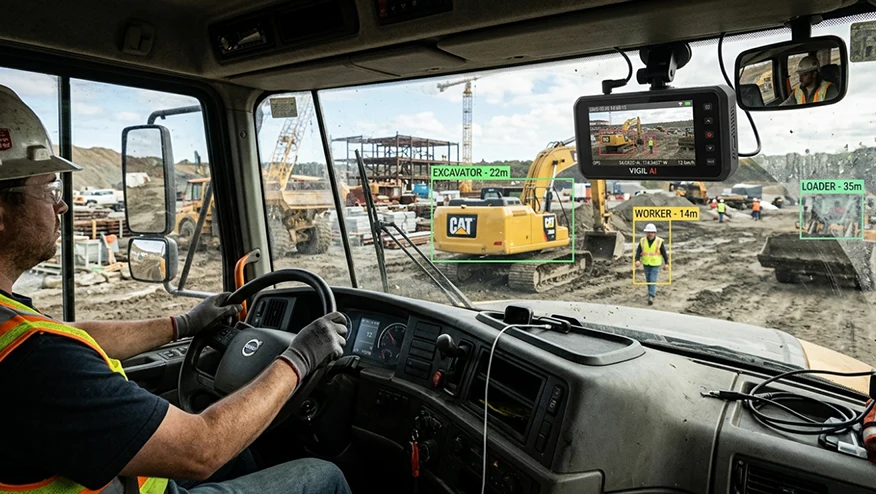
That’s why understanding how do AI dash cams work in construction vehicles is not optional anymore. Instead of waiting for an incident, they can detect distracted driving or other issues in real-time and alert drivers or fleet managers before the situation becomes worse. AI dash cams can flag events and help drivers improve with cloud-based coaching tools.
In this blog, let us understand how can AI dash cams reduce accidents, the technologies behind dash cams, and how they differ from traditional dash cams.
Importance of safety in the construction industry
The construction industry is considered one of the riskiest industries, especially in places where fleet operations take place.
It tops in workplace fatalities. 1 Out of 5 fatal injuries would have happened in the construction industry. The construction site contains heavy equipment and huge commercial vehicles such as excavators, dump trucks, and loaders. Unlike roads, they don’t have a fixed layout, and the environment keeps changing.
That’s why the risk of accidents is high in the construction industry when compared to other industries. Common dangers at construction sites include improper usage of equipment, vehicle collisions, and a lack of visibility for drivers of their surroundings.
If an accident occurs, it leads to severe injuries to workers, affecting the continuity of work, and results in legal liabilities and increased insurance costs.
That’s why modern construction companies have started using safety technology such as AI dash cams. The dash cams used in the construction fleet provide real-time video footage, helping fleet managers to clearly view daily operations.
AI dash cams integration in construction technology helps monitor the behaviour of drivers and identify potential hazards. By providing visibility into vehicle operations, AI dash cams are enabling construction companies to build safer site environments.
How Do AI Dash Cams Work in Construction Vehicles?
Artificial intelligence dash cams are very useful for fleet management. But you must be wondering how do AI dash cams work in construction vehicles, and whether we can benefit from installing them? Let us explore how dash cams work with AI. In simple words, an AI dash cam uses a physical camera device with AI software that monitors driver behaviour and their surroundings.
A construction vehicle operates on job sites where there are blind spots and workers who are just feet away from heavy equipment. The fleet operators work 10 to 12 hours on heavy machinery. That’s why it is important to build AI, particularly for the construction environment.
The camera continuously records the surroundings and the drivers who are operating construction vehicles. An AI software analyzes the footage in real time. For example, it can detect if the operator is tired and give him an in-cab alert before the fatigue turns into an incident.
Here’s how AI dash cams integration in construction technology functions and acts as an extra pair of eyes for fleet managers.
Real-time detection: AI dash cams monitor risky behaviours, such as drivers using phones, or if they are distracted or tired, and they can also flag dangerous patterns like hard braking or swerving while driving. It is important to detect such activities in a construction environment, which can otherwise turn into fatal incidents.
Immediate alerts: When an AI dash cam identifies a risk, it issues an in-cab audio alert or visual warning that helps drivers correct their behaviour on the spot. For example, a dump truck reversing toward a worker happens in a second, and they have to be corrected immediately with an alert instead of creating a report.
Event recording: AI dash cams in construction vehicles can save video clips of incidents automatically, like near misses or collisions. This footage can act as direct evidence in OSHO investigations and insurance claims without disputes.
Cloud upload and analysis: Most AI dash cam systems used in construction fleets are connected to the cloud and upload critical footage to fleet management platforms. Fleet managers can review incidents from their system without detaching AI dash cams from the vehicle.
Key Technologies Behind AI Dash Cams
The power of an AI dash cam lies in its hardware and the stack of technologies that work underneath. Understanding what’s inside the device can help you make informed decisions and set realistic expectations about its capabilities.
1. Computer Vision
Computer vision in AI dash cams is the primary technology that allows Cameras to see and identify objects like vehicles, equipment and workers.
2. Convolutional Neural Networks
AI dash cams in construction vehicles use CNN models to analyze driver behaviour and vehicle movement. This technology in AI dash cams minimizes the risk of collision by identifying external traffic elements.
3. Edge computing
Computer vision models are deployed on the dash cams using edge computing technology. In the construction site, you don’t have the luxury of waiting for a cloud server to process information. Edge processing makes it possible for the system to think and react on the vehicle itself to give real-time alerts.
4. Advanced AI processors
AI dash cams use high-end processors which can run together with more than 30 high-precision AI models.
5. Machine Learning
ML algorithms are used to train the camera to recognize risky behaviour such as distracted driving and tailgating.
6. Sensor Fusion
Construction-grade systems use dual-band GPS that is more precise than the GPS available in applications like Google Maps. Dual band GPS tells the driver in which lane they are and whether the vehicle is on the right or left with accuracy.
AI dash cams also use a G-Sensor, which detects shocks and measures physical forces on the vehicles, such as a sharp turn or a sudden collision and informs fleet managers about them.
7. Cloud and 5G connectivity
High-priority clips from saved video footage are uploaded to the cloud for manager review and legal evidence.
4 Types of AI Dash Cameras Used in Construction Vehicles
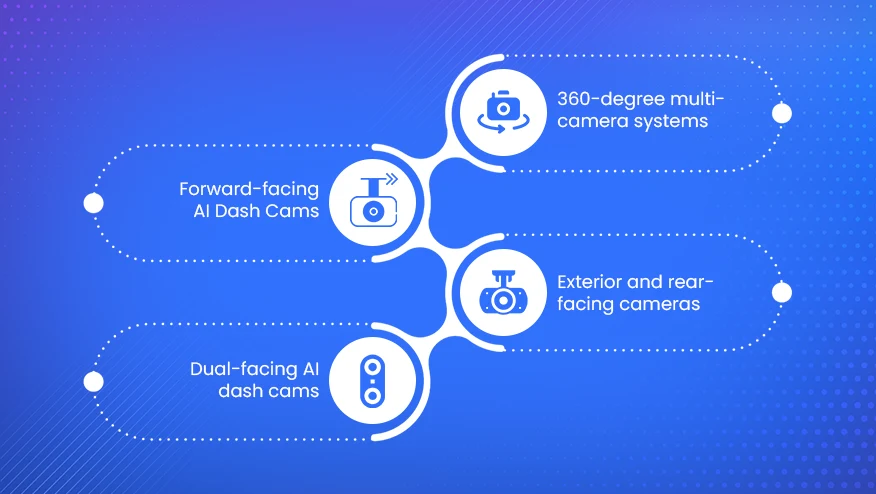
- Forward-facing AI Dash Cams: This is one of the basic types of dash cams that help capture footage of accidents and near misses in front of the vehicle. These cameras will detect road-facing risks and their footage as solid evidence to speed up the claims process.
- Dual-facing AI dash cams: These AI dash cameras can capture footage both in front of the vehicle and events that happen inside the vehicle. They can prove that drivers are practicing good behaviour while coaching them with the help of in-cab alerts.
- 360-degree multi-camera systems: This is a game-changer for heavy equipment and provides complete visibility around it, helping reduce blind spots. These AI dash cams are valuable in high-risk operations like excavation or demolition.
- Exterior and rear-facing cameras: Exterior cameras placed outside the vehicle capture a 360-degree view of the surroundings and are useful when drivers face blind spots and need to make tight turns. Rear-facing cameras are essential for construction vehicles like dump trucks and concrete mixers that have to reverse frequently in close spaces with workers nearby.
4 Key Features of AI Dash Cams for Construction Equipment
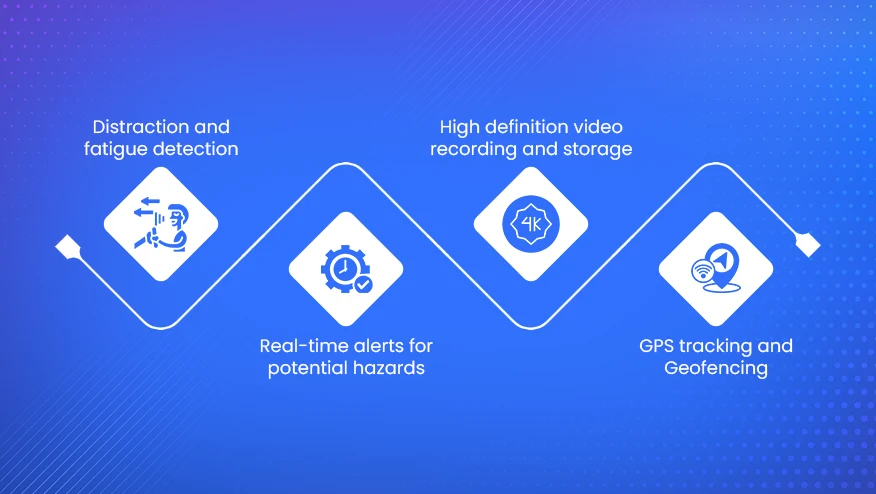
Distraction and fatigue detection: Construction operators work for longer shifts. AI dash cams monitor drivers to detect whether they’re sleepy or distracted to flag their behaviour and provide in-cab alerts.
Real-time alerts for potential hazards: Danger may come in any form in construction sites. AI dash cams analyze driving time and detect unsafe practices. They can trigger an alert and help drivers to react in a few seconds, preventing accidents.
High definition video recording and storage: AI dash cams have in-built night vision and sensors to capture high-quality footage. They can be stored in the local SD card and in the cloud.
GPS tracking and Geofencing: GPS tracking units can identify if there are fuel inefficiencies and optimize routes. Geo-fencing sends alerts to fleet managers when a vehicle moves out of a permitted zone. This feature can prevent equipment theft when unauthorized persons access vehicles.
AI Dash Cams vs Traditional Dash Cameras
Earlier dash cams were very simple. When you fix it in a construction vehicle, it will just record what’s happening and store it on the SD card. If an accident occurs, fleet managers will watch the footage and analyze why that incident happened. The traditional dash cam simply witnesses and records videos, but does not react to them.
But technology has changed a lot now. Companies were able to reduce risks by monitoring surroundings and analyzing drivers’behaviour in real-time after AI dash cams integration in construction technology.
Traditional dash cams can only show you what went wrong. But AI dash cams can show you what is about to go wrong and what actions you can take to prevent it. This proactive approach is an answer to how can AI dash cams reduce accidents in construction areas.
For example, if a driver glances down at his phone, the AI dash cam would alert him immediately with a short audio prompt, “Keep your phone down.” This prompt will help drivers to fix their mistakes right away before something undesirable happens. AI dash cams escalate the events to fleet managers, unlike traditional cameras.
If you’re planning to upgrade from traditional systems to AI dash cams, this table will help you understand the difference between them.
| Feature | Traditional dash cams | AI dash cams |
|---|---|---|
| Primary function | Passive video recording | Records video and real-time monitoring |
| Incident Response | After an accident occurs | Gives proactive alerts to drivers |
| Driver monitoring | None | Checks if they’re tired or distracted |
| Storage | SD card | Cloud and SD card |
| AI detection models | None | More than 30 neural network models work together |
| Monthly expenses | Low or one-time hardware | Ranges between $15 to $60 per vehicle |
| Insurance benefit | Acts like a witness and provides evidence | Premium savings of 5% to 20% |
Benefits of Using AI Dash Cams in Construction
Construction fleets are different from other commercial fleets. The construction site is filled with heavy equipment, vehicles, and different types of machinery that operate on rough surfaces. That’s why there are more chances of accidents happening in this environment. AI dash cams in construction vehicles help improve safety and better fleet management.
1. Instant safety alerts for drivers:
AI dash cams give immediate alerts to drivers when they are doing something risky. For example, if they are tailgating or distracted while driving, it provides real-time alerts to drivers. This helps them correct their actions before they become problematic and minimizes accidents.
2. Tracks driver behaviour:
AI dash cams integration in construction technology helps track driver behaviour. Cameras monitor if the driver is wearing a seat belt or not, or if the driver is using their phone while driving.
Fleet managers can later use the footage to train drivers and correct their unsafe driving habits.
3. Evidence during incidents:
AI dash cams provide useful evidence when there are accidents or near-miss incidents. Companies can use this evidence for insurance claims or dispute resolution. It also helps analyze the root cause behind incidents.
4. Integration with Fleet Management Systems:
AI dash cams in construction vehicles can integrate with existing fleet management platforms. With this integration, you can analyze video data and telematics data in the same system.
5. Secure Video Storage:
AI dash cams use hybrid Storage enabling you to store the footage on the local SD card and cloud storage. This facilitates your access to data anytime, anywhere.
6. Improved fleet efficiency:
Fleet managers can improve operations using the footage stored by AI dash cams. For example, they can optimize routes and reduce unnecessary fuel consumption. Thus, AI dash cams help improve fleet efficiency.
7. Protection against false claims:
AI dash cams integration in construction technology protects companies and drivers from false allegations. Footage recorded and saved by them contains clear time stamps and a 360-degree view of the surroundings.
Future of Construction Safety with AI Dash Cams
The U.S market for AI dash cams is expected to reach $3.77 billion by 2035 with an annual growth rate of 16.39%. AI dash cams for fleet management are becoming popular as they enhance accountability and minimize liability in a high-risk industry.
Today’s AI dash cams can detect driver fatigue. But in the future, AI dash cams in construction vehicles can predict what is about to happen rather than recognizing something happening in the present.
Companies are now using Predictive Fusion AI systems that look into the future based on past and present factors. AI dash cams can be connected with telematics and site management software, creating a well-connected construction site.
U.S. federal and OSHA regulations are tightening around fleet safety. From being a safety tool, AI dash cams are becoming a compliance tool because of this.
Industry experts predict that in five years, AI will become a part of the vehicle’s active safety systems. The more you use the AI dash cams in vehicles, the smarter they get and become more accurate than they were before.
Conclusion
AI dash cams are gradually changing the way the construction industry works. With the improvement of technology, AI dash cams are becoming smarter day by day.
They use computer vision and Artificial Intelligence to identify people and other obstacles while driving. Companies are increasingly adopting AI dash cams as their cost is gradually reducing with an increase in efficiency.
Even small and medium-sized construction companies can afford AI dash cams because of the wide availability of hardware and software technology. AI dash cams integration in construction technology helps create safer job sites.
FAQs
How do AI dash cams improve safety in construction zones?
Drivers don’t have complete visibility in construction sites due to blind spots or while reversing the vehicle. AI dash cams are capable of recording and analyzing surroundings and providing in-cab alerts to drivers. Now you can understand how do AI dash cams improve safety in construction zones.
How much do AI dash camera systems cost?
The price of AI Dash cams varies based on their features. Basic dash cam hardware costs between $200 and $500 per vehicle, depending on features such as a front-facing or dual-facing camera. Many advanced dash cam platforms charge a monthly subscription of around $15 to $60 for features such as cloud storage and AI analytics.
How can AI dash cams reduce accidents in construction areas?
In construction areas, accidents happen because of poor visibility for drivers and unpredictable movements by workers. AI dash cams integration in construction technology can reduce these risks in many ways.
They can continuously monitor the surrounding environment and detect obstacles. AI dash Cameras can send immediate alerts to drivers after analyzing their behaviour. Dash cams can analyze incident footage to identify unsafe driving patterns and provide better safety training to drivers.
Get in Touch with
AI Experts
Kapil Kumar is a leading voice in the field of Artificial Intelligence, blending deep technical expertise with a passion for innovation and real-world impact. As an accomplished author, researcher, and AI practitioner, he brings clarity to complex technologies—making AI not only understandable, but actionable. Whether decoding algorithms or envisioning ethical frameworks for AI, he is committed to guiding professionals, students, and tech enthusiasts through the rapidly evolving world of artificial intelligence.