

ChatGPT Integrated into U.S. GenAI.mil Initiative

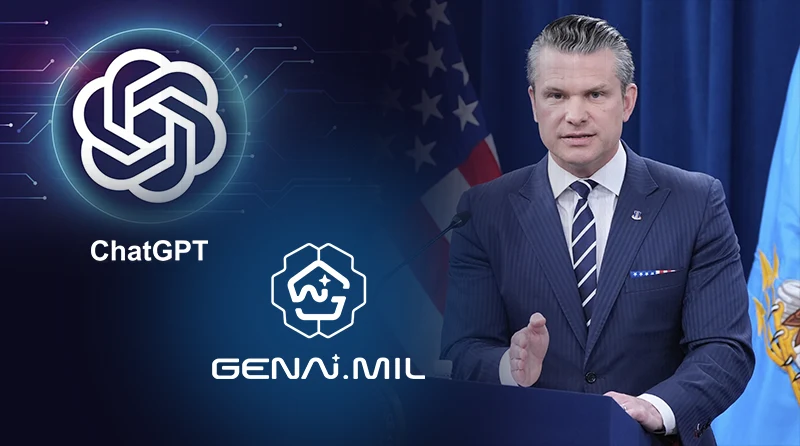
The U.S. government’s internal push to operationalize generative AI took another step forward with the announcement that ChatGPT will be integrated into GenAI.mil, the Department’s enterprise platform designed to put frontier AI tools into the hands of millions of personnel.
GenAI.mil was positioned from the start as a central “front door” for secure AI usage—less a single model, more an ecosystem where approved capabilities can be accessed under consistent guardrails. In late 2025, the Department publicly framed the platform as a way to cultivate an “AI-first” workforce and accelerate routine workflows, initially emphasizing the launch of Gemini for Government as an early flagship model on the system.
Now, adding ChatGPT signals an expansion strategy: bring multiple best-in-class models into a controlled environment and let teams apply them to real work, rather than forcing one-model-fits-all adoption.
Why ChatGPT, and why now?
According to the Department’s announcement, integrating ChatGPT is presented as a practical move to make “frontier AI capabilities” more standard in day-to-day operations—supporting knowledge work at scale across the enterprise. That lines up with the broader direction outlined in the Department’s AI strategy documents, which emphasize democratizing access to leading models “at all classification levels” while maintaining secure implementation pathways.
In plain terms, the promise is speed and lift: drafting and summarizing internal documents, accelerating research and analysis, helping teams build and review plans, and reducing administrative drag. Previous coverage around GenAI.mil’s debut highlighted use cases such as onboarding support and contract-processing assistance—work that is high-volume, rules-heavy, and often slowed by manual coordination.
The ChatGPT integration also reflects a broader pattern: GenAI.mil is being treated as a modular platform where model choice can follow mission needs, rather than a monolithic deployment that lives or dies on a single vendor.
The governance questions don’t go away
Any expansion of generative AI inside government systems invites scrutiny—especially around data handling, auditability, and the boundary between “helpful assistant” and decision-making tool. The Department’s public positioning has consistently framed GenAI.mil as a secure environment for experimentation and productivity, but the details that matter most to practitioners are operational: What data is allowed in prompts? What logging exists? What red-teaming has been done? How are outputs validated before they influence real-world actions?
Those questions are not unique to ChatGPT; they apply to every model introduced into an enterprise environment. What changes with ChatGPT’s addition is simply the scale of attention. OpenAI’s flagship product is widely used in the private sector, and its arrival on GenAI.mil will raise expectations that the platform can deliver immediate value—while also increasing pressure to prove it can do so responsibly.
For government teams watching the rollout, the near-term story is less about hype and more about implementation: whether multi-model access inside GenAI.mil translates into measurable time savings, better internal documentation, and smoother cross-team execution—without compromising security or accountability. The integration is a milestone, but the real test will be what happens after the announcement: adoption, training, guardrails, and the hard work of making AI useful on purpose.