
How AI Reduces Costs in Supply Chain Management?

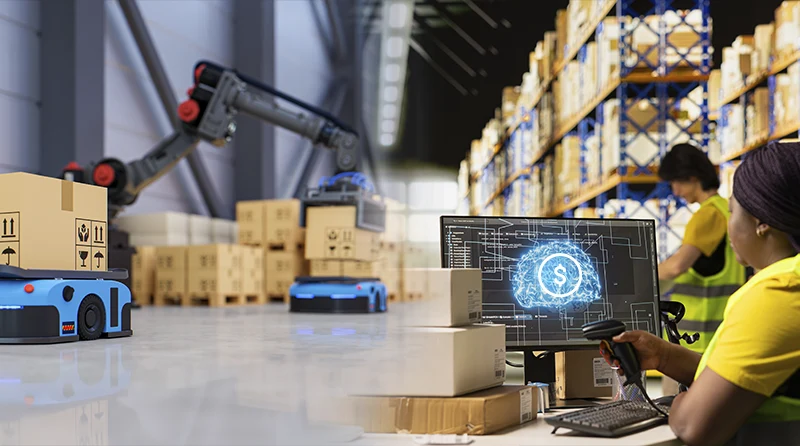
Some of the top global supply chain cost pain points are volatile freight rates, inflationary pressures on raw materials, and high inventory holding costs. Additionally, challenges with demand forecasting and price optimization result in lost business opportunities and revenue.
According to Accenture’s study, supply chain disruptions caused $1.6 trillion in missed revenue. The challenges are increasingly becoming complex, and the only solution is to utilize AI in operations.
Introduction
AI/ML can lower costs and ease problems in the supply chain by helping managers make better decisions in each stage of the process.
Artificial Intelligence can help you improve logistics cost by 15%, inventory level by 35%, and 65% of service levels [McKinsey & Company]. It helps supply chain companies make confident decisions, adopt innovative business practices, and reduce overhead. Supporting the facts, AI in the supply chain market is set to reach $50.41 billion by 2032, at a CAGR of 20.2% (2025-2032). North America is the dominating market with 36.7% share, and the Asia Pacific is the fastest-growing market.
These pressures have changed how supply chains operate. Cost control is no longer only about negotiation or scale. It now depends on how quickly companies can analyze data, predict changes, and respond in real time. This is where AI starts to play a larger role across supply chain operations.
The Growing Role of AI in Supply Chain Management
The manual processes and static rules for supply chain operations are no longer effective. These struggles with volatility, scale, and speed increase the cost for businesses and result in a loss of revenue. Many teams still depend on manual work, fixed rules, and past data. That approach now creates more problems than solutions.
This is where AI is slowly becoming part of daily supply chain decisions, not as a replacement for people, but as support where professionals struggle most. AI can process large amounts of data that teams cannot review in time. It looks at demand signals, supplier data, inventory levels, and logistics performance together. Humans usually see these as separate pieces.
AI’s role in supply chain operations goes beyond automating basic tasks. Predictive analytics and demand forecasting help businesses plan inventory more accurately.
Inventory optimization helps reduce excess stock while avoiding shortages. While AI improves route optimization, it also works with transportation management systems (TMS) and warehouse management systems (WMS). With enterprise resource planning (ERP) tools, AI improves supply chain visibility. It is easier to identify inefficiencies and understand where costs accumulate.
Where Costs Accumulate in Traditional Supply Chains?
In conventional supply chains, costs accumulate at each step as the product moves from sourcing to customer delivery. The fact is, these costs often build up due to some key reasons such as multiple intermediaries, inefficient processes, over- or under-inventory levels, and more.

Let’s understand it!
- Inventory Carrying and Excess Stock
Holding too much of the wrong inventory or stock increases handling and storage costs. When companies overestimate demand, they end up with excess stock that resides in warehouses. Slow-moving products block working capital. In some cases, goods expire or become outdated. Businesses then discount heavily just to clear space. What looked like a safe decision turns into lost profit.
- Transportation and Fuel Inefficiencies
Transportation is one of the significant cost-accumulating factors in supply chain management. In the absence of route optimization, fuel and operational expenses are higher. It leads to deadhead miles, where trucks run empty or partially full, fuel waste happens during congestion, and creates last-mile complexity that increases per delivery cost.
- Labor-intensive Warehouse Operations
Manual picking, packing, and sorting of goods is a cost-intensive process. The process is slow and often leads to human errors. Furthermore, handling reshipping and returns is also painful and adds high cost to the supply chain operations. During the peak season for managing long shifts, labor wages and administrative overheads also increase.
- Supplier Risk and Procurement Inefficiencies
Supplier risk management is also crucial in terms of cost. Why? Unreliable suppliers and procurement inefficiencies create issues such as rushing orders at the end of the time, holding extra safety stock, and disappointed customers. For example, a low-cost supplier may increase long-term risk through delays or quality issues. These disruptions affect production schedules and customer commitments.
- Demand Volatility and Stockouts
The entire supply chain industry depends on the demand and supply of goods. But, due to the seasonal changes, market trends, and unexpected events, demand rarely stays stable. Manual demand forecasting often leads to inaccuracy, overstocking, or running out of inventory. It leads to lost revenue. On the other hand, it locks up capital and storage space. Eventually, it also increases the cost.
The conventional supply chains struggle to stay efficient, but fail as global industry demands are shifting rapidly. Using AI for supply chain management is the only solution.
AI Applications in Supply Chain Management That Reduce Costs
Do you know that AI-based supply chain management solutions help reduce cost by up to 20% through demand forecasting, route optimization, and inventory management.
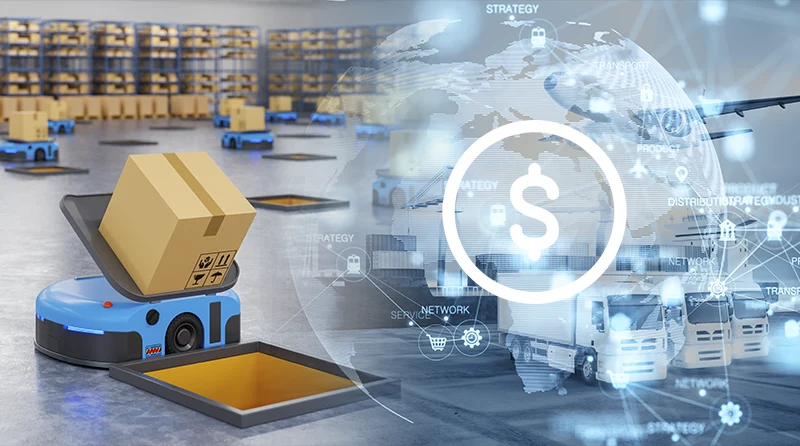
Overall, it improves efficiency. AI works as a potent instrument to help organizations eliminate bottlenecks such as manual data silos, rigid logistics planning, excess inventory, stockouts, and warehouse delays.
Let’s understand it through applications and how AI reduces costs in supply chain management.
- Demand Forecasting and Predictive Analytics
An inaccurate forecast is an avoidable condition for supply chain businesses, and it can cause over- or understocking challenges. AI helps with demand forecasting, evaluating historical data, trends, weather, traffic, and other factors. Predictive analytics helps businesses and their teams adjust before demand becomes a challenge and predict demand with accuracy. This means fewer emergency shipments and lower inventory costs.
- Inventory Optimization and Automated Replenishment
Inventory is a key player in the supply chain business. It affects cash flow directly as excess stock creates waste and locks capital, and low stock leads to missed revenue. AI/ML tools adjust inventory levels in real-time, utilizing data such as sales, leads, and supply. Automated replenishment places the orders based on actual demand, rather than following static rules. As a result, companies achieved better supply chain visibility.
- Route Optimization and Logistics Planning
Route optimization and logistics planning are as crucial as inventory optimization, demand forecasting, and others. The biggest fear for any supply chain company is fuel cost. There are chances that the planning team sits at another location and does not know the routes completely.
In another scenario, manually, it’s impossible to predict the weather and traffic conditions. AI and Machine Learning solve all these challenges. AI systems analyze delivery schedules, fuel usage, traffic patterns, customers’ time windows, and load capacity. Based on their recommended fuel-efficient route, it helps teams with appropriate logistics planning. This reduces delays and freight costs.
- Warehouse Automation and Robotics
Manual warehouse management leads to high labor costs and human errors. On the other hand, AI in supply chain management helps with warehouse automation that reduces repetitive work, and teams can focus on core & strategic tasks. Robotics lowers the labor costs through smart picking, packing, and space allocation without human intervention.
Predictive maintenance also reduces downtime by identifying equipment issues before breakdowns occur. Together, these improvements lower operational costs and improve efficiency within the digital supply chain.
- AI-driven Procurement and Supplier Analytics
AI and ML analyze suppliers based on key factors such as supply chain cost, material quality, pricing, lot size, historical sourcing data, and geopolitical risks. This eliminates the vague choices that a business makes manually about the suppliers. As a result, you’ll have uninterrupted sourcing, improved negotiation, no hidden costs, and reliable suppliers from all over the globe.
In addition to the above, the key benefits of AI integration in the supply chain business are reduced logistics costs, improved efficiency, lowered inventory, and enhanced resilience.
As a matter of fact, AI in supply chain management drives tremendous results from real-time data analytics to establish robust, digital supply chain systems.
However, AI is an umbrella term and comprises its subsets, such as Gen AI, Agentic AI, Natural Language Processing(NLP), and others. All these technologies have their dedicated applications in the sector.
Generative AI is one of the trending segments, and in real terms, businesses are leveraging it for better efficiency. Therefore, let’s continue with the next section to understand its relevance.
Generative AI in Supply Chain Management
According to an EY study, 40% of supply chain organizations are investing in Gen AI. The key use cases of GenAI in supply chain management help analyze vast data sets to generate insights, optimize operations, and automate complex decisions. Its key benefits are demand planning & forecasting, inventory optimization, risk management & resilience, logistics & route planning, sourcing, procurement, and content creation.
- Scenario Planning and Simulation
The scenario planning and simulation is preparing for “What-If” scenarios. Supply chain operations face uncertainty, regardless of the factor, such as harsh weather conditions, geopolitical unrest, low production, manufacturing crisis, unreliable suppliers, or any other factor.
Here, Gen AI simulates conditions and helps businesses to prepare in advance for crisis management. For example, what happens if demand increases by 20 percent? What if a key supplier fails?
The What-if modeling helps in optimizing resource allocation, rerouting inventory, reducing potential downtime, and more to streamline operations.
- Automated Reporting and Decision Support
Manual report-making is a time-consuming process. Managers spend too much time reviewing the spreadsheets and documents. This slows down decision cycles.
Generative AI makes this process easy for the teams. These systems create customized reports and drive deep insights from the vast, complex supply chain data. It supports executives by explaining model outputs, running ad-hoc analyses, and suggesting optimizations.
Using automated reporting backed by Gen AI, making informed decisions is easier than conventional processes.
- Risk Modeling and Disruption Forecasting
Generative AI supports risk modeling by combining supplier data, market trends, logistics updates, and external factors. It can forecast possible disruptions and estimate their financial impact. Instead of reacting under pressure, teams can respond with structure and control.
Rather than replacing traditional AI in supply chain management, Generative AI strengthens it. It helps organizations stay prepared in uncertain conditions while keeping costs under control through supporting planning, reporting, and risk management.
Industry-Specific AI Applications
Supply chain management is not limited to a single specific industry. Every sector revolves around supply and demand. However, they face different supply chain pressures than others. In simple terms, the way AI is used in healthcare-based supply chains will not remain the same in e-commerce or manufacturing.
Let’s have a closer look at key industry-specific AI applications.
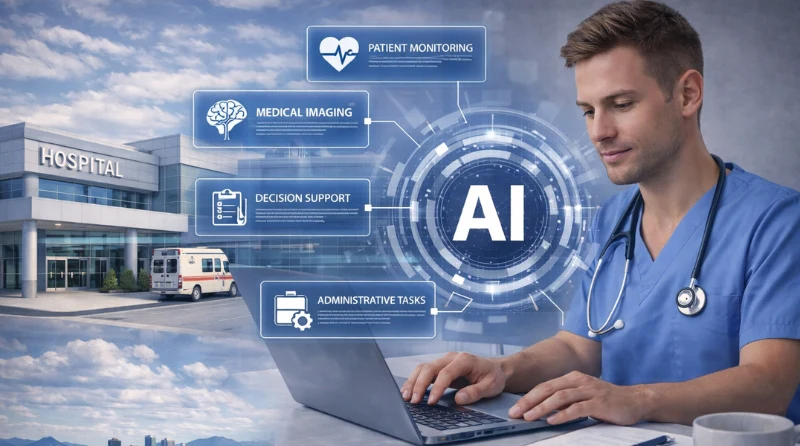
- AI Applications in Hospital Supply Chain Management
The hospital supply chain management is an end-to-end, coordinated process of sourcing, purchasing, storing, and distributing medical supplies, medical devices, equipment, and pharmaceuticals. This is to ensure that whenever it is needed for patient care, it must be available.
Key components are procurement, sourcing, inventory management, logistics and distribution, and supplier relationship management.
How does AI help?
AI analyzes historical data and other factors and helps with predictive demand forecasting. Automated inventory management tracks inventories and helps with reordering medical supplies and pharmaceuticals. The other applications of AI in healthcare supply chain management are strategic procurement, real-time tracking of logistics, clinical integration, and loss prevention.
- Retail and eCommerce Supply Chains
Retail and e-commerce are fast-growing industries, and they are not the same as they were five years ago. Even trends are changing overnight, which puts pressure on supply chain operations and management.
AI-based supply chain management helps retailers adjust inventory in real time. Predictive analytics improves demand forecasting by analyzing past sales, browsing behavior, and seasonal patterns. This lowers inventory carrying costs while reducing stockouts.
Route optimization also plays a key role. Faster delivery improves customer satisfaction, but inefficient logistics increases fuel and labor expenses. AI works with transportation management systems to select better routes and reduce delays.
For retail leaders, the AI impact on supply chain management is visible in better margins and improved customer experience.
- Manufacturing and Industrial Supply Chains
The supply chain has a core presence in the manufacturing industry. Manufacturers depend on a steady material flow. One delayed shipment can significantly impact production lines.
AI supports inventory optimization by balancing raw material supply with production schedules. When connected to ERP systems, it provides better coordination between procurement, warehousing, and operations.
Predictive maintenance is another key use case. AI analyzes equipment data to identify possible breakdowns before they happen. This reduces downtime and avoids expensive emergency repairs.
In manufacturing and industrial environments, AI strengthens the digital supply chain by improving planning accuracy and reducing operational risk.
Measurable Cost Savings from AI for Supply Chain Management
AI for supply chain management directly impacts the revenue and balance sheet. For example, well-managed inventory avoiding under- or overstocking means reduced wastage and less capital locked up. A better demand forecast means fewer emergency incidents to supply the goods. Thus, it’s true that AI delivers ROI in real time.
That is why 64% of supply chain leaders consider AI and GenAI capabilities important while planning new technology investments.
- Reduced Inventory Holding Costs
As we’ve discussed earlier in this blog, overstocking leads to holding a significant amount. However, with AI-driven inventory optimization and accurate demand forecasting, businesses can reduce excess stock by 15-30%. This means demand pattern-based ordering and reduced inventory holding costs.
AI inventory optimization also reduces the chances of understocking, which saves suppliers from the last-minute rush and havoc created when orders are more and inventory is less.
- Lower Transportation and Fuel Costs
Dynamic route optimization is one of the key benefits of using AI in supply chain and logistics. AI algorithms automatically analyze diverse factors such as traffic congestion, weather data, delivery locations, vehicle availability and capacities, and transportation mode. Considering all, AI supply chain systems re-route the deliveries to the fuel-efficient routes, reducing consumption and maximizing transportation utilization. As a result, a big portion of the cost is saved.
- Improved Supplier Performance and Negotiation Leverage
Some of the top reasons behind the hidden cost are quality issues and supplier delays. As a matter of fact, emergency sourcing, rush shipping, and production increase the expenses. But not with using AI in supply chain management.
AI enhances supply chain visibility and provides actionable insights to business leaders. This enhances the collaboration and coordination among suppliers, procurers, manufacturers, retailers, and distributors. Businesses can compare pricing trends, reliability metrics, and risk factors before making decisions. Better data strengthens negotiation leverage. Companies move from reactive purchasing to strategic procurement.
- Reduced Waste, Markdowns, and Returns
The best way to reduce waste and returns is for the right product to be at the right place at the exact time when needed. AI in the supply chain works tremendously, and it happens through hyper-local demand sensing (analyzes local weather, social media trends, and regional events to predict accurate need) and perishable management (monitoring shelf life and environmental conditions).
In terms of Markdown, AI reduces the mismatch between supply and demand. This enables teams to plan more accurately, which leads to fewer markdowns. AI can suggest incremental price adjustments based on real-time demand elasticity, preventing the need for clearance sales that reduce profit margins.
From a costing perspective, returns are not good for any business as they increase the carbon footprint and other expenses. Even in the healthcare sector, it can create expiry-related issues. AI reduces returns by improving demand accuracy, product matching, sentiment analysis, and quality control before goods reach customers.
Challenges and Risks
Now, you have gone through how AI reduces costs in supply chain management and have understood how it is beneficial for streamlined operations. However, there are certain associated challenges to adopting AI for the supply chain.
The key challenges are as follows:
- Data Quality and Integration Issues
AI feeds on data, and it is a universal truth. For example, generative AI-based systems require data for training to process any desired task. AI systems need clean and refined data, and if it’s inaccurate, the outcome will also be wrong and inconsistent.
Many supply chains run on disconnected systems. ERP, WMS, and TMS platforms may not share data smoothly. Manual entries create errors. Missing records reduce forecasting accuracy.
Without proper integration, AI models struggle to generate reliable insights. Before investing heavily, businesses must fix data silos and improve system alignment.
- Change Management and Workforce Adoption
Using AI for supply chain management also needs change management and workforce adoption. Employees may fear job loss due to AI and stick to the manual processes due to their comfort zone. This can create issues even before you officially introduce AI systems to the employees.
- Model Transparency and Operational Risk
We have read a myriad of times that AI and automation require less or no human intervention. AI models can be complex and produce inconsistent output that can put an entire team at operational risk. Especially if models are poorly configured, this happens. Still, these AI models and systems require observation, and that needs training and consistent learning.
To reduce the chances of risks and eliminate challenges, you need to play strategically. The better idea is to go with the pilot project first. Based on the outcomes, you can expand it on a full scale to gain the benefits.
Final Thoughts
AI is reshaping almost all industries, and this has surged in recent years. The supply chain industry is no exception, and already, businesses are witnessing real-time benefits of it. From a future perspective, AI will keep making the supply chain more stable by finding risks like relying too much on a few suppliers or areas. It will empower companies to better anticipate and react to large-scale disruptions.
AI will help businesses adapt quickly, reduce risks, and run their supply lines more efficiently by analysing and predicting things in real time. You only need to decide when to adopt it for your business for strategic benefits.
FAQs
1. Will Supply Chain Management Be Replaced by AI?
No, the supply chain management will not be replaced by AI, even though it will work as a supporting system. By collaborating with AI and human expertise, businesses can strengthen the decision making process and streamline supply chain management.
2. What are the applications of AI in supply chain management?
Key applications of AI for supply chain management include:
- Demand Forecasting and Planning
- Predictive Analytics
- Inventory Optimization
- Route Optimization
- Supplier Relationship Management, and more.
3. What is a primary function of AI in supply chain management?
The primary functions of AI in supply chain management are demand forecasting, predictive maintenance, risk management, automation, and increasing efficiency. This happens through analyzing vast amounts of supply chain data.
4. How does GenAI help with sustainability in supply chain management?
Generative AI helps supply chain companies through scenario analysis and algorithm optimization. It is capable of identifying opportunities for reducing carbon emissions, minimizing waste, and promoting ethical sourcing practices.
5. How does AI help in warehouse operations?
AI in warehouse operations helps through automation and robotics. The automation and robotics tools are useful for repetitive and labor-intensive tasks such as picking, packing, and sorting.
Get in Touch with
AI Experts
Kapil Kumar is a leading voice in the field of Artificial Intelligence, blending deep technical expertise with a passion for innovation and real-world impact. As an accomplished author, researcher, and AI practitioner, he brings clarity to complex technologies—making AI not only understandable, but actionable. Whether decoding algorithms or envisioning ethical frameworks for AI, he is committed to guiding professionals, students, and tech enthusiasts through the rapidly evolving world of artificial intelligence.