

Japan AI Regulation News 2026: Key Developments and Government Updates


Key Takeaways
- Japan AI regulation is innovation-first: it encourages technology innovation and ethical use of AI.
- The Japan AI Promotion Act is not too strict in its requirements, but it is an example of the national AI strategy.
- Multiple government agencies work together to craft a joint Japan AI policy framework for safety, innovation, and economic competitiveness.
- Privacy, copyright, and competition laws are all examples of existing AI laws that apply to many of the operations, and this is a practical and layered AI governance system.
- Firms and startups can also draw on flexibility, but also need strong governance strategies like transparency, data security, and risk mitigation to grow trust and ensure compliance.
If you’ve been following Japan AI Regulation News, you might have noticed that Japan is on a slightly different path than other countries in terms of artificial intelligence rules.
Rather than rushing to implement strict laws, Japan is more committed to encouraging innovation and closely monitoring any risks that may arise. The government will try to get domestic firms to adopt and use AI responsibly, but not restrict technological progress. This balance is central to Japan AI policy.
So why did Japan introduce AI regulations in the first place?
The AI is emerging rapidly in all sectors: manufacturing, healthcare, finance, and public services. As adoption grows, concerns around misinformation, data privacy, copyright, and AI safety have become impossible to ignore.
As revealed by recent news of the AI regulation and ongoing updates on Japan’s AI regulations, policymakers are trying to set clear expectations for businesses and keep Japan competitive in the global technology race.
The urgency becomes clearer when you look at market growth and adoption trends:
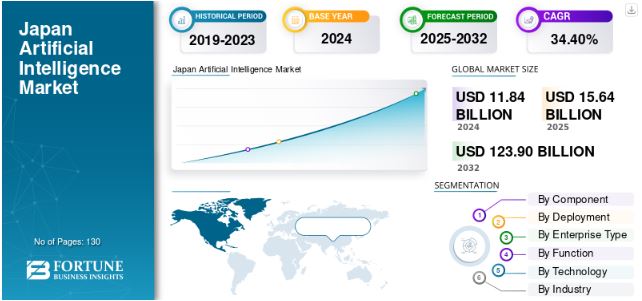
- Japan’s AI market is projected to reach up to $123.9 billion by 2032.
- Generative AI demand could reach $11.7 billion by 2030.
- About 31.2% of Japanese professionals already use generative AI at work.
- Japan’s overall AI adoption rate is around 51%, showing rapid expansion.
To this end, today’s news of Japan AI regulation is not policy talk, but also a reflection of how Japan is preparing its economy and society for an AI-driven future.
What Is Japan’s Current Approach to AI Regulation?
Japan AI regulation policy reflects a unique principle: it seeks direction and governance actively rather than structures and control. Instead of creating its own comprehensive AI bill, the government takes a more laissez-faire and pragmatic approach of encouraging innovation and addressing risk through existing legislation, industry cooperation, and ethical frameworks. This model accords with Japan’s belief that excessively strict regulations would impede technological progress in a rapidly evolving landscape.
One principle often described as “human-centric AI” is at the core of the Japan AI regulation strategy. Policymakers want companies to develop AI systems that are transparent, secure, and useful for society. In Japan, the current laws on privacy, consumer protection, intellectual property, and cybersecurity are updated to address AI use cases rather than creating entirely new enforcement bodies. The Ministry of Finance also issues voluntary advice to companies, especially for the use of generative AI tools.
This approach has several reasons: First, there is the global fear of AI Governance Failure: regulation that is either too late or is so strict that innovation stalls. Japan’s goal is to avoid either. Officials work closely with private firms, researchers, and local governments to develop policies to use in the making of formal regulations. This collaborative process allows regulators to quickly adapt to change.
Latest Japan AI Regulation News: The AI Promotion Act
One of the most significant headlines from Japan AI Regulation News is that the first national law in Japan to explicitly regulate artificial intelligence is the AI Promotion Act . The government took up this act to help promote AI innovation, as well as to provide a clear national direction for responsible development and use. In Japan, AI is more of a risk to control than a technology to actively support and guide.
What Is the AI Promotion Act?
The AI Promotion Act was created to foster the growth of AI and to provide a model for safe and ethical use. AI is a widely recognized factor in Japan’s economy, productivity, and competitiveness worldwide. This bill allows policy-makers to spur the use of AI in firms, foster R&D efforts, and protect the social good through technological transitions.
The intent of this act is not strict compliance regimes, but coordination, transparency, and responsible innovation. The government does not rely on fines or repression, but controls behaviour through policy making and collaboration with industry.
Implementation Status
But the law was not yet implemented in Japan. In 2025, the government passed the AI Promotion Act, which was signed into law very quickly. Government agencies began coordinating AI policies, publishing guidance to businesses, and coordinating public-sector projects with national AI goals. By 2026, the focus has shifted from policy making toward real-world implementation, with ministries actively supporting AI adoption across industries.
The Future Direction
It is not a victory for regulation, but an opening point for future policy-making. As AI technologies grow more sophisticated and ubiquitous, Japan will likely adopt more specific, sectoral regulation of data governance, safety protocols, and accountability measures.
Overall, it reflects Japan’s efforts to make early steps toward innovation, to monitor risks closely and slowly adjust regulations as technology changes.
Other Relevant Laws, Regulations, and Guidelines
Although the Japan AI Promotion Act articulates the national agenda for AI development, Japan applies several existing laws and guidelines to both manage risk and ensure responsible adoption. Together, they establish a strong Japan AI governance model that is based on innovation, ethics, and lawful accountability.
Copyright Act
The Copyright Act protects intellectual property and maintains the right of creators to make AI content. As generative AI grows, firms must ensure their tools are not inadvertently violating copyrights. The intent of the law is to uphold fairness within the creative community and to promote innovation.
Personal Information Protection Law (PIPL)
AI systems collect, store, and process personal data according to the Personal Information Protection Law. With AI increasingly absorbing sensitive data, this legislation elevates privacy and security protection to the highest corporate priorities.
Unfair Competition Prevention Act
The Unfair Competition Prevention Act states that AI cannot be used to make money from unfair business practices, such as stealing proprietary algorithms or disclosing sensitive data. It also allows for fair competition and ethical AI use in all industries.
Antimonopoly Law
The antimonopoly laws of Japan also protect competition from the role of AI-assisted market dominance. Although a monopoly exists, authorities watch mergers and acquisitions and business practices to create a competitive AI ecosystem that fuels innovation.
Economic Security Promotion Act
The Economic Security Promotion Act links AI to national security and economic priorities. It discusses the importance of protecting critical technologies like AI systems, which are essential to infrastructure, defense, and competitiveness in the nation.
Key Government Bodies Shaping AI Policy in Japan
In Japanese AI models there are a series of government agencies and councils charged with regulation, innovation and safety. Together, they form the backbone of Japanese AI policy that orients enterprises, researchers, and public institutions towards the responsible use of AI.
Cabinet Office (CAO)
The Cabinet Office controls the implementation of AI in Japan on a national level and ensures that AI is applied in Japan in response to the economic, social, and security needs of Japan. Serving as the coordinating agency for the various ministries, the CAO drives the overall direction of AI innovation and follows the progress towards the goals.
Japan AI Strategy Council
The Japan AI Strategy Council is an advisory group composed of experts from academia, industry, and government. It is responsible for risk analysis, advisory, and support duties aimed at establishing Japan AI safety guidelines for misuse prevention and ethical AI deployment.
Ministry of Economy, Trade and Industry (METI)
METI is a professional development group focusing on industrial and technological growth, including investment in AI-based companies, R&D projects, and AI infrastructure projects. It facilitates innovation and shapes sectoral policies that align with national goals of greater importance.
Ministry of Internal Affairs and Communications (MIC)
MIC provides the telephone system, data center, and AI-enabled public services. It regulates digital networks and practices of data management to ensure the safe and reliable operation of AI applications in all social contexts.
AI Safety Institute (AISI)
The AI Safety Institute designs standards, conducts research, and recommends AI risk assessment strategies. It also forms part of the Japanese AI safety guidelines that the government has drafted to combat errors, bias, and other harmful effects of AI systems.
Personal Information Protection Commission (PPC)
The PPC enforces the privacy and data protection laws and ensures that the AI systems follow the Privacy Information Protection Law. It provides guidance to the organization on the ethical use of data and the preservation of citizen privacy.
Japan’s AI Regulation vs. the US, EU, and China
Japan’s rules on AI are different from those of other countries. While the EU and China impose stringent rules and the US aspires to follow the industry, Japan favors collaboration, ethics, and voluntary regulation for innovation. It is in this balance that Japanese firms can experiment, but are safe and transparent.
Here’s a clear comparison of Japan, the US, the EU, and China in AI regulation
| Aspect | Japan | US | EU | China |
|---|---|---|---|---|
| Regulatory Approach | Flexible, guidance-focused; promotes innovation with voluntary guidelines | Privately operated enterprises with minimal federal oversight are subject to regulation by individual states | Strict, legally binding regulations (e.g., AI Act) | Strict government control, mandatory compliance, and heavy penalties |
| Key Legal Frameworks | Japan AI Promotion Act, Copyright Act, Personal Information Protection Law, Economic Security Promotion Act | Algorithmic Accountability Act (proposed), sector-specific laws (e.g., FTC guidelines) | AI Act, GDPR, sector-specific regulations | AI regulations under Cybersecurity Law, Data Security Law, and National AI Standards |
| AI Safety & Ethics | Japan AI safety guidelines, risk assessment frameworks, and voluntary ethical principles | Mostly private sector initiatives; AI ethics boards are emerging | Mandatory risk management, ethical requirements, and transparency obligations | Strong government oversight and ethical compliance are required for sensitive sectors |
| Innovation & Industry Support | Strong government incentives, R&D funding, and national AI strategy | High private investment, innovation encouraged with minimal restrictions | Innovation is supported but tightly regulated | Government-led AI development programs and national strategic plans |
| Data Governance & Privacy | Personal Information Protection Law ensures privacy and moderate data access for AI research | Sectoral privacy laws; emphasis on self-regulation | GDPR sets strict data handling rules | Government controls data, strict surveillance, and heavy penalties for breaches |
| Global Collaboration | Works closely with international partners, emphasizing human-centric AI | Mainly private sector collaboration | Focus on harmonizing regulations across EU member states | Limited international collaboration; focuses on national standards |
Focus Areas of Japan’s AI Regulations
Japan‘s policy on AI governance has had the advantage of targeting innovation and safeguarding society rather than imposing harsh rules too soon.
Innovation-First Regulatory Philosophy
For Japan, innovation is at the center of its AI strategy. Regulators are in no way obliged to perform conformity tests, but rather a platform for experimentation, research, and commercialization of AI technologies.
The government also favors flexibility in regulation to support start-ups and R&D. Industry participation in the rule-making process. Faster adoption of emerging AI applications in businesses across industries.
Authorities view AI as an important driver of economic growth and global competitiveness. This means that Japan lacks the time and resources to develop hard rules that would slow innovation. Policy makers tend to follow developments in technologies and take measures when risks associated with technologies become clearer.
A Soft-Law, Guidance-Based Approach
The soft law comprises non-binding legal guidelines, ethical principles, and voluntary standards, which Japan relies on in preference to stringent legal regulations
Some of these features are unique:
- AI guidelines are developed by governments, not by rules
- Voluntary compliance promotes collaboration and voluntary compliance among the industry
- Technology changes, and we need constant updates
Firms are free to innovate within the boundaries of national expectations regarding safety, transparency, and accountability. The regulator acts as coordinator and counsellor rather than enforcer, advocating for responsible conduct through consensus rather than coercion.
Read Also: AI Consulting Firms
Building an AI-Ready Society
In Japan, the AI policy is more than a mechanism to regulate developers; it is an effort to prepare the whole world for the adoption of AI.
The government invests in AI education and digital literacy programs that give tools to better understand AI and literacy. Retraining of workers and human-AI collaboration skills, public-sector AI and smart infrastructure deployment.
Japan also recognizes that it is not possible to tame AI risks through regulation alone; rather, it is necessary to enhance the social capacity of citizens, businesses, and institutions to integrate AI safely into daily life. Such social readiness will eradicate the fear of automation and help long-term economic transformation.
Social Principles of Human-Centered AI (Social Principles)
In Japan, government control over AI is ethically guided by the Social Principles of Human-Centered AI, which the Japanese government developed to ensure that AI technologies do not replace or harm people but serve them.
These are the fundamentals of integrity:
- Respect: AI must respect human rights and freedoms
- Fairness and inclusion: Systems should not be discriminatory and biased
- Transparency and Accountability: AI decisions should be observable and transparent
- Safety and Reliability: systems need to be securely and predictably operating
Ultimately, humans have their say in important decisions. In combining the regulation of AI with human values, Japan links technology with society, while preserving public trust in AI technologies.
How Japan’s AI Rules Impact Businesses and Startups
The application of AI rules in Japan offers both incentives and responsibilities to firms under its jurisdiction. Japanese policies are not subject to strict regulation, but encourage innovation of firms and startups as per established ethical and governance rules. This regulatory environment provides some flexibility, but requires businesses to engage in risk management, transparency assurance, and data practice execution.
Key Impacts on Businesses and Startups
Greater freedom to innovate
In Japan, this innovation-first regulatory model allows startups to experiment with AI solutions without high demands and thus introduce newcomers to the market more readily.
Higher expectations for responsible AI use.
Regulators, even if they are not punishable with harsh fines, expect companies to adhere to regulations on AI, be transparent, and take risks before adopting AI systems.
Stronger data governance requirements
Privacy laws dictate that a business should not share any information it holds about its employees, including those who train or use generative AI with large datasets.
Increased collaboration with government initiatives
Many firms have public funding, collaborate on research, and participate in national efforts to increase AI innovation and commercialization.
Growing global competitiveness pressure
Because Japan’s policies are increasingly reflective of global governance discourse, Japanese companies are required to adhere to international AI standards.
Recommended Actions for Firms
Implement policies that govern AI in the firm. Aim for a clear direction for AI development, testing, and deployment based on the nation’s guidelines and industry expectations.
Improve data protection and compliance programs
Analyze how your organisation gathers, stores, and uses information in order to protect the privacy and trust of your customers.
Transparency and risk assessment are required.
Be sure to keep records of AI decision-making before it is put out into the public eye and look for mistakes, safety risks, or undesirable results.
Invest in workforce training and AI literacy.
Train employees in AI skills and ethical standards so they can work responsibly with AI-powered systems.
Policies are always re-examined in order to get a clear picture. In Japan, businesses should listen to what is said and then adjust plans early rather than wait for a change in AI regulations.
Final Words
Japan’s response to the regulation of AI shows that governments may not always have to choose innovation over safety, but can choose both at the same time. Japan develops a flexible business, society, and technology model that allows technology to evolve naturally rather than infringing upon them too early. Through its legal systems, current laws, and human-centered ethical principles, the country plays its fair game in encouraging responsible AI development.
As AI is increasingly used across all industries in Japan, renewed efforts to improve government policy, business, and research are underway. It is a gradual, adaptive approach to innovation that empowers firms to innovate confidently but at the expense of transparency, accountability, and public trust. Japan offers both a space for startups and large firms to experiment.
As real-world use cases take hold and new risks are identified, Japan AI regulations will likely be more detailed in the years to come. But the core philosophy will probably never change: encourage innovation first, monitor impacts carefully, and adjust governance where necessary.
FAQs
Does Japan require companies to register AI systems before launching them?
No, most AI systems are not currently registered in Japan. While companies can build AI products themselves without the approval of their regulators, they should always follow national rules and be willing to take risks. The law on privacy, competition, and intellectual property should provide flexibility for businesses.
How does Japan support AI startups compared to other countries?
Japan is actively a sponsor of AI startups through the government, its research programs, and its innovation hubs. This includes encouraging large established companies, startups, and universities to collaborate and improving access to technology, data, and investment for smaller businesses.
Are foreign companies affected by Japan’s AI regulations?
Yes. Generally, firms providing AI services must comply with Japanese data privacy and fair competition laws. Foreign firms entering the Japanese market are often forced to alter their management structures to address local conditions.
Get in Touch with
AI Experts
Kapil Kumar is a leading voice in the field of Artificial Intelligence, blending deep technical expertise with a passion for innovation and real-world impact. As an accomplished author, researcher, and AI practitioner, he brings clarity to complex technologies—making AI not only understandable, but actionable. Whether decoding algorithms or envisioning ethical frameworks for AI, he is committed to guiding professionals, students, and tech enthusiasts through the rapidly evolving world of artificial intelligence.