

15 Best AI Construction Estimating Software in 2026

- The use of AI in the construction industry is growing at a very fast pace and will reach approximately USD 35.53 billion by 2034, mainly due to the drive toward estimating and planning automation.
- AI construction estimating software delivers estimates much quicker than traditional methods by reducing estimating cycles from many weeks down to only hours with higher accuracy rates, which dramatically decreases the cost associated with redoing work.
- People still do estimates using manually created spreadsheets; however, they are still error-prone. Using an AI-powered workflow makes the process more consistent and reliable.
- Many of the large construction companies have already implemented an artificial intelligence-based system for increasing their productivity, enabling faster decision-making and ultimately making their organization more efficient through streamlining processes.
- The real benefit of AI is when it integrates with other technology. Using AI-powered software combined with ERP and BIM systems facilitates real-time cost updates and provides better coordination between components of each construction project, reducing cost overruns and controlling financial management.
Construction delays are often thought to be because of the project execution, but the real cause of construction delays actually arises much earlier in the process when performing estimates. According to McKinsey Company, global investment in energy, infrastructure, mining, and real estate totaled around $6 trillion in 2013 and could rise to $13 trillion by 2030.. These results are caused by disjointed planning, lack of clarity in the use of data, and inadequate coordination between phases during the early parts of a project’s development.
A large percentage of the time spent on performing estimates is actually used for repetitive calculations. Normally, as much as 80% of the total estimate development time is attributed to quantity-related calculations with only low strategic value. Additionally, manually performing workflows increases the number of errors and inconsistencies that result during the estimating process due to the disconnected data sources.
AI construction estimating software is creating a new paradigm for the estimating process by automating takeoffs, which reduces the time to estimate by 40%-60% and increases the accuracy of the estimate based upon data analysis.
Furthermore, the software has also led to the evolution of the role of an estimator, from a cost calculator to a risk manager and a data-driven decision-maker. According to AGC’s annual survey, 61% of construction firms now utilize and expect to increase their investments in AI technology. This number was only 44% in 2024.
In this blog, we will explore the top 15 construction estimating software.
What Is AI Construction Estimating Software?
AI construction estimating software is a program that utilizes computer vision and machine learning to pull quantities from drawings, analyze historical costs from prior projects, and create accurate estimates based on data while requiring little or no manual input. The software automates the takeoff process, provides cost variance estimate information, and informs estimators of risk factors.
This fundamentally changes how estimators produce their estimates from a manual to a data-driven process that estimates continuously as the project design evolves and as the market conditions change. The software also offers AI-driven tools in construction, such as project scheduling, cost control, and BIM-based planning.
How It Works
While most estimating programs are one-dimensional, these types are integrated estimating systems that manage a structured process.
Input Layer
In the first step, the estimator enters multiple project input sources, including 2D drawings, BIM models, specifications, and costs from previous projects.
AI Processing Layer
Computer vision scans drawings to identify wall, fixture, and material components. Machine learning algorithms analyze the previous projects to better understand costs and how pricing behaves. NLP (natural language processing) obtains relevant data from contracts, BOQs, and specifications.
Layer of Output
By using the above method, the estimating software provides the buyer with a complete estimate of cost, bill of quantities (BoQ), and level of risk for a particular project at the time of submitting the final project estimate. The estimating software automatically updates the design if any changes are made by the architect or builder to ensure that costs continue to reflect the rapidly changing needs of the project.
This approach transfers the estimation process from manual computation to continuous data-driven calculations, making it the best tool to manage renovations and capex projects.
Read Also: How do ai dash cams work in construction
Top 10 AI Construction Estimating Software for 2026
AI construction estimating software is revolutionizing how contractors perform cost planning by automating takeoff, improving precision, and giving faster bid submission for complicated projects.
| Tool Name | BIM Integration | Pricing | AI Takeoff Accuracy |
|---|---|---|---|
| CountBricks | Yes (Customised Integrations) | $25 per user per month | High (Custom AI models) |
| ProCore | Yes | Variable pricing | Medium (Strong in predictive analytics / Less takeoff focus) |
| Sage Estimating | Partially (Only estimates from the application) | Variable pricing | Medium/High |
| Togal.AI | Yes | From $299 per user/month | High |
| STACK | Yes | From $1,999 per user/year | Medium/High |
| Autodesk ProEst | Yes | From $108 per user/month | High |
| Houzz Pro | Partially | Variable pricing | Medium |
| Kreo | Yes | From $35 per user/month | Medium |
| TakeCost | Yes | $49 per user/month | Medium |
| Beam AI | Partially | Variable pricing | Medium |
The platforms are part of an ecosystem of AI products designed to improve construction planning through estimation, automation, and predicting results.
15 Best AI Construction Estimating Software in 2026
AI construction estimating software is enabling contractors to automate takeoffs, make more accurate bids, and connect the estimating to other AI tools and project management systems so that contractors will have more control over the project cost and get to a decision quicker.
#1. Togal.AI
Togal.AI provides technology that removes the manual measurement inefficiencies associated with traditional take-off processes. They uses computer vision to scan existing building or home plans and automatically identify items within those plans, allowing estimators to provide consistent estimates and faster turnaround times on multiple bids throughout the course of the project.
Best suited for: Estimators with high volume of bids
Pricing: $299/month/user
#2. CountBricks
With CountBricks, you can accurately estimate your building materials, ensuring that you don’t miss any items in blueprints by getting precise measurements and calculating correctly. This helps to minimize the number of reworks and keep an accurate record of costs associated with your construction project.
Ideal for: Contractors who place a premium on accuracy
Cost: starting at $25 per user per month
#3. STACK
STACK helps you solve all of your virtual workforce issues when it comes to estimating. This is done by providing your team with access to the most current information as it becomes available, allowing teams to collaborate and develop automatic takeoffs seamlessly. This also helps to coordinate estimating processes across the entire project and ultimately eliminate any unnecessary delays to the project.
Ideal for: Subcontractors and virtual teams
Cost: starting at $1,999 per user, per year
#4. TakeCost
TakeCost automates the process of generating proposals from plans and cost estimates based on each plan using AI technology. It solves the need for quick turnaround times for bids by automating the breakdown of costs and the creation of proposals and enables the teams developing them to respond to potential projects quickly while being consistent and accurate.
Ideal for: Rapid-bidding teams
Cost: starting at $49 per user, per month
#5. Sage Estimating
Sage Estimating provides the ability to generate detailed analyses of costs and implement structured financial plans. It uses a comprehensive collection of cost libraries and also provides predictive analytical data through its reporting features. They assist estimators in improving the overall accuracy of their estimates and organizations make better financial decisions as a result.
Ideal for: Project with complex financial structures
Cost: Custom pricing
#6. ConstructConnect
ConstructConnect provides real-time market data and cost information to help contractors create accurate estimates in relation to modern material prices and labor on projects. This allows them to accurately distinguish themselves by estimating correctly and eliminating outdated pricing information.
Intended user: Commercial contractors
Pricing: Customized pricing
#7. TaksoAI
TaksoAI utilizes predictive analytics tools to provide contractors with the information they need before making bids. They provide information about potential cost variations and reduce uncertainty in early-stage estimation so that contractors can make informed decisions about their bids.
Intended user: Construction managers planning a project
Pricing: Customized pricing
#8. Autodesk ProEst
Autodesk ProEst integrates BIM with estimating workflows. As a solution to disconnects between estimating and design, Autodesk ProEst enables teams to develop accurate estimates using the models and, as a result, reduce the number of manual errors. This will result in many more consistent estimates.
Intended user: Firms using BIM as their primary way of designing their projects
Pricing: $108.00 per month per user
#9. Kreo
Kreo allows teams to use the insights received through automated takeoffs and design to improve efficiency in early-stage estimation. In addition, they offer design teams intended data to optimize their design and produce accurate estimates; this leads to improved accuracy and results by utilizing data-driven processes when producing.
Intended user: Architects and estimators
Pricing: $35.00 per month for each user
#10. Procore
Procore connects estimating with predictive analytics and project management while significantly enhancing collaboration and improving decision-making. This reduces risk and ensure improved overall efficiency across large-scale construction site projects by connecting the workflows between estimating and project management, etc.
Idea for: Large construction firms
Cost: Custom pricing
#11. Beam AI
Beam AI leverages predictive analytics and risk models to overcome the issue of delayed decision-making on construction projects. It enables project teams to proactively identify potential issues and make adjustments to their project plans before they occur. This results in higher-quality project delivery and decreased uncertainty with estimating workflows.
Best for: Teams focused on risk management
Pricing: Custom pricing
#12. Houzz Pro
Using AI technology, Houzz Pro provides contractors and remodelers with tools that streamline the estimating and scheduling process. They eliminate issues with creating proposals and working with clients. They also help construction teams stay better coordinated between the different jobs they are working on.
Best for: Remodelers and designers
Pricing: Custom pricing
#13. Handoff
Handoffs present a solution for team members to instantly stay up-to-date with their estimates as well as share workflows among project teams. They help to bridge the communication gap between teams by increasing coordination between all parties involved in the design-build process during the pre-construction phase of any project. This keeps all parties involved in the estimating phase of the project in sync throughout that process.
Best for: Teams who value collaboration
Pricing: Custom pricing
#14. Operum
Operum increases collaboration and visibility of data related to estimating workflows and decreases fragmentation of team and tool interactions. By integrating all communication related to estimations, Operum helps provide better ways to make decisions on construction projects.
Best for: Team-oriented environments
Pricing: Custom pricing
#15. Attentive.ai
Attentive.ai automates site analysis and estimating to eliminate the inefficiencies caused by manual inspections and data gathering. This solution increases the accuracy of project plans and improves the level of decision-making ability for contractors on all aspects of site-based construction projects.
Best for: Contractors who work primarily in infrastructure
Pricing: Custom pricing
Traditional vs AI Estimating Construction Software
Using AI construction estimating software is more than an upgrade; it represents a broad financial change. Although traditional estimating systems rely on people’s manual efforts to estimate the cost of a project, AI estimating systems utilize automation, prediction, and scale.
The Traditional Estimating Reality: The Cost of Inefficiency
Traditional estimating systems are based on manual takeoffs and spreadsheets coupled with stationary pricing database systems. Estimators typically spend days measuring quantity, updating estimated cost, and modifying their bids and rely so heavily on labor for doing estimates. Due to the ineffectiveness inherent in traditional estimating, a large percentage of cost overruns on most projects happen due to the unreliability of pricing data. It also led to difficulty in communicating current market fluctuations, resulting in lower margins realized by contractors on projects and loss of potential earnings to the contractors.
The AI Estimating Reality: The Return on Investment
AI estimating software allows estimating professionals to automate repetitive activity by providing time savings of up to 40% to 60%. AI can provide approximate calculations for estimators because they’ve learned from historical empirical data, increasing their accuracy to 97%. The technology continually monitors and updates itself with real-time information and integrates previously performed project costs, real-time labor, and material prices into each estimation, enabling construction estimators to take proactive action instead of reacting to costs after the fact.
ROI Breakdown: Traditional vs AI
The ultimate benefit lies in scalability and efficiency. With one estimator being able to manage multiple bid requests at once (doubling the number of requests processed), this kicks up the amount of output without needing to increase headcount. While AI tools may have a larger initial cost upfront, typically you will reach a return on this investment (ROI) faster through things like quicker bids, more accurate bids, and better margin control, usually within just a few months after adopting the tools.
Bonus Read: Best Tools for Monitoring AI Overviews
Key Features in AI Estimating Software for Construction
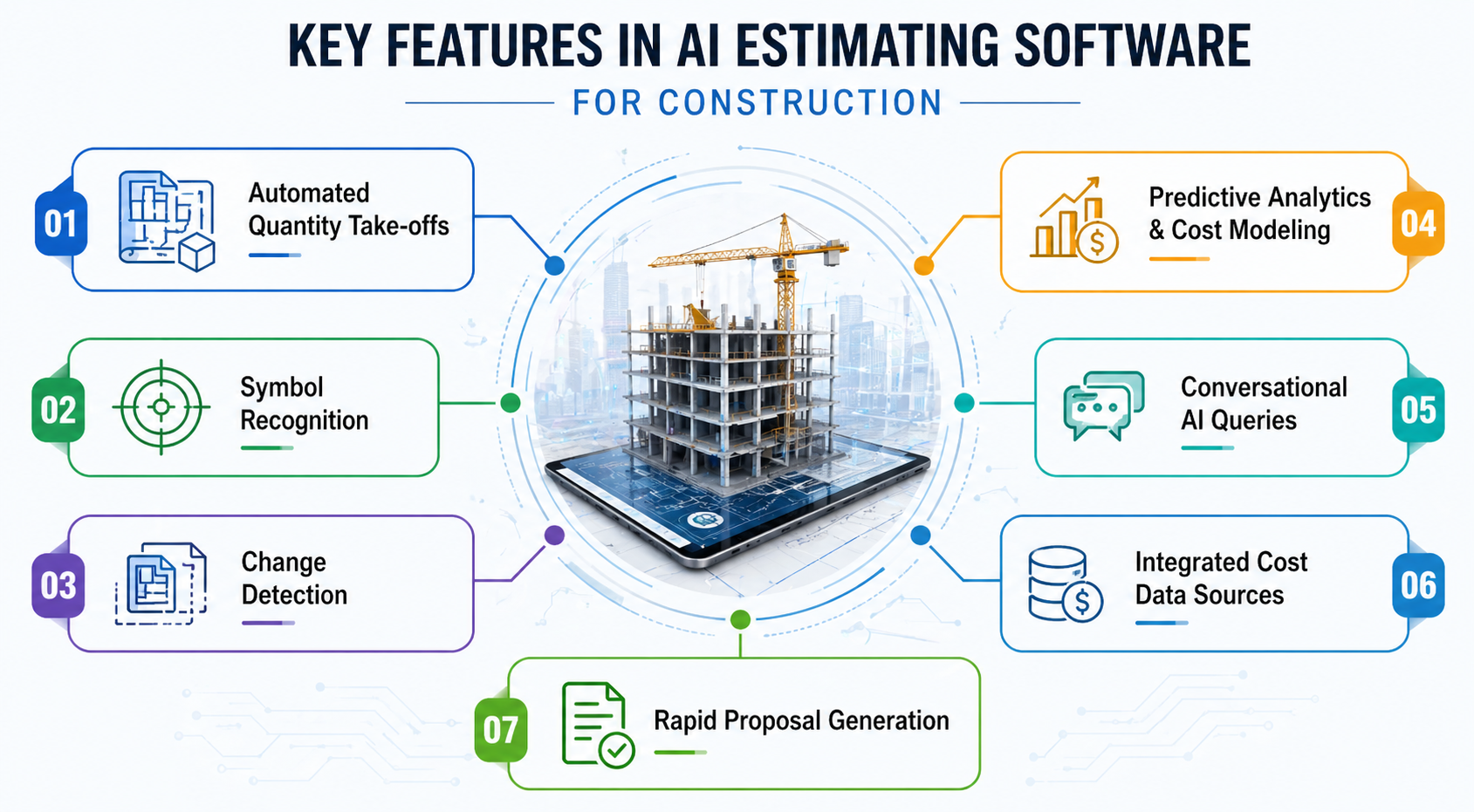
AI construction estimating software uses automation, pattern recognition, and predictive modeling to replace slow, manual processes by providing data-driven executions throughout the estimating cycle.
Automated Quantity Take-offs
AI-powered takeoff engines utilize computer vision to identify and quantify items from 2D drawings and BIM models, eliminating the need for manual measuring. The takeoff process has historically been one of the longest processes in the estimating process, and therefore automating it can cut down on time spent on that task by up to 50%, as well as provide greater consistency in the estimates.
Symbol Recognition
More advanced AI systems are able to identify and categorize the same repetitive items (outlets, fixtures, HVAC, etc.) across a large set of drawings. This allows these items to be counted with accuracy at scale, as opposed to the typical missed count in a manual estimating workflow.
Change Detection
AI systems can compare multiple versions of a set of drawings to identify specific changes between those drawings. By comparing drawings in this manner, the estimator can eliminate the need to redo the entire takeoff process, instead concentrating on just those items that have changed.
Predictive Analytics & Cost Modeling
Machine learning models analyze past data from construction projects that track labor rates and how much material costs were over time to make projections for the future project costs while identifying potential risks that could change that cost. It changes estimating from a static calculation to something that supports better decision-making moving forward. This helps with bid accuracy and protecting the margin.
Conversational AI Queries
Natural language processing (NLP) is used for estimators to query drawings or documents for quantities or scope with no manual navigation, allowing for quicker ways of accessing project data.
Integrated Cost Data Sources
AI will connect the quantity of items extracted from drawings to the most recent pricing data to develop timely cost estimates and Bills of Quantities, thereby reflecting actual market conditions when providing estimates, rather than outdated cost databases.
Rapid Proposal Generation
AI systems convert organized data into proposals automatically when the estimate is completed, which means less time is spent on administration, thus allowing for faster submission of bids while matching formats across all documents submitted for bidding.
Conclusion
AI construction estimating software removes major inefficiencies associated with takeoff processes, revisions, and submitting bids, all while integrating accurate automation across BIM and ERP systems. This reduces the labor required to generate estimates, saving firms up to 30%. Software with the capability to generate reliable estimates allows for increased capability in terms of bidding.
FAQs
How does AI improve construction estimates?
Construction project estimation has been revolutionized by AI technologies, vastly simplifying quantity take-offs & cost analysis with pattern recognition from drawings, which fundamentally eliminates human error while giving exceptional and accurate estimates of construction costs.
What features should I look for in AI estimating tools?
When searching for AI estimating tools, look for integration with BIM; high accuracy through quantity take-off (95% or higher); predictive analytics functionality; and integration into an ERP system that provides you with accurate cost estimates, on-time project updates, and a maximum return for your investment.
Can AI software reduce construction project costs?
Construction projects can typically save between 25% and 40% on total project expenses due to faster bid responses, fewer human-created mistakes, and using AI’s predictive capabilities for planning and executing your project.
How accurate are AI-based construction estimates?
AI-based construction estimating tools will have an accuracy rate of 95%-98%, which is considerably better than traditional methods. More advanced AI tools can produce a consistent and reliable estimate from one job to the next with repeated cost calculations over time.
Get in Touch with
AI Experts
Kapil Kumar is a leading voice in the field of Artificial Intelligence, blending deep technical expertise with a passion for innovation and real-world impact. As an accomplished author, researcher, and AI practitioner, he brings clarity to complex technologies—making AI not only understandable, but actionable. Whether decoding algorithms or envisioning ethical frameworks for AI, he is committed to guiding professionals, students, and tech enthusiasts through the rapidly evolving world of artificial intelligence.